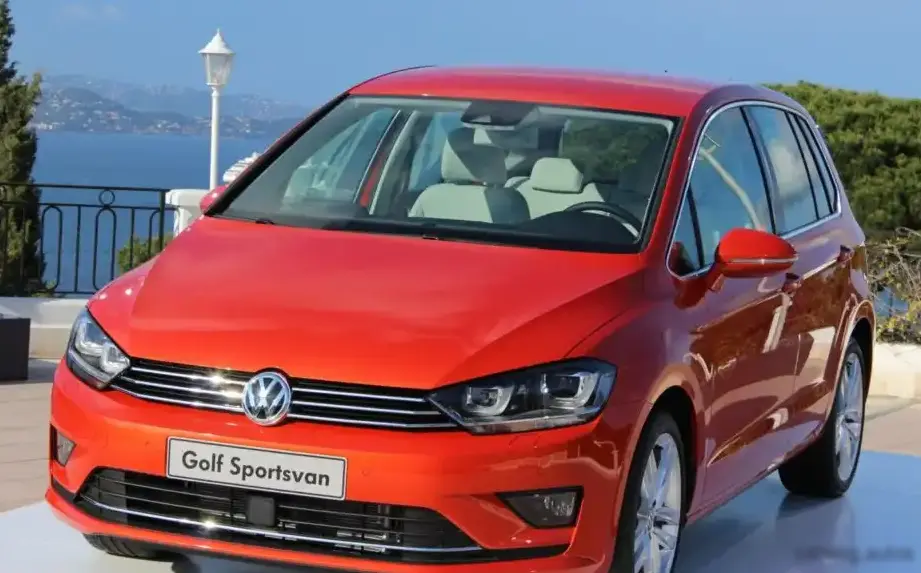
The Volkswagen Golf VII Sportsvan 1.4 TSI (125 hp) was a front-wheel-drive compact minivan produced between April 2014 and 2017. Positioned as a practical and versatile option within the Golf VII range, the Sportsvan aimed to bridge the gap between the standard Golf hatchback and larger MPV offerings. It was primarily marketed in Europe as a family vehicle offering increased interior space and cargo capacity compared to the standard Golf, while maintaining a relatively compact footprint. This variant, equipped with the 1.4-liter turbocharged gasoline engine and a six-speed manual transmission, represented a mid-range offering in the Sportsvan lineup, balancing fuel efficiency with adequate performance for everyday driving.
Technical Specifications
| Brand | Volkswagen |
| Model | Golf |
| Generation | Golf VII Sportsvan |
| Type (Engine) | 1.4 TSI (125 Hp) |
| Start of production | April, 2014 |
| End of production | 2017 |
| Powertrain Architecture | Internal Combustion engine |
| Body type | Minivan |
| Seats | 5 |
| Doors | 5 |
| Fuel consumption (urban) | 6.9-7.1 l/100 km (34.1 – 33.1 US mpg, 40.9 – 39.8 UK mpg, 14.5 – 14.1 km/l) |
| Fuel consumption (extra urban) | 4.5-4.8 l/100 km (52.3 – 49 US mpg, 62.8 – 58.9 UK mpg, 22.2 – 20.8 km/l) |
| Fuel consumption (combined) | 5.4-5.6 l/100 km (43.6 – 42 US mpg, 52.3 – 50.4 UK mpg, 18.5 – 17.9 km/l) |
| CO2 emissions | 125-130 g/km |
| Fuel Type | Petrol (Gasoline) |
| Acceleration 0 – 100 km/h | 9.9 sec |
| Acceleration 0 – 62 mph | 9.9 sec |
| Acceleration 0 – 60 mph | 9.4 sec |
| Maximum speed | 200 km/h (124.27 mph) |
| Weight-to-power ratio | 10.9 kg/Hp, 91.8 Hp/tonne |
| Weight-to-torque ratio | 6.8 kg/Nm, 146.8 Nm/tonne |
| Power | 125 Hp @ 5000-6000 rpm |
| Power per litre | 89.6 Hp/l |
| Torque | 200 Nm @ 1400-4000 rpm (147.51 lb.-ft. @ 1400-4000 rpm) |
| Engine layout | Front, Transverse |
| Engine Model/Code | CZCA |
| Engine displacement | 1395 cm3 (85.13 cu. in.) |
| Number of cylinders | 4 |
| Engine configuration | Inline |
| Fuel injection system | Direct injection |
| Engine aspiration | Turbocharger, Intercooler |
| Valvetrain | DOHC |
| Engine oil capacity | 4 l (4.23 US qt | 3.52 UK qt) |
| Kerb Weight | 1362 kg (3002.7 lbs.) |
| Max. weight | 1880 kg (4144.69 lbs.) |
| Max load | 518 kg (1141.99 lbs.) |
| Trunk (boot) space – minimum | 500 l (17.66 cu. ft.) |
| Trunk (boot) space – maximum | 1520 l (53.68 cu. ft.) |
| Fuel tank capacity | 50 l (13.21 US gal | 11 UK gal) |
| Length | 4338 mm (170.79 in.) |
| Width | 1807 mm (71.14 in.) |
| Height | 1578 mm (62.13 in.) |
| Wheelbase | 2685 mm (105.71 in.) |
| Front track | 1543 mm (60.75 in.) |
| Rear (Back) track | 1514 mm (59.61 in.) |
| Minimum turning circle | 11.1 m (36.42 ft.) |
| Drivetrain Architecture | Front wheel drive |
| Number of gears | 6 gears, manual transmission |
| Assisting systems | ABS (Anti-lock braking system) |
| Steering type | Steering rack and pinion |
Powertrain & Engine Architecture
The heart of the Golf VII Sportsvan 1.4 TSI (125 hp) is the CZCA engine code, a 1.4-liter inline-four cylinder gasoline engine. This engine belongs to the EA211 family, known for its compact design and efficiency. It features direct fuel injection (FSI) and a turbocharger with an intercooler, enabling a good balance of power and fuel economy. The direct injection system precisely meters fuel into the combustion chamber, improving combustion efficiency and reducing emissions. The turbocharger boosts power output by forcing more air into the engine. The engine utilizes a dual overhead camshaft (DOHC) valvetrain, optimizing valve timing for improved performance across the rev range. The six-speed manual transmission provides precise gear changes and allows the driver to fully utilize the engine’s power band.
Driving Characteristics
The 125 hp output and 200 Nm (147 lb-ft) of torque delivered by the 1.4 TSI engine provided adequate performance for everyday driving in the Sportsvan. Acceleration from 0 to 100 km/h (0-62 mph) took approximately 9.9 seconds. While not a particularly sporty configuration, the engine offered sufficient power for overtaking and highway cruising. The manual transmission allowed for greater driver control and engagement compared to the optional DSG dual-clutch transmission. The gear ratios were tuned for a balance of fuel efficiency and responsiveness. Compared to the more powerful 1.8 TSI variants, the 1.4 TSI offered a more economical driving experience, but with a noticeable difference in acceleration and overall performance. The 1.4 TSI was also less stressed than the higher output engines, potentially leading to improved long-term reliability.
Equipment & Trim Levels
The Golf VII Sportsvan 1.4 TSI (125 hp) typically came equipped with a reasonable level of standard features. These included air conditioning, power windows, power mirrors, a touchscreen infotainment system with Bluetooth connectivity, and alloy wheels. Safety features such as ABS, electronic stability control, and multiple airbags were also standard. Higher trim levels offered additional features such as automatic climate control, parking sensors, a larger touchscreen display, and upgraded interior upholstery. Optional extras included a panoramic sunroof, navigation system, and adaptive cruise control. Interior upholstery was typically cloth, with leather options available on higher trims.
Chassis & Braking
The Golf VII Sportsvan utilized a MacPherson strut front suspension and a multi-link rear suspension, providing a comfortable and controlled ride. The suspension was tuned to prioritize comfort and stability, making it well-suited for family use. The braking system consisted of disc brakes on the front wheels and drum brakes on the rear wheels. ABS (Anti-lock Braking System) was standard, enhancing braking performance and safety. Stabilizer bars were fitted to both the front and rear axles to reduce body roll during cornering. The chassis was designed to maximize interior space while maintaining a relatively compact exterior footprint.
Market Reception & Comparison
The Golf VII Sportsvan 1.4 TSI (125 hp) was generally well-received by automotive critics as a practical and versatile family vehicle. It was praised for its spacious interior, comfortable ride, and fuel efficiency. However, some critics noted that the 1.4 TSI engine could feel underpowered when fully loaded or driving uphill. Compared to the 1.8 TSI variants, the 1.4 TSI offered better fuel economy but less performance. The 1.6 TDI diesel variant provided even better fuel economy but with a different driving experience. The Sportsvan competed with other compact minivans such as the Citroën C4 Picasso and Renault Scenic.
Legacy
The Volkswagen Golf VII Sportsvan 1.4 TSI (125 hp) has proven to be a relatively reliable vehicle in the used car market. The EA211 engine family is generally known for its durability, and the manual transmission is less prone to issues than the DSG dual-clutch transmission. Regular maintenance, including oil changes and timing belt replacements, is crucial for ensuring long-term reliability. The Sportsvan’s spacious interior and practical features continue to make it an attractive option for families seeking a versatile and economical vehicle. While not a performance-oriented model, the 1.4 TSI variant offers a good balance of fuel efficiency, practicality, and affordability.