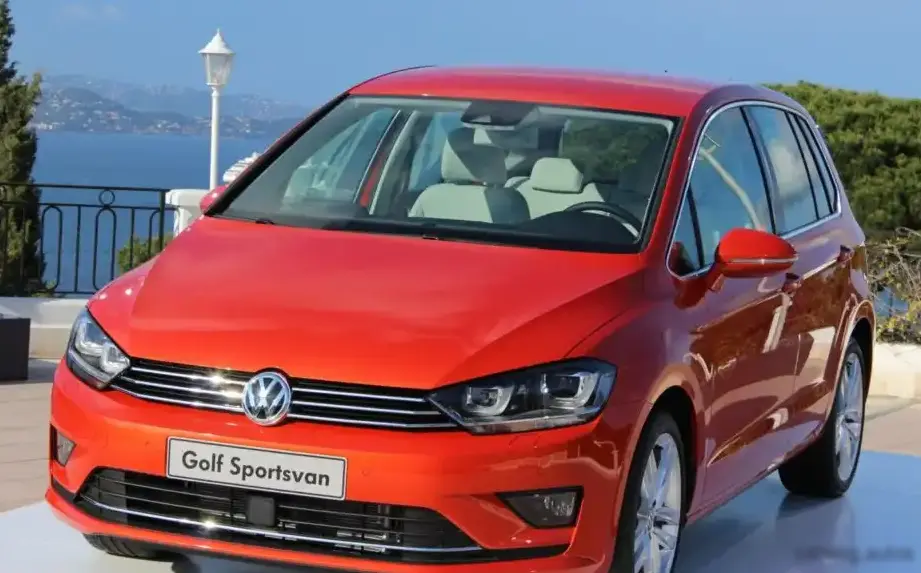
The Volkswagen Golf VII Sportsvan 1.6 TDI (110 hp) DSG was a compact minivan produced between June 2013 and April 2017. Positioned as a practical and fuel-efficient option within the broader Golf VII Sportsvan range, it catered to buyers seeking a versatile vehicle for family use or light commercial applications. This variant occupied the lower-mid range of the Sportsvan lineup, offering a balance between affordability and functionality, slotting below the more powerful petrol and diesel options. It was primarily marketed in Europe, where the compact minivan segment held significant popularity.
Technical Specifications
| Brand | Volkswagen |
| Model | Golf |
| Generation | Golf VII Sportsvan |
| Type (Engine) | 1.6 TDI (110 Hp) DSG |
| Start of production | June, 2013 |
| End of production | April, 2017 |
| Powertrain Architecture | Internal Combustion engine |
| Body type | Minivan |
| Seats | 5 |
| Doors | 5 |
| Fuel consumption (urban) | 4.4-4.5 l/100 km (53.5 – 52.3 US mpg) |
| Fuel consumption (extra urban) | 3.8-4.0 l/100 km (61.9 – 58.8 US mpg) |
| Fuel consumption (combined) | 4.0-4.2 l/100 km (58.8 – 56 US mpg) |
| CO2 emissions | 104-109 g/km |
| Fuel Type | Diesel |
| Acceleration 0 – 100 km/h | 11.3 sec |
| Acceleration 0 – 62 mph | 11.3 sec |
| Acceleration 0 – 60 mph | 10.7 sec |
| Maximum speed | 192 km/h (119.3 mph) |
| Weight-to-power ratio | 13.1 kg/Hp, 76.6 Hp/tonne |
| Weight-to-torque ratio | 5.7 kg/Nm, 174.1 Nm/tonne |
| Power | 110 Hp @ 3200-4000 rpm |
| Torque | 250 Nm @ 1500-3000 rpm (184.39 lb.-ft. @ 1500-3000 rpm) |
| Engine layout | Front, Transverse |
| Engine Model/Code | CRKB, CXXB, DBKA |
| Engine displacement | 1598 cm3 (97.52 cu. in.) |
| Number of cylinders | 4 |
| Engine configuration | Inline |
| Fuel injection system | Diesel Commonrail |
| Engine aspiration | Turbocharger, Intercooler |
| Valvetrain | DOHC |
| Engine oil capacity | 4.6 l (4.86 US qt | 4.05 UK qt) |
| Kerb Weight | 1436 kg (3165.84 lbs.) |
| Max. weight | 1940 kg (4276.97 lbs.) |
| Max load | 504 kg (1111.13 lbs.) |
| Trunk (boot) space – minimum | 500 l (17.66 cu. ft.) |
| Trunk (boot) space – maximum | 1520 l (53.68 cu. ft.) |
| Fuel tank capacity | 50 l (13.21 US gal | 11 UK gal) |
| Length | 4338 mm (170.79 in.) |
| Width | 1807 mm (71.14 in.) |
| Height | 1578 mm (62.13 in.) |
| Wheelbase | 2685 mm (105.71 in.) |
| Front track | 1543 mm (60.75 in.) |
| Rear (Back) track | 1514 mm (59.61 in.) |
| Minimum turning circle | 11.1 m (36.42 ft.) |
| Drivetrain Architecture | Front wheel drive |
| Number of gears and type of gearbox | 7 gears, automatic transmission DSG |
| Front brakes | Ventilated discs |
| Rear brakes | Disc |
Powertrain & Engine Architecture
The heart of the Golf VII Sportsvan 1.6 TDI was the CRKB, CXXB, or DBKA engine code, a 1.6-liter inline-four cylinder diesel engine. This engine was part of Volkswagen’s modular engine family, designed for efficiency and reduced emissions. It utilized a common rail direct injection system, delivering fuel directly into the combustion chamber at extremely high pressure. This, combined with a turbocharger and intercooler, allowed for a good balance of power and fuel economy. The engine featured a Double Overhead Camshaft (DOHC) valvetrain, optimizing airflow for improved performance. The 110 horsepower output was achieved at 3200-4000 rpm, while peak torque of 250 Nm (184 lb-ft) was available from 1500-3000 rpm. Paired with this engine was the 7-speed dual-clutch transmission (DSG), known for its quick and smooth gear changes. The DSG transmission contributed to both fuel efficiency and a more engaging driving experience compared to a traditional automatic.
Driving Characteristics
The 1.6 TDI with the DSG transmission offered a comfortable and practical driving experience. Acceleration was adequate for everyday driving, with a 0-60 mph time of around 10.7 seconds. However, it wasn’t designed for sporty performance. The DSG transmission provided responsive shifts, and the engine’s torque delivery made it easy to maintain speed on highways. Compared to the more powerful 2.0 TDI variants, the 1.6 TDI felt less energetic, particularly when fully loaded or climbing hills. The gear ratios in the DSG were tuned for fuel efficiency, meaning the engine sometimes felt strained at higher speeds. Manual transmission versions of the 1.6 TDI offered slightly better fuel economy but required more driver involvement. The Sportsvan’s suspension was tuned for comfort, providing a smooth ride over most road surfaces.
Equipment & Trim Levels
The Golf VII Sportsvan 1.6 TDI DSG typically came with a reasonable level of standard equipment. This included air conditioning, power windows, central locking, and an infotainment system with a touchscreen display. Safety features such as ABS, electronic stability control, and multiple airbags were also standard. Interior upholstery was typically cloth, with options for upgraded materials available. Common optional extras included parking sensors, a navigation system, heated seats, and alloy wheels. Trim levels varied slightly depending on the market, but generally, this variant represented a mid-range offering, providing a good balance of features and price.
Chassis & Braking
The Golf VII Sportsvan featured a front-wheel-drive layout with independent suspension at the front and a torsion beam suspension at the rear. The front brakes were ventilated discs, providing good stopping power, while the rear brakes were solid discs. The suspension was tuned for comfort and stability, offering a composed ride. Stabilizer bars were fitted to both the front and rear axles to reduce body roll during cornering. The steering was a rack and pinion system, providing precise and responsive handling.
Market Reception & Comparison
The Golf VII Sportsvan 1.6 TDI DSG was generally well-received by automotive critics as a practical and fuel-efficient family vehicle. It was praised for its spacious interior, comfortable ride, and economical diesel engine. However, some critics noted that the engine lacked outright power, particularly when compared to the more powerful petrol and diesel options. Fuel economy was a strong point, with combined figures ranging from 4.0 to 4.2 liters per 100 kilometers (58.8-56 US mpg). Compared to the 2.0 TDI models, the 1.6 TDI offered lower running costs but sacrificed performance. The 1.6 TDI was also often compared to similar compact minivans from other manufacturers, such as the Citroën C4 Picasso and Renault Scenic, often holding its own in terms of practicality and fuel efficiency.
Legacy
The 1.6 TDI engine, while generally reliable, has been subject to some scrutiny regarding emissions compliance and potential issues with the diesel particulate filter (DPF). Proper maintenance, including regular oil changes and the use of high-quality diesel fuel, is crucial for ensuring the longevity of this powertrain. In the used car market, the Golf VII Sportsvan 1.6 TDI DSG remains a popular choice for buyers seeking a practical and economical family vehicle. Its reputation for reliability and fuel efficiency, combined with the versatility of the Sportsvan body style, continues to make it a competitive option. However, potential buyers should be aware of the potential DPF issues and ensure the vehicle has been properly maintained.