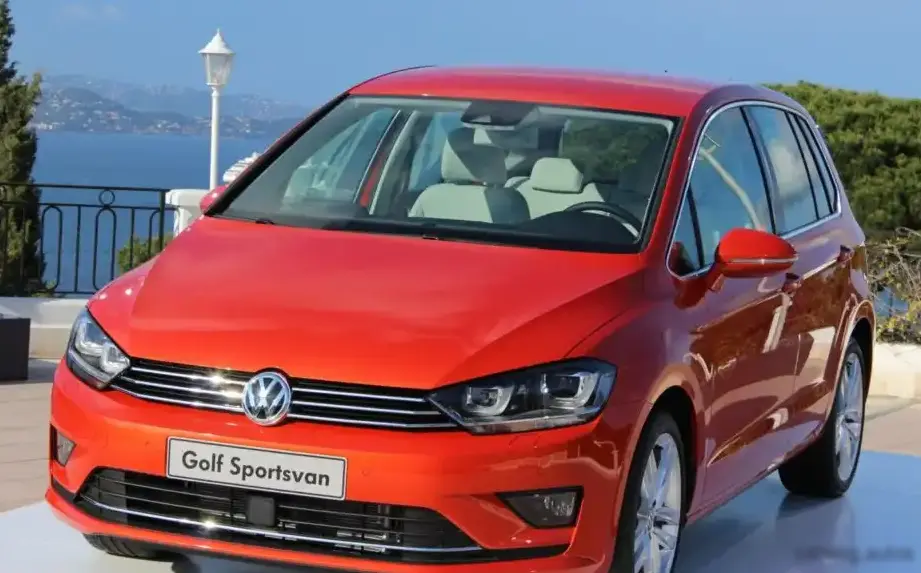
The Volkswagen Golf VII Sportsvan 2.0 TDI with the 150 horsepower (Hp) engine and dual-clutch gearbox (DSG) was a key variant within the broader Golf Sportsvan (also known as the Golf Variant in some markets) lineup, produced between April 2014 and 2017. Positioned as a mid-range offering, it aimed to bridge the gap between the more economical diesel options and the higher-performance gasoline engines. The Sportsvan itself was Volkswagen’s compact MPV (Multi-Purpose Vehicle) offering, designed to provide increased interior space and practicality compared to the standard Golf hatchback, while maintaining a relatively compact footprint. This model was primarily marketed in Europe, where compact MPVs were a popular segment, offering a versatile alternative to traditional hatchbacks and small SUVs.
Technical Specifications
| Brand | Volkswagen |
| Model | Golf |
| Generation | Golf VII Sportsvan |
| Type (Engine) | 2.0 TDI (150 Hp) DSG |
| Start of production | April, 2014 |
| End of production | 2017 |
| Powertrain Architecture | Internal Combustion engine |
| Body type | Minivan |
| Seats | 5 |
| Doors | 5 |
| Fuel consumption (urban) | 5.4 l/100 km (43.6 US mpg, 52.3 UK mpg, 18.5 km/l) |
| Fuel consumption (extra urban) | 4.3-4.4 l/100 km (54.7 – 53.5 US mpg, 65.7 – 64.2 UK mpg, 23.3 – 22.7 km/l) |
| Fuel consumption (combined) | 4.7-4.8 l/100 km (50 – 49 US mpg, 60.1 – 58.9 UK mpg, 21.3 – 20.8 km/l) |
| CO2 emissions | 122-125 g/km |
| Fuel Type | Diesel |
| Acceleration 0 – 100 km/h | 9.2 sec |
| Acceleration 0 – 62 mph | 9.2 sec |
| Acceleration 0 – 60 mph | 8.7 sec |
| Maximum speed | 210 km/h (130.49 mph) |
| Weight-to-power ratio | 9.9 kg/Hp, 100.5 Hp/tonne |
| Weight-to-torque ratio | 4.4 kg/Nm, 227.9 Nm/tonne |
| Power | 150 Hp @ 3500-4000 rpm |
| Power per litre | 76.2 Hp/l |
| Torque | 340 Nm @ 1750-3000 rpm (250.77 lb.-ft. @ 1750-3000 rpm) |
| Engine layout | Front, Transverse |
| Engine Model/Code | CRLB, DCYA, DFGA |
| Engine displacement | 1968 cm3 (120.09 cu. in.) |
| Number of cylinders | 4 |
| Engine configuration | Inline |
| Fuel injection system | Diesel Commonrail |
| Engine aspiration | Turbocharger, Intercooler |
| Valvetrain | DOHC |
| Engine oil capacity | 4.7 l (4.97 US qt | 4.14 UK qt) |
| Kerb Weight | 1492 kg (3289.3 lbs.) |
| Max. weight | 1990 kg (4387.2 lbs.) |
| Max load | 498 kg (1097.9 lbs.) |
| Trunk (boot) space – minimum | 500 l (17.66 cu. ft.) |
| Trunk (boot) space – maximum | 1520 l (53.68 cu. ft.) |
| Fuel tank capacity | 50 l (13.21 US gal | 11 UK gal) |
| Length | 4338 mm (170.79 in.) |
| Width | 1807 mm (71.14 in.) |
| Height | 1578 mm (62.13 in.) |
| Wheelbase | 2685 mm (105.71 in.) |
| Front track | 1543 mm (60.75 in.) |
| Rear (Back) track | 1514 mm (59.61 in.) |
| Minimum turning circle | 11.1 m (36.42 ft.) |
| Drivetrain Architecture | The Internal combustion engine (ICE) drives the front wheels of the vehicle. |
| Drive wheel | Front wheel drive |
| Number of gears and type of gearbox | 6 gears, automatic transmission DSG |
| Front brakes | Ventilated discs |
| Rear brakes | Disc |
| Assisting systems | ABS (Anti-lock braking system) |
| Steering type | Steering rack and pinion |
INTRODUCTION
The Golf VII Sportsvan, launched in 2014, represented Volkswagen’s attempt to capitalize on the growing demand for compact MPVs in Europe. Built on the MQB (Modular Transverse Matrix) platform – specifically the A3 variant also used by the Audi A3 and SEAT Leon – the Sportsvan offered a more spacious and practical alternative to the standard Golf hatchback. The 2.0 TDI 150 Hp DSG variant was a popular choice, offering a balance of fuel efficiency, performance, and convenience. It sat in the middle of the Sportsvan range, above the lower-powered diesel options (like the 1.6 TDI) and below the more potent gasoline engines (like the 1.4 TSI). Production of this specific configuration ran from 2014 until 2017, coinciding with a mid-cycle refresh of the Golf VII range.
Powertrain & Engine Architecture
The heart of the Golf VII Sportsvan 2.0 TDI was the Volkswagen Group’s common rail diesel engine, available in several iterations denoted by engine codes such as CRLB, DCYA, and DFGA. This 1968cc, four-cylinder engine featured a turbocharger with an intercooler to boost power and efficiency. The engine utilized a direct injection system, injecting fuel directly into the combustion chamber at extremely high pressure. The valvetrain employed a dual overhead camshaft (DOHC) configuration, optimizing valve timing for improved performance and reduced emissions. The 150 Hp output was achieved between 3500 and 4000 rpm, while peak torque of 340 Nm (250.77 lb.-ft.) was available from 1750 to 3000 rpm. This broad torque curve provided strong pulling power across a wide range of engine speeds. Paired with the engine was the Volkswagen Group’s 6-speed DSG (Direct-Shift Gearbox), a dual-clutch transmission known for its quick and smooth gear changes. The DSG allowed for both fully automatic operation and manual gear selection via steering wheel-mounted paddles or the gear selector.
Driving Characteristics
The 2.0 TDI 150 Hp/DSG combination in the Golf Sportsvan delivered a competent and refined driving experience. While not overtly sporty, the engine provided ample power for everyday driving and comfortable highway cruising. Acceleration from 0-60 mph took approximately 8.7 seconds, and the car could reach a top speed of 210 km/h (130.49 mph). The DSG transmission contributed to smooth and seamless gear changes, enhancing the overall driving experience. Compared to the lower-powered 1.6 TDI, the 2.0 TDI offered noticeably more responsive acceleration and effortless overtaking capability. However, it didn’t possess the outright punch of the higher-output gasoline engines. The DSG’s gear ratios were tuned for a balance of fuel efficiency and performance, with taller gears for relaxed cruising and shorter gears for quicker acceleration. The Sportsvan’s suspension, while tuned for comfort, provided reasonably controlled handling, although it wasn’t as engaging as the standard Golf hatchback.
Equipment & Trim Levels
The Golf VII Sportsvan 2.0 TDI 150 Hp DSG typically came equipped with a generous level of standard features. These included air conditioning, power windows, power mirrors, a touchscreen infotainment system with Bluetooth connectivity, and alloy wheels. Higher trim levels added features such as automatic climate control, a larger touchscreen display, navigation system, parking sensors, and adaptive cruise control. Interior upholstery was typically cloth, with leather options available as an upgrade. Dashboard trim and interior accents varied depending on the trim level. Optional extras included a panoramic sunroof, upgraded sound system, and various driver assistance systems.
Chassis & Braking
The Golf Sportsvan’s chassis featured independent suspension at the front (typically MacPherson struts) and either a semi-independent torsion beam or independent multi-link suspension at the rear, depending on the specific trim level and options. The 2.0 TDI models generally received the more sophisticated multi-link rear suspension for improved ride comfort and handling. Braking systems consisted of ventilated discs at the front and solid discs at the rear. Anti-lock braking system (ABS) was standard, providing enhanced braking performance and stability. Stabilizer bars were fitted to both the front and rear axles to reduce body roll during cornering.
Market Reception & Comparison
The Golf VII Sportsvan 2.0 TDI 150 Hp DSG was generally well-received by automotive critics. It was praised for its spacious interior, comfortable ride, and fuel-efficient engine. The DSG transmission was also lauded for its smooth and quick gear changes. Compared to the 1.6 TDI, the 2.0 TDI offered a significant performance upgrade, making it a more enjoyable car to drive. However, it was slightly more expensive to purchase and maintain. Fuel economy was a strong point, with combined figures ranging from 4.7 to 4.8 l/100 km (50-49 US mpg). Reliability was generally good, although some owners reported issues with the DSG transmission, particularly early units.
Legacy
The Volkswagen Golf VII Sportsvan 2.0 TDI 150 Hp DSG remains a popular choice in the used car market. The 2.0 TDI engine is known for its durability and relatively low running costs, provided it is properly maintained. The DSG transmission, while potentially requiring more frequent servicing than a traditional automatic, offers a superior driving experience. The Sportsvan’s practicality and spaciousness continue to appeal to families and those seeking a versatile vehicle. While newer models offer more advanced technology and features, the Golf VII Sportsvan 2.0 TDI remains a well-rounded and capable compact MPV.