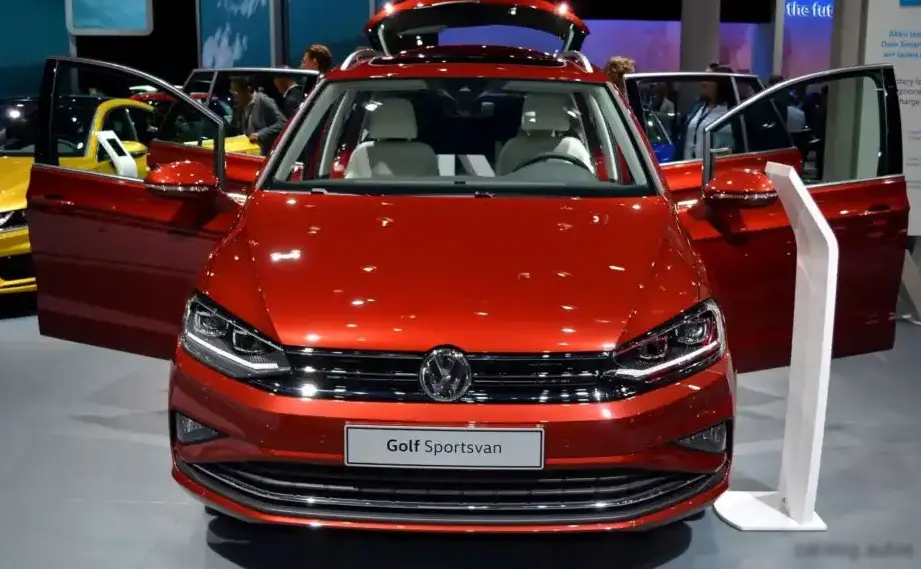
The Volkswagen Golf VII Sportsvan, specifically the facelifted version produced from 2017 to 2019, represented Volkswagen’s entry into the compact multi-purpose vehicle (MPV) segment. Positioned as a more practical alternative to the standard Golf hatchback, the Sportsvan offered increased interior space and versatility without sacrificing the Golf’s core driving characteristics. The 1.0 TSI (110 horsepower) variant, equipped with a six-speed manual transmission, served as a key entry point into the Sportsvan lineup, appealing to buyers prioritizing fuel efficiency and affordability. It was part of the broader Golf VII family, built on the MQB (Modular Transverse Matrix) platform, also known as the A7 platform.
Technical Specifications
| Brand | Volkswagen |
| Model | Golf |
| Generation | Golf VII Sportsvan (facelift 2017) |
| Type (Engine) | 1.0 TSI (110 Hp) |
| Start of production | 2017 |
| End of production | 2019 |
| Powertrain Architecture | Internal Combustion engine |
| Body type | Minivan |
| Seats | 5 |
| Doors | 5 |
| Fuel consumption (urban) | 6 l/100 km (39.2 US mpg, 47.1 UK mpg, 16.7 km/l) |
| Fuel consumption (extra urban) | 4.4 l/100 km (53.5 US mpg, 64.2 UK mpg, 22.7 km/l) |
| Fuel consumption (combined) | 5 l/100 km (47 US mpg, 56.5 UK mpg, 20 km/l) |
| CO2 emissions | 113 g/km |
| Fuel Type | Petrol (Gasoline) |
| Acceleration 0 – 100 km/h | 10.7 sec |
| Acceleration 0 – 62 mph | 10.7 sec |
| Acceleration 0 – 60 mph | 10.2 sec |
| Maximum speed | 192 km/h (119.3 mph) |
| Emission standard | Euro 6 |
| Weight-to-power ratio | 12.2 kg/Hp, 82.1 Hp/tonne |
| Weight-to-torque ratio | 6.7 kg/Nm, 149.3 Nm/tonne |
| Power | 110 Hp |
| Power per litre | 110.1 Hp/l |
| Torque | 200 Nm @ 2000-3500 rpm (147.51 lb.-ft. @ 2000-3500 rpm) |
| Engine layout | Front, Transverse |
| Engine Model/Code | CHZC |
| Engine displacement | 999 cm3 (60.96 cu. in.) |
| Engine configuration | Inline |
| Fuel injection system | Direct injection |
| Engine aspiration | Turbocharger, Intercooler |
| Engine oil capacity | 4 l (4.23 US qt | 3.52 UK qt) |
| Kerb Weight | 1340 kg (2954.19 lbs.) |
| Max. weight | 1850 kg (4078.55 lbs.) |
| Max load | 510 kg (1124.36 lbs.) |
| Trunk (boot) space – maximum | 1520 l (53.68 cu. ft.) |
| Fuel tank capacity | 50 l (13.21 US gal | 11 UK gal) |
| Max. roof load | 75 kg (165.35 lbs.) |
| Permitted trailer load with brakes (8%) | 1500 kg (3306.93 lbs.) |
| Permitted trailer load with brakes (12%) | 1300 kg (2866.01 lbs.) |
| Permitted trailer load without brakes | 670 kg (1477.1 lbs.) |
| Permitted towbar download | 80 kg (176.37 lbs.) |
| Length | 4351 mm (171.3 in.) |
| Width | 1807 mm (71.14 in.) |
| Height | 1613 mm (63.5 in.) |
| Wheelbase | 2670 mm (105.12 in.) |
| Front track | 1533-1549 mm (60.35 – 60.98 in.) |
| Rear (Back) track | 1504-1520 mm (59.21 – 59.84 in.) |
| Drive wheel | Front wheel drive |
| Number of gears and type of gearbox | 6 gears, manual transmission |
| Front brakes | Ventilated discs |
| Rear brakes | Disc |
| Assisting systems | ABS (Anti-lock braking system) |
| Steering type | Steering rack and pinion |
| Power steering | Electric Steering |
Powertrain & Engine Architecture
The heart of the Golf VII Sportsvan 1.0 TSI was the CHZC engine, a three-cylinder, 1.0-liter turbocharged gasoline engine. This engine was part of Volkswagen’s EA211 engine family, known for its compact design and efficiency. The CHZC featured direct fuel injection, delivering fuel directly into the combustion chamber for improved combustion efficiency and reduced emissions. A single scroll turbocharger with an intercooler boosted power output, providing 110 horsepower and 200 Nm (147.51 lb-ft) of torque between 2000 and 3500 rpm. The six-speed manual transmission was chosen to maximize fuel economy and provide a more engaging driving experience. The engine utilized a timing chain, intended to reduce maintenance compared to timing belts.
Driving Characteristics
The 1.0 TSI engine, while not offering blistering performance, provided adequate power for everyday driving. Acceleration from 0-60 mph took approximately 10.2 seconds, and top speed was rated at 119.3 mph. The turbocharger provided a noticeable boost in power during acceleration, but the engine could feel somewhat strained when fully loaded or climbing hills. The six-speed manual transmission offered precise shifts and allowed drivers to keep the engine in its optimal power band. Compared to the more powerful 1.4 TSI or diesel variants, the 1.0 TSI prioritized fuel economy over outright performance. The Sportsvan’s suspension was tuned for comfort, providing a relatively smooth ride, although it wasn’t as sporty as the standard Golf hatchback.
Equipment & Trim Levels
The 1.0 TSI Sportsvan typically came with a reasonable level of standard equipment. This included air conditioning, a touchscreen infotainment system with Bluetooth connectivity, alloy wheels, and a suite of safety features such as ABS, ESC (Electronic Stability Control), and multiple airbags. Higher trim levels, such as Comfortline and Highline, added features like automatic climate control, parking sensors, a larger touchscreen display, and upgraded interior upholstery. Optional extras included a panoramic sunroof, adaptive cruise control, and a navigation system.
Chassis & Braking
The Golf VII Sportsvan utilized a MacPherson strut front suspension and a multi-link rear suspension, providing a good balance of comfort and handling. The front brakes were ventilated discs, while the rear brakes were solid discs. The Sportsvan’s chassis was reinforced to accommodate the increased weight and dimensions compared to the standard Golf. The electric power steering provided light and precise steering feel. Stabilizer bars were fitted to both the front and rear axles to reduce body roll during cornering.
Market Reception & Comparison
The Golf VII Sportsvan 1.0 TSI was generally well-received by automotive critics as a practical and fuel-efficient MPV. It was praised for its spacious interior, comfortable ride, and user-friendly technology. However, some reviewers noted that the 1.0 TSI engine could feel underpowered, especially when carrying a full load of passengers and luggage. Compared to the 1.4 TSI variant, the 1.0 TSI offered better fuel economy but less performance. The diesel-powered models (like the 1.6 TDI) provided even better fuel economy but came with the added cost and potential maintenance concerns associated with diesel engines. The Sportsvan competed with other compact MPVs such as the Citroën C4 SpaceTourer and the Opel/Vauxhall Meriva.
Legacy
The 1.0 TSI engine proved to be a relatively reliable powertrain, although some owners have reported issues with the turbocharger and fuel injectors. The EA211 engine family, in general, has a good reputation for durability. On the used car market, the Golf VII Sportsvan 1.0 TSI represents a good value proposition for buyers seeking a practical, fuel-efficient, and well-equipped MPV. Its compact size and easy maneuverability make it well-suited for urban driving, while its spacious interior and versatile seating configuration make it ideal for families. The Sportsvan’s continued presence on the used car market is a testament to its enduring appeal and practicality.