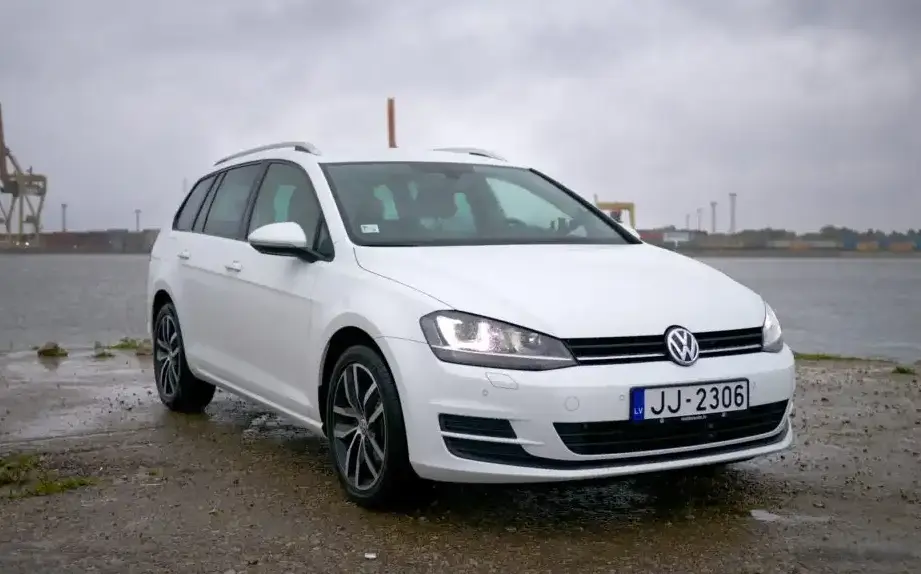
The Volkswagen Golf VII Variant 1.2 TSI (110 hp) DSG was a front-wheel-drive, five-door station wagon produced between April 2014 and March 2017. Positioned as an entry-level to mid-range offering within the Golf VII Variant lineup, it provided a balance of fuel efficiency and practicality for families and individuals seeking a versatile vehicle. This variant was primarily sold in the European market, where station wagons (known as ‘estates’) maintain significant popularity. It represented Volkswagen’s commitment to offering a diverse range of Golf models to cater to varying customer needs.
Technical Specifications
| Brand | Volkswagen |
| Model | Golf |
| Generation | Golf VII Variant |
| Type (Engine) | 1.2 TSI (110 Hp) DSG |
| Start of production | April, 2014 |
| End of production | March, 2017 |
| Powertrain Architecture | Internal Combustion engine |
| Body type | Station wagon (estate) |
| Seats | 5 |
| Doors | 5 |
| Fuel consumption (urban) | 6.1 – 6.0 l/100 km (38.6 – 39.2 US mpg) |
| Fuel consumption (extra urban) | 4.5 – 4.4 l/100 km (52.3 – 53.5 US mpg) |
| Fuel consumption (combined) | 5.1 – 5.0 l/100 km (46.1 – 47 US mpg) |
| CO2 emissions | 117 – 115 g/km |
| Fuel Type | Petrol (Gasoline) |
| Acceleration 0 – 100 km/h | 10.4 sec |
| Acceleration 0 – 62 mph | 10.4 sec |
| Acceleration 0 – 60 mph | 9.9 sec |
| Maximum speed | 196 km/h (121.79 mph) |
| Emission standard | Euro 6 |
| Weight-to-power ratio | 11.4 kg/Hp |
| Weight-to-torque ratio | 7.1 kg/Nm |
| Power | 110 Hp @ 4600-5600 rpm |
| Torque | 175 Nm @ 1400-4000 rpm (129.07 lb.-ft. @ 1400-4000 rpm) |
| Engine layout | Front, Transverse |
| Engine Model/Code | CYVB |
| Engine displacement | 1197 cm3 (73.05 cu. in.) |
| Number of cylinders | 4 |
| Engine configuration | Inline |
| Number of valves per cylinder | 4 |
| Fuel injection system | Direct injection |
| Engine aspiration | Turbocharger, Intercooler |
| Engine oil capacity | 4 l (4.23 US qt | 3.52 UK qt) |
| Kerb Weight | 1249 kg (2753.57 lbs.) |
| Max. weight | 1860 kg (4100.6 lbs.) |
| Max load | 611 kg (1347.02 lbs.) |
| Trunk (boot) space – minimum | 605 l (21.37 cu. ft.) |
| Trunk (boot) space – maximum | 1620 l (57.21 cu. ft.) |
| Fuel tank capacity | 50 l (13.21 US gal | 11 UK gal) |
| Max. roof load | 75 kg (165.35 lbs.) |
| Permitted trailer load with brakes (8%) | 1500 kg (3306.93 lbs.) |
| Permitted trailer load with brakes (12%) | 1300 kg (2866.01 lbs.) |
| Permitted trailer load without brakes | 660 kg (1455.05 lbs.) |
| Permitted towbar download | 80 kg (176.37 lbs.) |
| Length | 4562 mm (179.61 in.) |
| Width | 1799 mm (70.83 in.) |
| Width including mirrors | 2027 mm (79.8 in.) |
| Height | 1481 mm (58.31 in.) |
| Wheelbase | 2635 mm (103.74 in.) |
| Front track | 1549 mm (60.98 in.) |
| Rear (Back) track | 1520 mm (59.84 in.) |
| Ride height (ground clearance) | 140 mm (5.51 in.) |
| Minimum turning circle (turning diameter) | 10.9 m (35.76 ft.) |
| Drivetrain Architecture | Front wheel drive |
| Number of gears and type of gearbox | 7 gears, automatic transmission DSG |
| Front brakes | Ventilated discs |
| Rear brakes | Disc |
| Tires size | 195/65 R15; 205/55 R16 |
| Wheel rims size | 6J x 15; 6.5J x 16 |
Powertrain & Engine Architecture
The Golf VII Variant 1.2 TSI (110 hp) was powered by the Volkswagen CYVB engine, a 1.2-liter turbocharged inline-four cylinder gasoline engine. This engine was part of Volkswagen’s EA111 engine family, known for its compact size and efficiency. The ‘TSI’ designation stands for ‘Turbocharged Stratified Injection,’ indicating the use of direct fuel injection and a turbocharger. The direct injection system, utilizing piezo injectors, allowed for precise fuel delivery and improved combustion efficiency. The turbocharger, coupled with an intercooler, boosted power output despite the relatively small displacement. The engine featured four valves per cylinder and a timing chain, contributing to its durability. The engine’s output of 110 horsepower at 4600-5600 rpm and 175 Nm (129 lb-ft) of torque between 1400-4000 rpm was considered adequate for everyday driving, but not particularly sporty. The engine was paired with a 7-speed dual-clutch transmission (DSG), which provided quick and smooth gear changes. The DSG transmission contributed to both fuel efficiency and a more engaging driving experience compared to a traditional automatic.
Driving Characteristics
The 1.2 TSI with the DSG transmission offered a comfortable and refined driving experience. Acceleration from 0-60 mph took approximately 9.9 seconds, and top speed was rated at 121.79 mph. While not a performance-oriented setup, the turbocharger provided a noticeable boost in power during acceleration, making overtaking maneuvers manageable. The DSG transmission’s quick shifts helped to keep the engine in its optimal power band. Compared to the more powerful 1.4 TSI or 2.0 TDI variants, the 1.2 TSI felt less responsive, particularly when fully loaded. The gear ratios were tuned for fuel economy rather than outright performance. The front-wheel-drive configuration provided predictable handling, but lacked the all-weather capability of all-wheel-drive Golf models. Overall, the driving experience was geared towards practicality and efficiency, making it well-suited for daily commutes and long-distance journeys.
Equipment & Trim Levels
The 1.2 TSI DSG variant typically came with a reasonable level of standard equipment. This included air conditioning, power windows, power mirrors, a multi-function steering wheel, and an infotainment system with a touchscreen display. Safety features such as ABS, electronic stability control, and multiple airbags were standard. Higher trim levels offered additional features such as alloy wheels, fog lights, parking sensors, cruise control, and upgraded upholstery. Optional extras included a panoramic sunroof, navigation system, and advanced driver-assistance systems. Interior upholstery was typically cloth, with the option of leather upgrades on higher trims. The dashboard layout was typical of the Golf VII, with a clean and functional design.
Chassis & Braking
The Golf VII Variant featured independent suspension at the front, typically utilizing MacPherson struts, and a multi-link rear suspension. This setup provided a good balance of ride comfort and handling. The 1.2 TSI variant generally used smaller brake discs compared to higher-performance models. Front brakes were ventilated discs, while rear brakes were solid discs. ABS (Anti-lock Braking System) was standard, providing enhanced braking performance in emergency situations. Stabilizer bars were fitted to both the front and rear axles to reduce body roll during cornering. The suspension tuning was geared towards comfort, prioritizing a smooth ride over sporty handling.
Market Reception & Comparison
The Golf VII Variant 1.2 TSI DSG was generally well-received by automotive critics as a practical and fuel-efficient option. It was praised for its comfortable ride, spacious interior, and refined driving experience. However, some critics noted that the engine lacked the punch of more powerful alternatives. Compared to the 1.4 TSI, the 1.2 TSI offered slightly better fuel economy but less performance. The 2.0 TDI diesel variants provided significantly more torque and better fuel economy, but at a higher purchase price. The 1.2 TSI was often seen as a good choice for drivers who prioritized fuel efficiency and practicality over outright performance.
Legacy
The CYVB 1.2 TSI engine, while generally reliable, has been known to exhibit some issues related to carbon buildup on the intake valves, particularly with infrequent oil changes or predominantly short-trip driving. The DSG transmission, while sophisticated, requires regular maintenance (fluid changes) to ensure long-term reliability. In the used car market, the Golf VII Variant 1.2 TSI DSG represents a relatively affordable entry point into Golf ownership. Its fuel efficiency and practicality continue to make it an attractive option for budget-conscious buyers. However, potential buyers should be aware of the potential maintenance requirements of both the engine and transmission and ensure a thorough inspection before purchase.