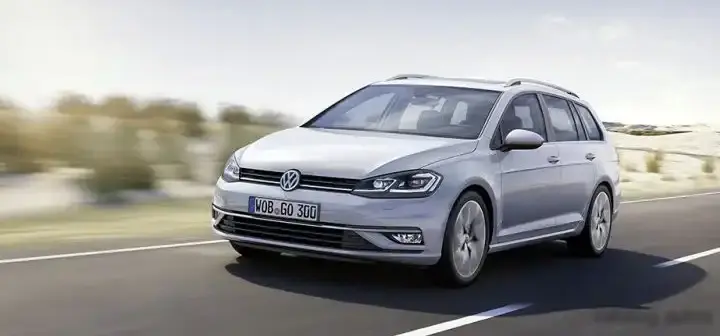
The Volkswagen Golf VII Variant, specifically the 1.5 TSI ACT (131 hp) BlueMotion model produced from July 2017 to 2019, represents a key iteration within the seventh generation of Volkswagen’s iconic Golf lineup. This variant, a practical station wagon (estate) body style, was positioned as a fuel-efficient and versatile option for families and individuals seeking a balance between performance and economy. It falls within the facelifted VII generation (often referred to as the 7.5), benefitting from styling updates and technological enhancements introduced mid-cycle. The Golf VII platform (PQ25) was a significant success for Volkswagen, underpinning a range of models and establishing a benchmark for front-wheel-drive compact vehicles.
Technical Specifications
| Brand | Volkswagen |
| Model | Golf |
| Generation | Golf VII Variant (facelift 2017) |
| Type (Engine) | 1.5 TSI ACT (131 Hp) BlueMotion |
| Start of production | July, 2017 |
| End of production | 2019 |
| Powertrain Architecture | Internal Combustion engine |
| Body type | Station wagon (estate) |
| Seats | 5 |
| Doors | 5 |
| Fuel consumption (urban) | 6.5-6.7 l/100 km (36.2 – 35.1 US mpg, 43.5 – 42.2 UK mpg, 15.4 – 14.9 km/l) |
| Fuel consumption (extra urban) | 4.3-4.4 l/100 km (54.7 – 53.5 US mpg, 65.7 – 64.2 UK mpg, 23.3 – 22.7 km/l) |
| Fuel consumption (combined) | 5.1-5.2 l/100 km (46.1 – 45.2 US mpg, 55.4 – 54.3 UK mpg, 19.6 – 19.2 km/l) |
| CO2 emissions | 116-119 g/km |
| Fuel Type | Petrol (Gasoline) |
| Acceleration 0 – 100 km/h | 9.5 sec |
| Acceleration 0 – 62 mph | 9.5 sec |
| Acceleration 0 – 60 mph | 9 sec (Calculated) |
| Maximum speed | 211 km/h (131.11 mph) |
| Emission standard | Euro 6d-TEMP |
| Weight-to-power ratio | 10.5 kg/Hp, 95.6 Hp/tonne |
| Weight-to-torque ratio | 6.9 kg/Nm, 146 Nm/tonne |
| Power | 131 Hp |
| Power per litre | 87.4 Hp/l |
| Torque | 200 Nm @ 1400-4000 rpm (147.51 lb.-ft. @ 1400-4000 rpm) |
| Engine layout | Front, Transverse |
| Engine Model/Code | DACA |
| Engine displacement | 1498 cm3 (91.41 cu. in.) |
| Number of cylinders | 4 |
| Engine configuration | Inline |
| Number of valves per cylinder | 4 |
| Fuel injection system | Direct injection |
| Engine aspiration | Turbocharger, Intercooler |
| Engine oil capacity | 4.3 l (4.54 US qt | 3.78 UK qt) |
| Kerb Weight | 1370 kg (3020.33 lbs.) |
| Max. weight | 1900 kg (4188.78 lbs.) |
| Max load | 530 kg (1168.45 lbs.) |
| Trunk (boot) space – minimum | 605 l (21.37 cu. ft.) |
| Trunk (boot) space – maximum | 1620 l (57.21 cu. ft.) |
| Fuel tank capacity | 50 l (13.21 US gal | 11 UK gal) |
| Max. roof load | 75 kg (165.35 lbs.) |
| Permitted trailer load with brakes (8%) | 1700 kg (3747.86 lbs.) |
| Permitted trailer load with brakes (12%) | 1400 kg (3086.47 lbs.) |
| Permitted trailer load without brakes | 680 kg (1499.14 lbs.) |
| Permitted towbar download | 80 kg (176.37 lbs.) |
| Length | 4567 mm (179.8 in.) |
| Width | 1799 mm (70.83 in.) |
| Width including mirrors | 2027 mm (79.8 in.) |
| Height | 1515 mm (59.65 in.) |
| Wheelbase | 2620 mm (103.15 in.) |
| Front track | 1533-1549 mm (60.35 – 60.98 in.) |
| Rear (Back) track | 1504-1520 mm (59.21 – 59.84 in.) |
| Ride height (ground clearance) | 140 mm (5.51 in.) |
| Minimum turning circle | 10.9 m (35.76 ft.) |
| Drive wheel | Front wheel drive |
| Number of gears and type of gearbox | 6 gears, manual transmission |
| Assisting systems | ABS (Anti-lock braking system) |
| Steering type | Steering rack and pinion |
| Power steering | Electric Steering |
| Tires size | 205/50 R17; 225/45 R17 |
| Wheel rims size | 6J x 17; 7J x 17 |
Powertrain & Engine Architecture
The heart of the Golf VII Variant 1.5 TSI ACT BlueMotion is the DACA engine code, a 1.5-liter turbocharged, direct-injection four-cylinder gasoline engine. This engine is part of Volkswagen’s EA211 family, known for its compact design and efficiency. The “ACT” designation stands for Active Cylinder Technology, a key feature of this engine. ACT allows the engine to deactivate two cylinders (typically cylinders 2 and 3) under light load conditions, effectively turning the engine into a two-cylinder unit to reduce fuel consumption. This switch is seamless and largely imperceptible to the driver. The engine utilizes a single turbocharger with an intercooler to boost power and torque. Fuel is delivered via direct injection, optimizing combustion efficiency and reducing emissions. The engine’s valvetrain features four valves per cylinder, contributing to its responsive nature. The 6-speed manual transmission was standard, providing a balance between fuel economy and driver engagement.
Driving Characteristics
The 131 hp output and 200 Nm (147 lb-ft) of torque deliver adequate performance for everyday driving. Acceleration from 0 to 62 mph takes approximately 9.5 seconds, and the top speed is 211 km/h (131 mph). While not a performance-oriented variant, the 1.5 TSI offers sufficient power for highway cruising and overtaking maneuvers. The manual transmission provides precise gear changes, and the engine’s torque curve is relatively flat, offering good responsiveness across a wide RPM range. Compared to the more powerful Golf variants, such as those equipped with the 2.0 TSI engine, the 1.5 TSI feels less urgent in its acceleration. However, it excels in fuel economy, making it a practical choice for drivers prioritizing efficiency. The Active Cylinder Technology is most noticeable during steady-state cruising, where it contributes to a quieter and more relaxed driving experience.
Equipment & Trim Levels
The Golf VII Variant 1.5 TSI ACT BlueMotion typically came equipped with a respectable level of standard features. These included air conditioning, a touchscreen infotainment system with Bluetooth connectivity, alloy wheels, and a suite of safety features such as ABS, ESC (Electronic Stability Control), and multiple airbags. Higher trim levels offered options such as automatic climate control, a larger touchscreen display, navigation system, parking sensors, and adaptive cruise control. Interior upholstery was typically cloth, with optional leather upgrades available. The dashboard layout was typical of the Golf VII, characterized by a clean and functional design.
Chassis & Braking
The Golf VII Variant’s chassis is based on the MQB (Modular Transverse Matrix) platform, providing a solid and well-balanced foundation. The suspension consists of independent MacPherson struts at the front and a multi-link setup at the rear. The braking system typically featured disc brakes on all four wheels, providing ample stopping power. The 1.5 TSI BlueMotion variant often included optimized aerodynamics and low rolling resistance tires to further enhance fuel efficiency. Stabilizer bars were fitted to both the front and rear axles to reduce body roll during cornering.
Market Reception & Comparison
The Golf VII Variant 1.5 TSI ACT BlueMotion was generally well-received by automotive critics for its fuel efficiency and practicality. It was praised for its comfortable ride, spacious interior, and refined driving experience. Compared to other Golf variants, such as the 1.6 TDI diesel, the 1.5 TSI offered a more responsive and refined driving experience, albeit with slightly higher fuel consumption. Against competitors like the Ford Focus Estate and Skoda Octavia Combi, the Golf VII Variant stood out for its build quality, sophisticated technology, and strong resale value.
Legacy
The 1.5 TSI engine has proven to be a reliable and durable powertrain, although some early versions experienced issues with particulate filter clogging. Regular maintenance, including oil changes and timely servicing, is crucial for ensuring long-term reliability. In the used car market, the Golf VII Variant 1.5 TSI ACT BlueMotion remains a popular choice for buyers seeking a practical, fuel-efficient, and well-equipped station wagon. Its combination of comfort, versatility, and economy continues to make it a compelling option in the compact estate segment.