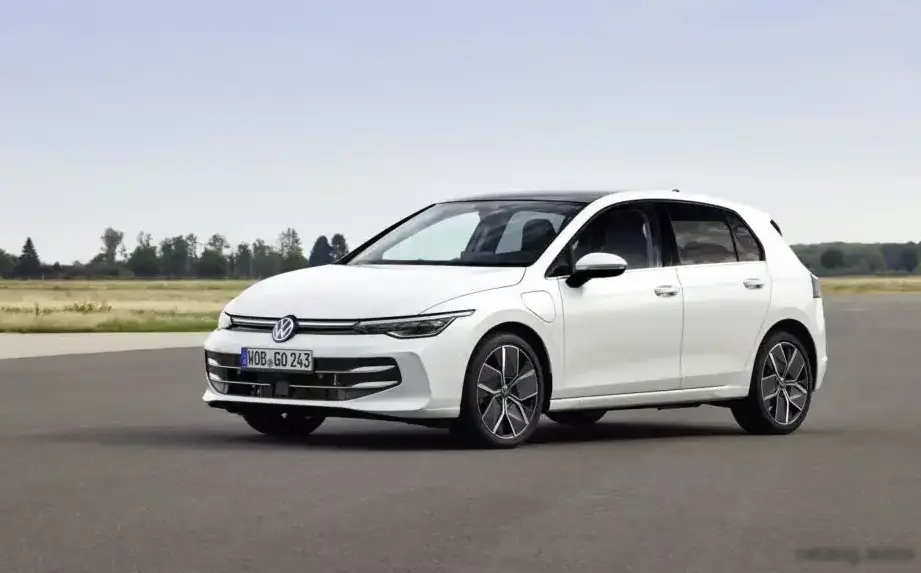
Technical Specifications
| Brand | Volkswagen |
| Model | Golf |
| Generation | Golf VIII (facelift 2024) |
| Type (Engine) | 2.0 TDI (150 Hp) DSG |
| Start of production | 2024 |
| Powertrain Architecture | Internal Combustion engine |
| Body type | Hatchback |
| Seats | 5 |
| Doors | 5 |
| Fuel consumption at Low speed (WLTP) | 6.7-6.8 l/100 km (35.1 – 34.6 US mpg, 42.2 – 41.5 UK mpg, 14.9 – 14.7 km/l) |
| Fuel consumption at Medium speed (WLTP) | 4.5-4.6 l/100 km (52.3 – 51.1 US mpg, 62.8 – 61.4 UK mpg, 22.2 – 21.7 km/l) |
| Fuel consumption at high speed (WLTP) | 3.8-3.9 l/100 km (61.9 – 60.3 US mpg, 74.3 – 72.4 UK mpg, 26.3 – 25.6 km/l) |
| Fuel consumption at very high speed (WLTP) | 4.4-4.5 l/100 km (53.5 – 52.3 US mpg, 64.2 – 62.8 UK mpg, 22.7 – 22.2 km/l) |
| Combined fuel consumption (WLTP) | 4.5-4.7 l/100 km (52.3 – 50 US mpg, 62.8 – 60.1 UK mpg, 22.2 – 21.3 km/l) |
| CO2 emissions (WLTP) | 119-123 g/km |
| Fuel Type | Diesel |
| Acceleration 0 – 100 km/h | 8 sec |
| Acceleration 0 – 62 mph | 8 sec |
| Acceleration 0 – 60 mph | 7.6 sec |
| Maximum speed | 223 km/h (138.57 mph) |
| Emission standard | Euro 6 EA |
| Weight-to-power ratio | 9.1 kg/Hp, 109.6 Hp/tonne |
| Weight-to-torque ratio | 3.8 kg/Nm, 263 Nm/tonne |
| Power | 150 Hp |
| Power per litre | 76.2 Hp/l |
| Torque | 360 Nm @ 1600-2750 rpm (265.52 lb.-ft. @ 1600-2750 rpm) |
| Engine layout | Front, Transverse |
| Engine Model/Code | EA288 evo |
| Engine displacement | 1968 cm3 (120.09 cu. in.) |
| Number of cylinders | 4 |
| Engine configuration | Inline |
| Cylinder Bore | 81 mm (3.19 in.) |
| Piston Stroke | 95.5 mm (3.76 in.) |
| Number of valves per cylinder | 4 |
| Fuel injection system | Diesel Commonrail |
| Engine aspiration | Turbocharger, Intercooler |
| Valvetrain | DOHC |
| Engine systems | Start & Stop System, Particulate filter |
| Kerb Weight | 1369 kg (3018.13 lbs.) |
| Max. weight | 1940 kg (4276.97 lbs.) |
| Max load | 571 kg (1258.84 lbs.) |
| Trunk (boot) space – minimum | 381 l (13.45 cu. ft.) |
| Trunk (boot) space – maximum | 1237 l (43.68 cu. ft.) |
| Fuel tank capacity | 50 l (13.21 US gal | 11 UK gal) |
| Permitted trailer load with brakes (8%) | 1800 kg (3968.32 lbs.) |
| Permitted trailer load with brakes (12%) | 1600 kg (3527.4 lbs.) |
| Permitted trailer load without brakes | 720 kg (1587.33 lbs.) |
| Permitted towbar download | 80 kg (176.37 lbs.) |
| Length | 4282 mm (168.58 in.) |
| Width | 1789 mm (70.43 in.) |
| Width including mirrors | 2073 mm (81.61 in.) |
| Height | 1483 mm (58.39 in.) |
| Wheelbase | 2620 mm (103.15 in.) |
| Front track | 1534-1550 mm (60.39 – 61.02 in.) |
| Rear (Back) track | 1502-1518 mm (59.13 – 59.76 in.) |
| Minimum turning circle (turning diameter) | 11.1 m (36.42 ft.) |
| Approach angle | 14° |
| Departure angle | 16° |
| Ramp-over (brakeover) angle | 11° |
| Drivetrain Architecture | The Internal combustion engine (ICE) drives the front wheels of the vehicle. |
| Drive wheel | Front wheel drive |
| Number of gears and type of gearbox | 7 gears, automatic transmission DSG |
| Front suspension | Independent, type McPherson with coil spring and anti-roll bar |
| Front brakes | Ventilated discs |
| Rear brakes | Disc |
| Assisting systems | ABS (Anti-lock braking system) |
| Steering type | Steering rack and pinion |
| Power steering | Electric Steering |
| Tires size | 205/55 R16; 225/45 R17; 225/40 R18 |
| Wheel rims size | 7J x 16; 7.5J x 17; 7.5J x 18 |
The Volkswagen Golf VIII 2.0 TDI DSG, launched in 2024 following a mid-life refresh, continues the Golf’s tradition as a benchmark in the compact hatchback segment. Built on the MQB Evo platform (1HX0/A3), this variant offers a compelling blend of efficiency and performance. The facelift brought updated styling, enhanced technology, and refined engine options. The 2.0 TDI with 150 horsepower and the 7-speed DSG transmission is positioned as a sweet spot in the range, appealing to buyers who prioritize fuel economy and comfortable cruising without sacrificing driving enjoyment. It represents a significant portion of Golf sales in Europe, where diesel remains a popular choice.
Powertrain & Engine Architecture
At the heart of this Golf variant lies the EA288 evo 2.0-liter four-cylinder diesel engine. This engine utilizes a common rail direct injection system, delivering fuel at extremely high pressures for optimized combustion. The engine employs a turbocharger with variable geometry turbine (VGT) technology and an intercooler to boost power and torque. The engine code is a key identifier, often found as a combination of letters and numbers indicating specific calibration and emission control features. The 150 hp output is achieved through careful tuning of the engine management system. The 7-speed DSG (Direct-Shift Gearbox) is a dual-clutch transmission known for its quick and smooth gear changes. It features two separate clutches, one for odd-numbered gears and one for even-numbered gears, allowing for seamless shifts and improved efficiency. The DSG is programmed with a focus on fuel economy, with taller gear ratios in the higher gears for relaxed highway cruising.
Driving Characteristics
The 2.0 TDI DSG offers a refined driving experience. While not as overtly sporty as the GTI or R models, it provides ample power for everyday driving and overtaking maneuvers. The maximum torque of 360 Nm (265.52 lb.-ft.) available from 1600-2750 rpm ensures strong acceleration in most situations. The DSG transmission contributes to a smooth and responsive feel, with minimal torque interruption during gear changes. Compared to the manual transmission versions of the same engine, the DSG offers greater convenience, particularly in urban traffic. However, some drivers may prefer the more direct engagement of a manual gearbox. Against higher-output TDI variants (like the 200 hp version), this 150 hp model feels less urgent, but it compensates with improved fuel economy and lower running costs.
Equipment & Trim Levels
The Golf VIII 2.0 TDI DSG typically comes well-equipped, even in base trim levels. Standard features often include air conditioning, a touchscreen infotainment system with Apple CarPlay and Android Auto compatibility, LED headlights, and a suite of safety features such as automatic emergency braking and lane-keeping assist. Higher trim levels add features like a larger touchscreen, digital instrument cluster, adaptive cruise control, heated seats, and premium upholstery. Optional extras include a panoramic sunroof, upgraded sound system, and various driver assistance packages. Interior upholstery is typically cloth in lower trims, with leather options available on higher-spec models. The dashboard layout is modern and minimalist, with a focus on usability.
Chassis & Braking
The Golf VIII utilizes an independent McPherson strut suspension at the front and a multi-link suspension at the rear, providing a comfortable and controlled ride. The suspension is tuned to balance handling and comfort, making it suitable for a wide range of driving conditions. Braking is handled by ventilated discs at the front and solid discs at the rear. ABS (Anti-lock Braking System) is standard, along with electronic stability control. The chassis is designed to be relatively lightweight, contributing to the car’s agility. Stabilizer bars are fitted to both the front and rear axles to reduce body roll during cornering.
Market Reception & Comparison
The Golf VIII 2.0 TDI DSG has generally received positive reviews from automotive critics. It is praised for its fuel efficiency, comfortable ride, and refined driving experience. Critics note that the diesel engine provides a good balance of power and economy, making it well-suited for long-distance driving. Compared to gasoline-powered Golf variants, the TDI offers significantly better fuel economy. However, some critics point out that the diesel engine can be slightly noisy compared to its gasoline counterparts. In terms of reliability, the EA288 engine family has a generally good reputation, although regular maintenance is essential to ensure longevity.
Legacy
The EA288 engine, in its various iterations, has become a mainstay in the Volkswagen Group’s diesel lineup. The 2.0 TDI variant, particularly when paired with the DSG transmission, has proven to be a reliable and durable powertrain. In the used car market, well-maintained examples of the Golf VIII 2.0 TDI DSG are likely to hold their value reasonably well, due to their reputation for fuel efficiency and practicality. However, potential buyers should be aware of the importance of regular servicing, including oil changes and filter replacements, to ensure the engine remains in good condition. The continued demand for efficient diesel vehicles suggests that this powertrain will remain relevant for years to come.