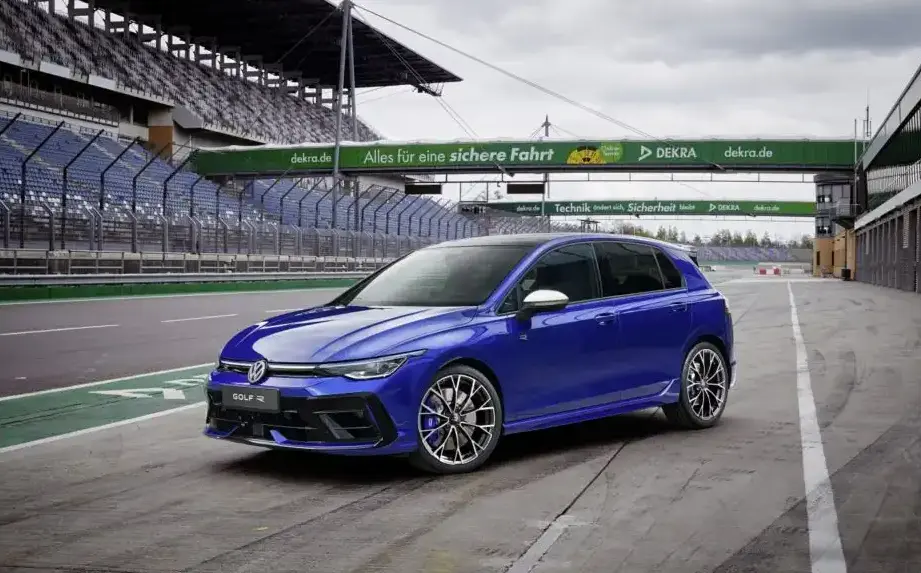
The Volkswagen Golf R, specifically the 2.0 TSI 333 Hp 4MOTION DSG variant introduced with the 2024 facelift (internally designated as the Golf VIII facelift), represents the pinnacle of performance within the eighth-generation Golf lineup. Production commenced in July 2024, building upon the established reputation of the Golf R as a capable and versatile hot hatchback. This iteration continues the Golf’s legacy of blending everyday usability with exhilarating performance, targeting enthusiasts seeking a premium driving experience. It sits at the top of the Golf range, offering significantly more power and sophisticated technology than lower trims like the Golf TSI or Golf eTSI mild-hybrid models.
Technical Specifications
| Brand | Volkswagen |
| Model | Golf |
| Generation | Golf VIII (facelift 2024) |
| Type (Engine) | R 2.0 TSI (333 Hp) 4MOTION DSG |
| Start of production | July, 2024 |
| Powertrain Architecture | Internal Combustion engine |
| Body type | Hatchback |
| Seats | 5 |
| Doors | 5 |
| Fuel consumption at Low speed (WLTP) | 11.6-11.9 l/100 km (20.3 – 19.8 US mpg, 24.4 – 23.7 UK mpg, 8.6 – 8.4 km/l) |
| Fuel consumption at Medium speed (WLTP) | 8.4-8.7 l/100 km (28 – 27 US mpg, 33.6 – 32.5 UK mpg, 11.9 – 11.5 km/l) |
| Fuel consumption at high speed (WLTP) | 6.9-7.3 l/100 km (34.1 – 32.2 US mpg, 40.9 – 38.7 UK mpg, 14.5 – 13.7 km/l) |
| Fuel consumption at very high speed (WLTP) | 7.6-8.1 l/100 km (30.9 – 29 US mpg, 37.2 – 34.9 UK mpg, 13.2 – 12.3 km/l) |
| Combined fuel consumption (WLTP) | 8.1-8.5 l/100 km (29 – 27.7 US mpg, 34.9 – 33.2 UK mpg, 12.3 – 11.8 km/l) |
| CO2 emissions (WLTP) | 184-193 g/km |
| Fuel Type | Petrol (Gasoline) |
| Acceleration 0 – 100 km/h | 4.6 sec |
| Acceleration 0 – 62 mph | 4.6 sec |
| Acceleration 0 – 60 mph | 4.4 sec |
| Maximum speed | 250 km/h (155.34 mph), Electronically limited |
| Emission standard | Euro 6e |
| Weight-to-power ratio | 4.4 kg/Hp, 226.1 Hp/tonne |
| Weight-to-torque ratio | 3.5 kg/Nm, 285.1 Nm/tonne |
| Power | 333 Hp @ 5600-6500 rpm |
| Power per litre | 167.8 Hp/l |
| Torque | 420 Nm @ 2100-5500 rpm (309.78 lb.-ft. @ 2100-5500 rpm) |
| Engine layout | Front, Transverse |
| Engine Model/Code | EA888 evo4 |
| Engine displacement | 1984 cm3 (121.07 cu. in.) |
| Number of cylinders | 4 |
| Engine configuration | Inline |
| Cylinder Bore | 82.5 mm (3.25 in.) |
| Piston Stroke | 92.8 mm (3.65 in.) |
| Number of valves per cylinder | 4 |
| Fuel injection system | Direct injection |
| Engine aspiration | Turbocharger, Intercooler |
| Valvetrain | DOHC |
| Engine systems | Start & Stop System, Particulate filter |
| Kerb Weight | 1473 kg (3247.41 lbs.) |
| Max. weight | 2040 kg (4497.43 lbs.) |
| Max load | 567 kg (1250.02 lbs.) |
| Trunk (boot) space – minimum | 341 l (12.04 cu. ft.) |
| Trunk (boot) space – maximum | 1197 l (42.27 cu. ft.) |
| Fuel tank capacity | 55 l (14.53 US gal | 12.1 UK gal) |
| Permitted trailer load with brakes (8%) | 1900 kg (4188.78 lbs.) |
| Permitted trailer load with brakes (12%) | 1700 kg (3747.86 lbs.) |
| Permitted trailer load without brakes | 750 kg (1653.47 lbs.) |
| Permitted towbar download | 80 kg (176.37 lbs.) |
| Length | 4296 mm (169.13 in.) |
| Width | 1789 mm (70.43 in.) |
| Width including mirrors | 2073 mm (81.61 in.) |
| Height | 1454 mm (57.24 in.) |
| Wheelbase | 2629 mm (103.5 in.) |
| Front track | 1539-1541 mm (60.59 – 60.67 in.) |
| Rear (Back) track | 1516-1518 mm (59.69 – 59.76 in.) |
| Minimum turning circle (turning diameter) | 12 m (39.37 ft.) |
| Approach angle | 11.6° |
| Departure angle | 15.7° |
| Ramp-over (brakeover) angle | 11.6° |
| Drivetrain Architecture | The Internal combustion engine (ICE) drives the front wheels permanently, and the rear wheels are driven through an electrically or mechanically operated clutch if necessary. |
| Drive wheel | All wheel drive (4×4) |
| Number of gears and type of gearbox | 7 gears, automatic transmission DSG |
| Front suspension | Independent, type McPherson with coil spring and anti-roll bar |
| Rear suspension | Independent multi-link spring suspension with stabilizer |
| Front brakes | Ventilated discs |
| Assisting systems | ABS (Anti-lock braking system) |
| Steering type | Steering rack and pinion |
| Power steering | Electric Steering |
| Tires size | 225/40 R18; 235/35 R19 |
| Wheel rims size | 18; 19 |
Powertrain & Engine Architecture
The heart of the Golf R is the EA888 evo4, a 2.0-liter turbocharged inline-four cylinder gasoline engine. This engine produces 333 horsepower at 5600-6500 rpm and 420 Nm (309.78 lb-ft) of torque between 2100 and 5500 rpm. The EA888 evo4 features direct fuel injection, a robust turbocharger with an integrated intercooler, and a dual overhead camshaft (DOHC) valvetrain. A particulate filter is included to meet stringent emissions standards. The engine is transversely mounted at the front of the vehicle. The power is then sent to all four wheels via Volkswagen’s 4MOTION all-wheel-drive system, coupled with a seven-speed dual-clutch transmission (DSG). The DSG provides rapid and precise gear changes, enhancing both acceleration and fuel efficiency.
Driving Characteristics
The Golf R 2.0 TSI 4MOTION DSG delivers a noticeably potent driving experience. The 4.6-second 0-60 mph acceleration time is indicative of its performance capabilities. The 4MOTION system provides excellent traction, particularly in adverse weather conditions, allowing for confident cornering and acceleration. The DSG transmission is well-tuned, offering both automatic convenience and the ability to manually shift gears via paddle shifters. Compared to lower-powered Golf variants, the R offers a significantly more responsive throttle and a more engaging driving experience. While the DSG is quick, some drivers may prefer the more direct feel of a traditional manual transmission, which is not offered in this configuration.
Equipment & Trim Levels
The Golf R comes standard with a comprehensive suite of features, including a digital cockpit, a large touchscreen infotainment system with navigation, adaptive cruise control, lane assist, and automatic emergency braking. Interior appointments typically include sport seats upholstered in cloth or leather, with unique R-specific badging and trim. Optional extras include a premium sound system, a panoramic sunroof, and upgraded interior lighting. The R trim generally represents the highest level of equipment available on the Golf, offering a more luxurious and technologically advanced experience than lower trims.
Chassis & Braking
The Golf R features a sport-tuned suspension with McPherson struts at the front and a multi-link setup at the rear. Stabilizer bars are fitted to both axles to reduce body roll during cornering. The braking system consists of ventilated discs at all four corners, providing ample stopping power. The R variant often receives larger brake rotors and calipers compared to standard Golf models. The steering is a rack-and-pinion system with electric power assistance, offering precise and responsive control.
Market Reception & Comparison
The Golf R has consistently received positive reviews from automotive critics, praised for its blend of performance, practicality, and refinement. Compared to other hot hatchbacks like the Honda Civic Type R or Hyundai Elantra N, the Golf R often stands out for its more mature and sophisticated character. While some competitors may offer more raw performance, the Golf R provides a more balanced and user-friendly experience. Fuel economy is respectable for a high-performance vehicle, but it is lower than that of more fuel-efficient Golf trims. Reliability has generally been good, although the complexity of the turbocharged engine and DSG transmission may require more specialized maintenance.
Legacy
The EA888 engine family, in various iterations, has proven to be a durable and reliable powerplant. The DSG transmission, while occasionally subject to maintenance needs, is generally considered robust when properly serviced. The Golf R, as a whole, has established itself as a benchmark in the hot hatchback segment, and the 2024 facelifted model continues this tradition. On the used car market, well-maintained Golf Rs tend to hold their value well, appealing to enthusiasts seeking a high-performance and versatile vehicle.