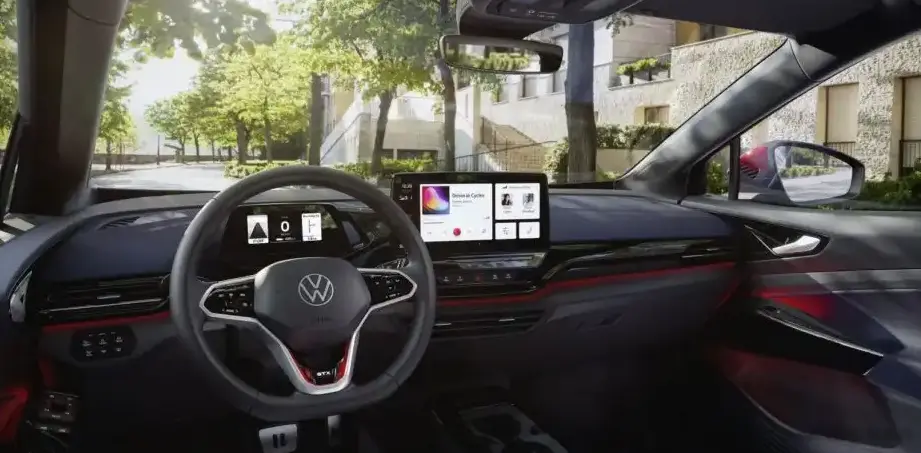
The Volkswagen ID.4 GTX 82 kWh (299 hp) 4MOTION is a fully electric, all-wheel drive compact SUV introduced in 2021 as a performance-oriented variant of the ID.4. Positioned as the top-tier trim level within the ID.4 lineup at its launch, the GTX offered increased power, a dual-motor all-wheel drive system, and a sportier aesthetic compared to the standard ID.4 models. It represents Volkswagen’s push into the electric vehicle market, leveraging the modular electric drive matrix (MEB) platform. The ID.4 GTX aimed to appeal to buyers seeking a practical, spacious, and technologically advanced electric SUV with enhanced performance capabilities.
Technical Specifications
| Brand | Volkswagen |
| Model | ID.4 |
| Generation | ID.4 |
| Type (Engine) | GTX 82 kWh (299 Hp) 4MOTION |
| Start of production | 2021 |
| Powertrain Architecture | BEV (Electric Vehicle) |
| Body type | SUV |
| Seats | 5 |
| Doors | 5 |
| Fuel Type | Electricity |
| Acceleration 0 – 100 km/h | 6.2 sec |
| Acceleration 0 – 62 mph | 6.2 sec |
| Acceleration 0 – 60 mph | 5.9 sec |
| Maximum speed | 180 km/h (111.85 mph) |
| Weight-to-power ratio | 7.2 kg/Hp, 139.1 Hp/tonne |
| Weight-to-torque ratio | 4.7 kg/Nm, 214.1 Nm/tonne |
| Gross battery capacity | 82 kWh |
| Net (usable) battery capacity | 77 kWh |
| Battery technology | Lithium-ion (Li-Ion) |
| Battery weight | 493 kg (1086.88 lbs) |
| Battery location | Below the floor |
| Recuperation output | 100 kW |
| All-electric range (WLTP) | 482 km (299.5 mi) |
| Average Energy consumption (WLTP) | 18.2 kWh/100 km (29.29 kWh/100 mi, 115 MPGe, 5.5 km/kWh, 3.4 mi/kWh) |
| Average Energy consumption | 16.3 kWh/100 km (26.23 kWh/100 mi, 128 MPGe, 6.1 km/kWh, 3.8 mi/kWh) |
| Kerb Weight | 2149 kg (4737.73 lbs) |
| Max. weight | 2750 kg (6062.71 lbs) |
| Max load | 601 kg (1324.98 lbs) |
| Trunk (boot) space – minimum | 543 l (19.18 cu. ft.) |
| Trunk (boot) space – maximum | 1575 l (55.62 cu. ft.) |
| Max. roof load | 75 kg (165.35 lbs) |
| Permitted trailer load with brakes (8%) | 1400 kg (3086.47 lbs) |
| Permitted trailer load with brakes (12%) | 1200 kg (2645.55 lbs) |
| Permitted trailer load without brakes | 750 kg (1653.47 lbs) |
| Permitted towbar download | 75 kg (165.35 lbs) |
| Length | 4582 mm (180.39 in) |
| Width | 1852 mm (72.91 in) |
| Height | 1637 mm (64.45 in) |
| Wheelbase | 2769 mm (109.02 in) |
| Front track | 1587-1597 mm (62.48 – 62.87 in) |
| Rear (Back) track | 1562-1568 mm (61.5 – 61.73 in) |
| Ride height (ground clearance) | 170 mm (6.69 in) |
| Drag coefficient (Cd) | 0.29 |
| Minimum turning circle (turning diameter) | 11.6 m (38.06 ft) |
| Climb angle | 20.6° |
| Drivetrain Architecture | One electric motor drives the front wheels, one electric motor drives the rear wheels. |
| Drive wheel | All wheel drive (4×4) |
| Number of gears and type of gearbox | 1 gears, automatic transmission |
| Front suspension | Independent type McPherson, Transverse stabilizer |
| Rear suspension | Independent multi-link suspension, Transverse stabilizer |
| Front brakes | Ventilated discs, 358 mm |
| Rear brakes | Drum |
| Assisting systems | ABS (Anti-lock braking system) |
| Steering type | Steering rack and pinion |
| Power steering | Electric Steering |
| Front wheel tires | 235/50 R20; 235/45 R21 |
| Rear wheel tires | 255/45 R20; 255/40 R21 |
| Front wheel rims | 8J x 20; 8.5J x 21 |
| Rear wheel rims | 9J x 20; 9J x 21 |
Powertrain & Engine Architecture
The ID.4 GTX utilizes a dual-motor, all-wheel drive powertrain. The front motor (EBR) produces 109 hp and 162 Nm (119 lb-ft) of torque, while the rear motor (EBJA) generates 204 hp and 310 Nm (229 lb-ft) of torque. Combined, the system delivers a total output of 299 hp and 460 Nm (339 lb-ft) of torque. Both motors are permanently magnet synchronous motors, with the rear motor employing a more powerful design. The 82 kWh (gross) / 77 kWh (net) lithium-ion battery pack is located under the vehicle floor, contributing to a low center of gravity. The GTX features a single-speed automatic transmission for each axle. The battery supports DC fast charging at up to 125 kW, allowing for a significant charge in approximately 30 minutes. The recuperation system can recover up to 100 kW of energy during deceleration, enhancing efficiency.
Driving Characteristics
The dual-motor setup of the ID.4 GTX provides noticeably quicker acceleration compared to the single-motor ID.4 variants. The 0-60 mph sprint takes approximately 5.9 seconds. The all-wheel drive system offers improved traction and stability, particularly in adverse weather conditions. While the single-speed transmission lacks the traditional gear changes of an internal combustion engine vehicle, it delivers instant torque and smooth acceleration. The GTX’s suspension is tuned for a slightly firmer ride than the standard ID.4, providing better body control during cornering. However, it still prioritizes comfort, making it a suitable daily driver. The steering is precise but lacks significant feedback.
Equipment & Trim Levels
The ID.4 GTX came standard with a comprehensive suite of features, including a 12-inch touchscreen infotainment system, a digital instrument cluster, heated front seats, a panoramic sunroof, and advanced driver-assistance systems such as adaptive cruise control, lane keeping assist, and automatic emergency braking. Unique to the GTX were sport seats with distinctive upholstery, a sport steering wheel, and exterior styling elements like a model-specific front bumper and badging. Optional extras included premium audio systems, upgraded interior trim materials, and larger wheel sizes.
Chassis & Braking
The ID.4 GTX utilizes an independent McPherson strut suspension at the front and an independent multi-link suspension at the rear, both incorporating a transverse stabilizer bar. The braking system features ventilated discs at the front (358mm) and drum brakes at the rear. The GTX’s chassis is reinforced compared to the standard ID.4 to handle the increased power and torque. The electronic stability control (ESC) system is calibrated to work in conjunction with the all-wheel drive system to optimize traction and handling.
Market Reception & Comparison
The ID.4 GTX was generally well-received by automotive critics, who praised its performance, spacious interior, and advanced technology. Compared to the standard ID.4, the GTX offered a significant performance upgrade, making it a more engaging driving experience. However, some reviewers noted that the ride quality was slightly firmer and that the price was higher. Compared to other electric SUVs in its class, such as the Tesla Model Y and the Ford Mustang Mach-E, the ID.4 GTX offered a competitive combination of performance, range, and value. Its fuel economy, measured in MPGe, was comparable to other leading electric SUVs.
Legacy
The ID.4 GTX represents an important step in Volkswagen’s transition to electric mobility. The MEB platform and the dual-motor powertrain technology introduced in the GTX have been carried over to other Volkswagen Group electric vehicles. While long-term reliability data is still emerging, early reports suggest that the ID.4 GTX’s powertrain is generally reliable. On the used car market, the ID.4 GTX holds its value relatively well, reflecting its desirable performance and features. As battery technology continues to improve and charging infrastructure expands, the ID.4 GTX is expected to remain a popular choice for buyers seeking a practical and enjoyable electric SUV.