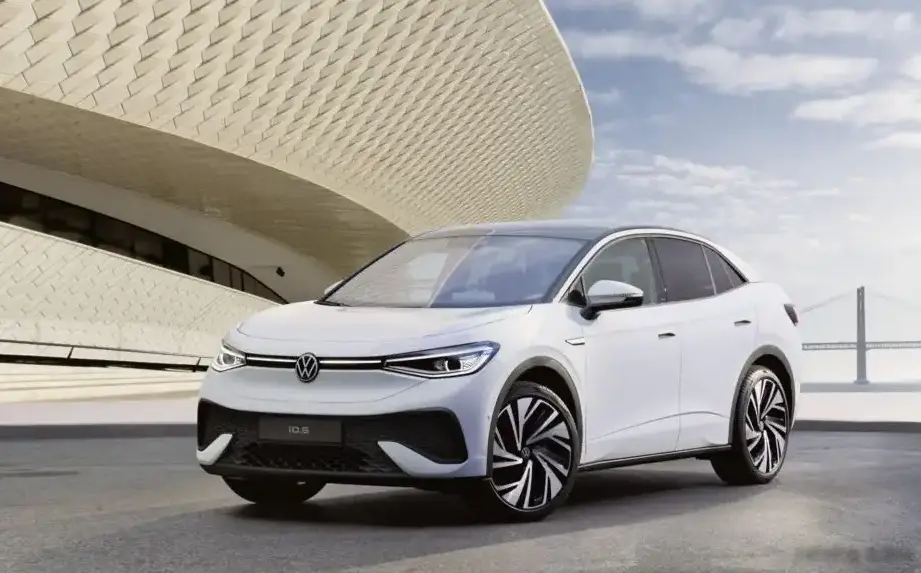
The Volkswagen ID.5 82 kWh, producing 204 horsepower, represents Volkswagen’s entry into the growing market of electric crossover coupes. Introduced in 2022 and continuing production through October 2023, the ID.5 is built upon the MEB platform – Volkswagen’s modular electric drive matrix – and shares its core components with the ID.4, but distinguishes itself with a more aggressively sloped roofline, giving it a coupe-like profile. Positioned as a stylish and practical all-electric vehicle, the 82 kWh variant aimed to provide a balance between range, performance, and affordability within the ID.5 lineup. It primarily targeted European and North American markets seeking a zero-emission alternative in the compact SUV segment.
Technical Specifications
| Brand | Volkswagen |
| Model | ID.5 |
| Generation | ID.5 |
| Type (Engine) | 82 kWh (204 Hp) |
| Start of production | 2022 |
| End of production | October, 2023 |
| Powertrain Architecture | BEV (Electric Vehicle) |
| Body type | Coupe, SUV |
| Seats | 5 |
| Doors | 5 |
| Fuel Type | Electricity |
| Acceleration 0 – 100 km/h | 8.4 sec |
| Acceleration 0 – 62 mph | 8.4 sec |
| Acceleration 0 – 60 mph | 8 sec |
| Maximum speed | 160 km/h (99.42 mph) |
| Weight-to-power ratio | 10 kg/Hp, 99.9 Hp/tonne |
| Weight-to-torque ratio | 6.6 kg/Nm, 151.8 Nm/tonne |
| Gross battery capacity | 82 kWh |
| Net (usable) battery capacity | 77 kWh |
| Battery technology | Lithium nickel manganese cobalt oxides (Li-NMC) |
| Battery weight | 495 kg (1091.29 lbs) |
| Battery location | Below the floor |
| All-electric range (WLTP) | 516 km (320.63 mi) |
| Average Energy consumption (WLTP) | 16.9 kWh/100 km (27.2 kWh/100 mi, 124 MPGe, 5.9 km/kWh, 3.7 mi/kWh) |
| Average Energy consumption | 16.2 kWh/100 km (26.07 kWh/100 mi, 129 MPGe, 6.2 km/kWh, 3.8 mi/kWh) |
| Electric motor power | 204 Hp |
| Electric motor Torque | 310 Nm (228.64 lb.-ft.) |
| Electric motor model/code | EBJA |
| Electric motor location | Rear axle, Transverse |
| Electric motor type | Synchronous |
| System power | 204 Hp |
| System torque | 310 Nm (228.64 lb.-ft.) |
| Kerb Weight | 2042 kg (4501.84 lbs) |
| Max. weight | 2650 kg (5842.25 lbs) |
| Max load | 608 kg (1340.41 lbs) |
| Trunk (boot) space – minimum | 549 l (19.39 cu. ft.) |
| Trunk (boot) space – maximum | 1561 l (55.13 cu. ft.) |
| Max. roof load | 75 kg (165.35 lbs) |
| Permitted trailer load with brakes (8%) | 1200 kg (2645.55 lbs) |
| Permitted trailer load with brakes (12%) | 1000 kg (2204.62 lbs) |
| Permitted trailer load without brakes | 750 kg (1653.47 lbs) |
| Permitted towbar download | 75 kg (165.35 lbs) |
| Length | 4599 mm (181.06 in) |
| Width | 1852 mm (72.91 in) |
| Width including mirrors | 2108 mm (82.99 in) |
| Height | 1615 mm (63.58 in) |
| Wheelbase | 2771 mm (109.09 in) |
| Front track | 1587-1597 mm (62.48 – 62.87 in) |
| Rear (Back) track | 1567-1573 mm (61.69 – 61.93 in) |
| Ride height (ground clearance) | 163 mm (6.42 in) |
| Drag coefficient (Cd) | 0.26 |
| Minimum turning circle (turning diameter) | 10.2 m (33.46 ft) |
| Drivetrain Architecture | One electric motor drives the rear wheels |
| Drive wheel | Rear wheel drive |
| Number of gears and type of gearbox | 1 gears, automatic transmission |
| Front suspension | Independent, type McPherson with coil spring and anti-roll bar |
| Rear suspension | Independent multi-link spring suspension with stabilizer |
| Front brakes | Ventilated discs |
| Rear brakes | Drum |
| Assisting systems | ABS (Anti-lock braking system) |
| Steering type | Steering rack and pinion |
| Power steering | Electric Steering |
| Front wheel tires | 235/55 R19; 235/50 R20; 235/45 R21 |
| Rear wheel tires | 255/50 R19; 255/45 R20; 255/40 R21 |
| Front wheel rims | 8J x 19; 8J x 20; 8.5J x 21 |
| Rear wheel rims | 8J x 19; 9J x 20; 9J x 21 |
Powertrain & Engine Architecture
The ID.5 82 kWh utilizes a single, permanently magnetized synchronous electric motor located on the rear axle. This motor, designated EBJA, produces 204 horsepower and 310 Nm (228.64 lb-ft) of torque. Power is delivered through a single-speed automatic transmission, characteristic of most electric vehicles. The motor is powered by an 82 kWh (gross) / 77 kWh (net) lithium-ion battery pack composed of lithium nickel manganese cobalt oxide (Li-NMC) cells. This battery pack is positioned under the vehicle floor, contributing to a low center of gravity and maximizing interior space. The MEB platform’s 800-volt architecture allows for fast DC charging capabilities, enabling a significant range boost with relatively short charging times. The vehicle does not have a traditional internal combustion engine, and therefore lacks components like a fuel tank, exhaust system, or multi-speed gearbox.
Driving Characteristics
The ID.5 82 kWh offers a smooth and quiet driving experience typical of electric vehicles. Acceleration from 0 to 60 mph takes approximately 8 seconds, and 0-62 mph in 8.4 seconds, making it competitive within its class. The single-speed transmission provides instant torque delivery, resulting in brisk acceleration at lower speeds. While not as dynamically focused as some performance-oriented EVs, the ID.5 prioritizes comfort and efficiency. The rear-wheel-drive configuration contributes to balanced handling, although it can exhibit some understeer when pushed hard. The low center of gravity, thanks to the battery pack’s placement, enhances stability. Different driving modes (Eco, Comfort, Sport) adjust throttle response and regenerative braking levels, allowing drivers to tailor the driving experience to their preferences.
Equipment & Trim Levels
The ID.5 82 kWh typically came standard with features such as a 10-inch touchscreen infotainment system, digital instrument cluster, LED headlights, automatic climate control, and a suite of driver-assistance systems including adaptive cruise control and lane-keeping assist. Interior upholstery was generally cloth or leatherette, with higher trims offering full leather options. Optional extras included a panoramic sunroof, premium sound system, and upgraded wheels. Trim levels varied by market, but generally followed a progression from base models to more luxurious variants with additional features and cosmetic enhancements. The ID.5 aimed to provide a modern and tech-focused interior, with a minimalist design aesthetic.
Chassis & Braking
The ID.5 utilizes an independent suspension system, with McPherson struts at the front and a multi-link setup at the rear. This configuration provides a comfortable ride and good handling characteristics. Front brakes are ventilated discs, while rear brakes are drums on most variants, a cost-saving measure. Anti-lock braking system (ABS) is standard. Steering is electric power-assisted, providing light and precise control. The vehicle’s weight, approximately 2042 kg (4501.84 lbs), is relatively high due to the battery pack, but the low center of gravity helps mitigate the effects of this weight. Stabilizer bars are included at both the front and rear to reduce body roll during cornering.
Market Reception & Comparison
The ID.5 82 kWh was generally well-received by critics, who praised its stylish design, spacious interior, and comfortable ride. However, some criticisms were leveled at the infotainment system, which was sometimes described as unintuitive. Compared to other trims in the ID.5 lineup, the 82 kWh variant offered a good balance between range and price. The higher-output versions provided quicker acceleration, but at a higher cost and with slightly reduced range. Fuel economy, expressed as energy consumption, was competitive with other electric crossovers, averaging around 16.9 kWh/100 km (27.2 kWh/100 mi). Reliability reports have been generally positive, with few major issues reported.
Legacy
The Volkswagen ID.5 82 kWh represents an important step in Volkswagen’s transition to electric mobility. The MEB platform and the powertrain technology used in the ID.5 have become foundational for other Volkswagen Group EVs. On the used car market, the ID.5 82 kWh remains a popular choice for buyers seeking a stylish and practical electric crossover. The longevity of the battery pack is a key consideration for potential buyers, but early reports suggest that the Li-NMC batteries are proving to be durable and reliable. As the electric vehicle market continues to evolve, the ID.5 82 kWh is likely to be remembered as a significant early adopter of mainstream electric vehicle technology.