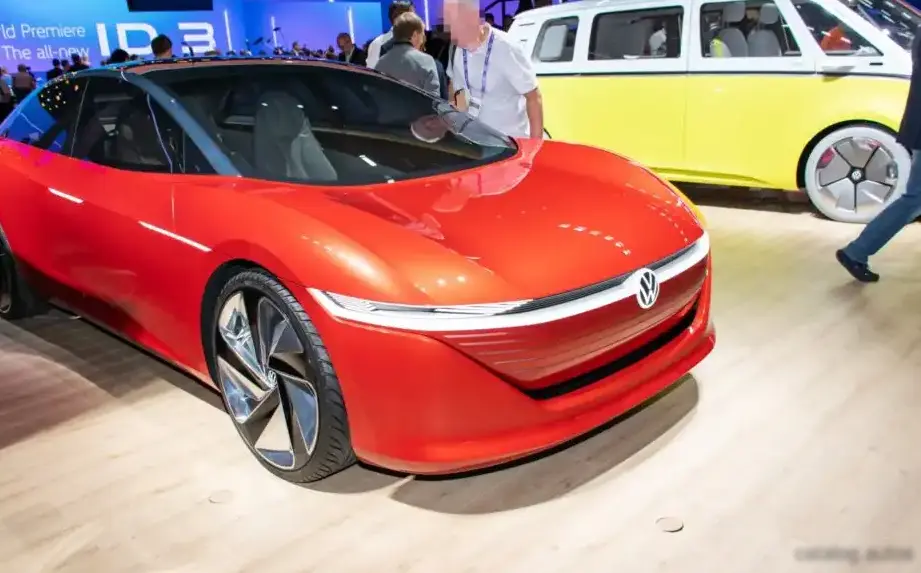
The Volkswagen ID. VIZZION Concept, unveiled in May 2018, represented Volkswagen’s vision for a future fully electric, autonomous luxury sedan. Positioned as a flagship concept, the VIZZION showcased the potential of the MEB (Modular Electric Drive Matrix) platform, intended to underpin a wide range of Volkswagen Group electric vehicles. It was not a production vehicle in itself, but a demonstrator of technology and design cues that would influence subsequent ID. family models. The concept aimed to blend long-range capability with a premium interior experience and advanced driver-assistance systems, anticipating a shift towards self-driving vehicles.
Technical Specifications
| Brand | Volkswagen |
| Model | ID. VIZZION |
| Generation | ID. VIZZION Concept |
| Type (Engine) | 111 kWh (306 Hp) AWD |
| Start of production | May, 2018 |
| End of production | May, 2018 |
| Powertrain Architecture | BEV (Electric Vehicle) |
| Body type | Sedan |
| Seats | 4 |
| Doors | 4 |
| Fuel Type | Electricity |
| Acceleration 0 – 100 km/h | 6.3 sec |
| Acceleration 0 – 62 mph | 6.3 sec |
| Acceleration 0 – 60 mph | 6 sec |
| Maximum speed | 180 km/h (111.85 mph) |
| Gross battery capacity | 111 kWh |
| All-electric range | 665 km (413.21 mi) |
| Electric motor power (Motor 1) | 102 Hp |
| Electric motor power (Motor 2) | 204 Hp |
| System power | 306 Hp |
| Trunk (boot) space – minimum | 565 l (19.95 cu. ft.) |
| Length | 5163 mm (203.27 in.) |
| Width | 1947 mm (76.65 in.) |
| Height | 1506 mm (59.29 in.) |
| Wheelbase | 3100 mm (122.05 in.) |
| Front track | 1660 mm (65.35 in.) |
| Rear (Back) track | 1660 mm (65.35 in.) |
| Drive wheel | All wheel drive (4×4) |
| Number of gears and type of gearbox | 1 gears, automatic transmission |
| Assisting systems | ABS (Anti-lock braking system) |
| Tires size | 255/30 R24 |
| Wheel rims size | 24 |
Powertrain & Engine Architecture
The ID. VIZZION Concept was built around Volkswagen’s MEB platform, a dedicated architecture for electric vehicles. The powertrain consisted of two electric motors – one driving the front wheels and another powering the rear – providing all-wheel drive capability. The front motor produced 102 horsepower, while the rear motor generated 204 horsepower, combining for a total system output of 306 horsepower. The large 111 kWh battery pack, positioned within the vehicle floor, provided an estimated range of 665 kilometers (413.21 miles) under the WLTP cycle. The single-speed automatic transmission, typical of electric vehicles, delivered seamless acceleration. The MEB platform allowed for flexible battery placement and motor configurations, enabling Volkswagen to offer various drivetrain options in future production models.
Driving Characteristics
While a concept vehicle and not subjected to extensive road testing, the ID. VIZZION was projected to offer brisk performance. The all-wheel-drive system and instant torque delivery from the electric motors enabled a 0-62 mph (0-100 km/h) acceleration time of approximately 6.3 seconds. The single-speed transmission provided linear acceleration without the gear changes associated with internal combustion engines. The low center of gravity, due to the battery pack’s placement, was expected to contribute to stable handling. The concept also incorporated advanced driver-assistance systems, including autonomous driving capabilities, which would have further altered the driving experience, potentially allowing for hands-off operation under certain conditions.
Equipment & Trim Levels
As a concept car, the ID. VIZZION featured a highly stylized and technologically advanced interior. The cabin was designed to be a lounge-like environment, emphasizing spaciousness and comfort. The dashboard was minimalist, dominated by a large, interactive display that controlled various vehicle functions. Traditional physical buttons were largely absent, replaced by touch-sensitive controls and voice commands. The seats were upholstered in premium materials, and the interior lighting created a sophisticated ambiance. The concept also showcased advanced augmented reality features, projecting information onto the windshield to enhance the driver’s awareness. Given its concept status, specific trim levels were not defined, but the VIZZION aimed to represent the highest level of luxury and technology that Volkswagen could offer in an electric vehicle.
Chassis & Braking
The ID. VIZZION’s chassis was designed to maximize efficiency and handling. The vehicle utilized an independent suspension system, optimized for ride comfort and stability. The low-slung design and the placement of the battery pack contributed to a low center of gravity, enhancing cornering performance. The braking system incorporated regenerative braking, which captured energy during deceleration and fed it back into the battery, increasing range. Anti-lock braking system (ABS) was standard. The concept car was equipped with large 24-inch wheels and 255/30 R24 tires, contributing to its striking visual appearance and providing ample grip.
Market Reception & Comparison
The ID. VIZZION Concept received generally positive reception from automotive media and industry observers. Critics praised its futuristic design, spacious interior, and long-range capability. The concept was seen as a bold statement of Volkswagen’s commitment to electric mobility and autonomous driving. Compared to other electric vehicle concepts of the time, the VIZZION stood out for its focus on luxury and its integration of advanced driver-assistance systems. While not directly comparable to production vehicles, the VIZZION’s specifications and features positioned it as a competitor to high-end electric sedans from Tesla and other manufacturers. The concept helped to generate excitement around the ID. family of electric vehicles and paved the way for the development of production models like the ID.4 and ID.7.
Legacy
The Volkswagen ID. VIZZION Concept served as a crucial stepping stone in Volkswagen’s transition to electric mobility. Many of the design elements and technological features showcased in the concept car found their way into subsequent ID. family models. The MEB platform, first demonstrated in the VIZZION, became the foundation for a wide range of electric vehicles across the Volkswagen Group. The concept’s emphasis on long-range capability, spacious interiors, and advanced driver-assistance systems influenced the development of production electric vehicles, helping to shape the future of the automotive industry. While the VIZZION itself was never sold to the public, its legacy lives on in the growing number of electric vehicles that are now on the roads.