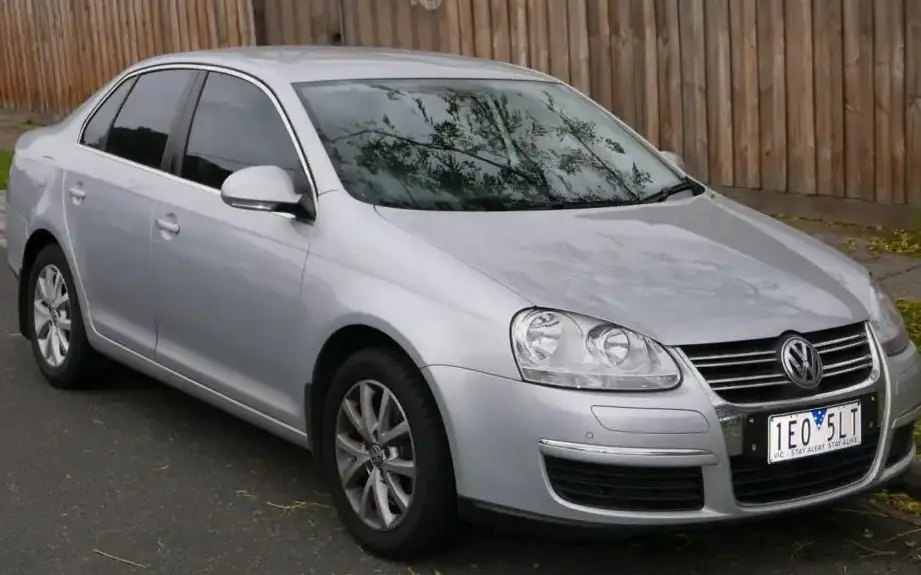
The Volkswagen Jetta V 1.6 i, producing 102 horsepower, was a key variant in the fifth generation of Volkswagen’s popular Jetta sedan, manufactured from 2005 to 2010. Positioned as the entry-level engine option in many markets, particularly in Europe and Latin America, this model aimed to provide affordable and efficient transportation within the compact car segment. It served as a stepping stone into the Jetta range, offering a more economical alternative to the more powerful 1.8T and 2.0T models. While not officially sold in the US market during this generation, the Jetta V was a significant model for Volkswagen globally, and this 1.6-liter variant represented a substantial portion of its sales volume.
Technical Specifications
| Brand | Volkswagen |
| Model | Jetta |
| Generation | Jetta V |
| Type (Engine) | 1.6 i (102 Hp) |
| Start of production | 2005 |
| End of production | 2010 |
| Powertrain Architecture | Internal Combustion engine |
| Body type | Sedan |
| Seats | 5 |
| Doors | 4 |
| Fuel consumption (urban) | 10.1 l/100 km (23.3 US mpg) |
| Fuel consumption (extra urban) | 6.2 l/100 km (37.9 US mpg) |
| Fuel consumption (combined) | 7.6 l/100 km (30.9 US mpg) |
| Fuel Type | Petrol (Gasoline) |
| Acceleration 0 – 100 km/h | 12.2 sec |
| Acceleration 0 – 62 mph | 12.2 sec |
| Acceleration 0 – 60 mph | 11.6 sec |
| Maximum speed | 186 km/h (115.58 mph) |
| Emission standard | Euro 4 |
| Weight-to-power ratio | 12.4 kg/Hp |
| Weight-to-torque ratio | 8.6 kg/Nm |
| Power | 102 Hp @ 5600 rpm |
| Torque | 148 Nm @ 3800 rpm (109.16 lb.-ft. @ 3800 rpm) |
| Engine layout | Front, Transverse |
| Engine Model/Code | BSE, BSF |
| Engine displacement | 1595 cm3 (97.33 cu. in.) |
| Number of cylinders | 4 |
| Engine configuration | Inline |
| Cylinder Bore | 81 mm (3.19 in.) |
| Piston Stroke | 77.4 mm (3.05 in.) |
| Compression ratio | 10.5:1 |
| Number of valves per cylinder | 2 |
| Fuel injection system | Multi-port manifold injection |
| Engine aspiration | Naturally aspirated engine |
| Valvetrain | OHC |
| Engine oil capacity | 4.5 l (4.76 US qt | 3.96 UK qt) |
| Coolant capacity | 8 l (8.45 US qt | 7.04 UK qt) |
| Kerb Weight | 1268 kg (2795.46 lbs.) |
| Max. weight | 1870 kg (4122.64 lbs.) |
| Max load | 602 kg (1327.18 lbs.) |
| Trunk (boot) space – minimum | 527 l (18.61 cu. ft.) |
| Fuel tank capacity | 55 l (14.53 US gal | 12.1 UK gal) |
| Length | 4554 mm (179.29 in.) |
| Width | 1781 mm (70.12 in.) |
| Height | 1459 mm (57.44 in.) |
| Wheelbase | 2578 mm (101.5 in.) |
| Front track | 1534 mm (60.39 in.) |
| Rear track | 1512 mm (59.53 in.) |
| Minimum turning circle | 10.9 m (35.76 ft.) |
| Drivetrain Architecture | Front wheel drive |
| Number of gears | 5 gears, manual transmission |
| Front suspension | Coil spring, Wishbone, Transverse stabilizer |
| Rear suspension | Independent multi-link suspension, Transverse stabilizer |
| Front brakes | Ventilated discs |
| Rear brakes | Disc |
| Assisting systems | ABS (Anti-lock braking system) |
| Steering type | Steering rack and pinion |
| Power steering | Electric Steering |
| Tires size | 205/55 R16 |
| Wheel rims size | 6.5 x 16 |
Powertrain & Engine Architecture
The Jetta V 1.6 i was powered by the Volkswagen EA113 engine family, specifically the BSE or BSF engine code depending on the market and year of production. This 1.6-liter inline-four engine featured a naturally aspirated configuration and a multi-port fuel injection system. The engine utilized a single overhead camshaft (OHC) design with two valves per cylinder. The BSE/BSF engines were known for their relatively simple design, contributing to their reliability and ease of maintenance. The engine’s 102 horsepower output at 5600 rpm and 148 Nm (109 lb-ft) of torque at 3800 rpm were adequate for everyday driving, but didn’t offer particularly sporty performance. The engine was transversely mounted in the front of the vehicle, driving the front wheels. The 5-speed manual transmission was the standard offering, designed to maximize fuel efficiency and provide a comfortable driving experience.
Driving Characteristics
The Jetta V 1.6 i with a manual transmission offered a predictable and user-friendly driving experience. Acceleration was modest, taking around 12.2 seconds to reach 62 mph (100 km/h). The engine felt somewhat strained at higher speeds or when carrying a full load. The gear ratios were optimized for fuel economy rather than outright performance. Compared to the more powerful 1.8T and 2.0T versions, the 1.6 i felt significantly slower, particularly during overtaking maneuvers. However, the lighter engine weight contributed to better handling balance and reduced understeer compared to its more powerful siblings. The clutch feel was generally light, and the gearshift action was precise, making it easy to drive in urban environments.
Equipment & Trim Levels
The 1.6 i Jetta V typically came with a base level of equipment, focusing on essential features. Standard amenities generally included power windows, central locking, air conditioning, and an audio system. Interior upholstery was typically cloth, with a relatively simple dashboard layout. Optional extras included alloy wheels, upgraded audio systems, and a sunroof. Trim levels varied by market, but the 1.6 i generally represented the entry point into the Jetta range, with higher trims offering more luxurious features and upgraded interior materials. Safety features such as ABS and front airbags were standard across the range.
Chassis & Braking
The Jetta V utilized a MacPherson strut front suspension and an independent multi-link rear suspension, providing a comfortable ride quality. The suspension was tuned for everyday driving, prioritizing comfort over sporty handling. Front brakes were ventilated discs, while rear brakes were solid discs. The ABS anti-lock braking system was standard, enhancing braking performance and stability. The steering was rack and pinion with electric power assistance, offering a light and responsive feel. The 1.6 i models typically featured smaller wheels and tires (205/55 R16) compared to the higher-performance trims, contributing to a slightly softer ride.
Market Reception & Comparison
The Jetta V 1.6 i was generally well-received as an affordable and practical family sedan. Critics praised its fuel efficiency and comfortable ride, but noted its lack of outright performance. Compared to the 1.8T and 2.0T models, the 1.6 i offered significantly lower running costs but lacked the same level of driving excitement. The 1.6 i was often seen as a sensible choice for drivers prioritizing economy and reliability over performance. In terms of fuel economy, the 1.6 i consistently outperformed the more powerful engines, achieving around 30.9 US mpg on a combined cycle. Reliability was generally good, with the EA113 engine proving to be durable and relatively trouble-free.
Legacy
The Jetta V 1.6 i remains a relatively common sight on used car markets today. The EA113 engine, while not without its issues (such as potential for oil consumption in some cases), is generally considered reliable and relatively inexpensive to maintain. Parts availability is good, and the car’s simple design makes it accessible to amateur mechanics. The Jetta V 1.6 i represents a solid value proposition for buyers seeking an affordable and practical compact sedan. Its fuel efficiency and comfortable ride continue to appeal to a wide range of drivers, making it a popular choice in the used car market.