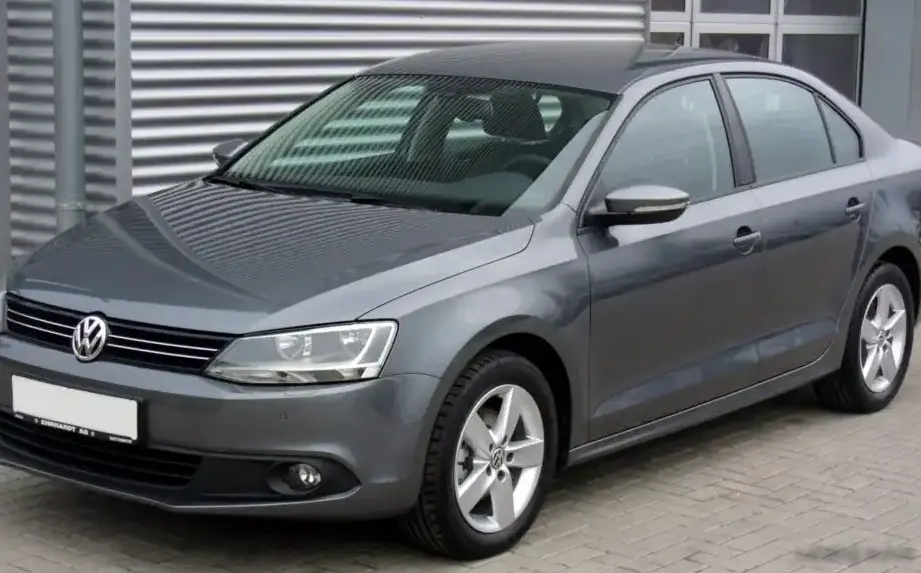
The Volkswagen Jetta VI 1.8 TSI (170 hp) Tiptronic, produced from 2013 to 2014, represented a significant offering within the sixth generation (Jetta VI) of Volkswagen’s popular compact sedan. Positioned as a mid-range trim, it bridged the gap between the more economical base models and the performance-oriented variants like the GLI. This version was primarily aimed at buyers seeking a balance of fuel efficiency, respectable power, and the convenience of an automatic transmission. It played a key role in the Jetta’s continued success in the North American market, where automatics were – and continue to be – highly preferred.
Technical Specifications
| Brand | Volkswagen |
| Model | Jetta |
| Generation | Jetta VI |
| Type (Engine) | 1.8 TSI (170 Hp) Tiptronic |
| Start of production | 2013 |
| End of production | 2014 |
| Powertrain Architecture | Internal Combustion engine |
| Body type | Sedan |
| Seats | 5 |
| Doors | 4 |
| Fuel consumption (economy) – urban (EPA) | 9.4 l/100 km (25 US mpg) |
| Fuel consumption (economy) – extra urban (EPA) | 6.5 l/100 km (36.2 US mpg) |
| Fuel Type | Petrol (Gasoline) |
| Weight-to-power ratio | 8.2 kg/Hp, 122 Hp/tonne |
| Weight-to-torque ratio | 5.6 kg/Nm, 179.3 Nm/tonne |
| Power | 170 Hp @ 4800 rpm |
| Power per litre | 94.5 Hp/l |
| Torque | 250 Nm @ 1500-4750 rpm (184.39 lb.-ft. @ 1500-4750 rpm) |
| Engine layout | Front, Transverse |
| Engine Model/Code | EA888 / CPKA, CPRA |
| Engine displacement | 1798 cm3 (109.72 cu. in.) |
| Number of cylinders | 4 |
| Engine configuration | Inline |
| Cylinder Bore | 82.5 mm (3.25 in.) |
| Piston Stroke | 84.1 mm (3.31 in.) |
| Compression ratio | 9.6:1 |
| Number of valves per cylinder | 4 |
| Fuel injection system | Direct injection |
| Engine aspiration | Turbocharger, Intercooler |
| Valvetrain | DOHC |
| Engine oil capacity | 5.5 l (5.81 US qt | 4.84 UK qt) |
| Coolant | 8 l (8.45 US qt | 7.04 UK qt) |
| Kerb Weight | 1394 kg (3073.24 lbs.) |
| Max. weight | 1941 kg (4279.17 lbs.) |
| Max load | 547 kg (1205.93 lbs.) |
| Trunk (boot) space – minimum | 440 l (15.54 cu. ft.) |
| Fuel tank capacity | 55 l (14.53 US gal | 12.1 UK gal) |
| Length | 4628 mm (182.2 in.) |
| Width | 1778 mm (70 in.) |
| Height | 1453 mm (57.2 in.) |
| Wheelbase | 2651 mm (104.37 in.) |
| Front track | 1541 mm (60.67 in.) |
| Rear (Back) track | 1532 mm (60.31 in.) |
| Ride height (ground clearance) | 139 mm (5.47 in.) |
| Drag coefficient (Cd) | 0.30 |
| Minimum turning circle (turning diameter) | 11.1 m (36.42 ft.) |
| Drivetrain Architecture | The Internal combustion engine (ICE) drives the front wheels of the vehicle. |
| Drive wheel | Front wheel drive |
| Number of gears and type of gearbox | 6 gears, automatic transmission Tiptronic |
| Front suspension | Independent, type McPherson with coil spring and anti-roll bar |
| Rear suspension | Independent multi-link spring suspension with stabilizer |
| Front brakes | Ventilated discs, 287×25 mm |
| Rear brakes | Disc, 272×10 mm |
| Assisting systems | ABS (Anti-lock braking system) |
| Steering type | Steering rack and pinion |
| Power steering | Electric Steering |
| Tires size | 205/55 R16; 225/45 R17 |
| Wheel rims size | 6.5J x 16; 7J x 17 |
Powertrain & Engine Architecture
At the heart of the Jetta VI 1.8 TSI Tiptronic lies the EA888 engine, specifically the CPKA or CPRA variant depending on the exact production date and market. This 1.8-liter inline-four cylinder engine is a turbocharged, direct-injection powerplant. Direct injection allows for precise fuel delivery, improving both power and fuel economy. The turbocharger, coupled with an intercooler, forces more air into the engine, boosting horsepower and torque. The engine utilizes a dual overhead camshaft (DOHC) valvetrain with four valves per cylinder, optimizing airflow for enhanced performance. The ‘TSI’ designation stands for ‘Turbocharged Stratified Injection,’ highlighting the key technologies employed.
The “Tiptronic” transmission is a six-speed automatic transmission with a manual shift mode. This allows drivers to have some control over gear selection, offering a more engaging driving experience when desired. The transmission is electronically controlled, adapting shift points based on driving conditions and throttle input. It’s a conventional torque-converter automatic, prioritizing smooth shifts and ease of use over the more aggressive, performance-focused dual-clutch transmissions (DSG) found in other Jetta variants.
Driving Characteristics
The 170 hp and 184 lb-ft of torque provided by the 1.8 TSI engine, when paired with the six-speed Tiptronic automatic, resulted in a comfortable and capable driving experience. Acceleration was adequate for everyday driving, with a 0-60 mph time estimated around 8.5-9 seconds. While not as quick as the Jetta GLI with its more powerful engine and sport-tuned suspension, the 1.8 TSI offered a more relaxed and refined ride. The automatic transmission prioritized smooth shifts, making it ideal for commuting and long highway drives. The Tiptronic function allowed for some driver involvement, but the transmission wasn’t particularly quick to respond to manual shifts. Compared to the six-speed manual transmission available on other Jetta models, the automatic resulted in a slight decrease in fuel economy and a less engaging driving experience, but offered greater convenience.
Equipment & Trim Levels
The Jetta VI 1.8 TSI Tiptronic typically came standard with features such as air conditioning, power windows and locks, a basic audio system with CD player, and alloy wheels. Higher trim levels, often bundled with optional packages, added features like a sunroof, upgraded audio system with touchscreen display, heated front seats, and a rearview camera. Interior upholstery was typically cloth, with leatherette or full leather options available as upgrades. The dashboard layout was functional and straightforward, with a focus on ergonomics.
Chassis & Braking
The Jetta VI utilized an independent McPherson strut suspension in the front and an independent multi-link suspension in the rear. This setup provided a good balance of ride comfort and handling. The front suspension incorporated a stabilizer bar to reduce body roll during cornering. Braking duties were handled by ventilated discs in the front and solid discs in the rear. Anti-lock braking system (ABS) was standard. The suspension tuning was geared towards comfort rather than outright sportiness, making it well-suited for everyday driving conditions.
Market Reception & Comparison
The Jetta VI 1.8 TSI Tiptronic was generally well-received by automotive critics. It was praised for its comfortable ride, fuel efficiency, and the convenience of the automatic transmission. However, some reviewers noted that the engine lacked the punch of the more powerful options, and the automatic transmission wasn’t as responsive as a manual or dual-clutch transmission. Compared to the Jetta 2.0 TDI, the 1.8 TSI offered slightly less fuel economy but a more refined driving experience. Against the Jetta GLI, it sacrificed performance for a lower price point and a more comfortable ride.
Legacy
The EA888 1.8 TSI engine, in general, has proven to be a relatively reliable powerplant, although it’s not without its potential issues. Common concerns include carbon buildup on the intake valves (requiring periodic cleaning) and potential oil consumption issues. The Tiptronic transmission is generally durable, but like any automatic transmission, it requires regular fluid changes to maintain optimal performance. Today, the Jetta VI 1.8 TSI Tiptronic represents a reasonably affordable and practical used car option. Its combination of fuel efficiency, comfort, and reliability makes it a popular choice for budget-conscious buyers seeking a dependable compact sedan.