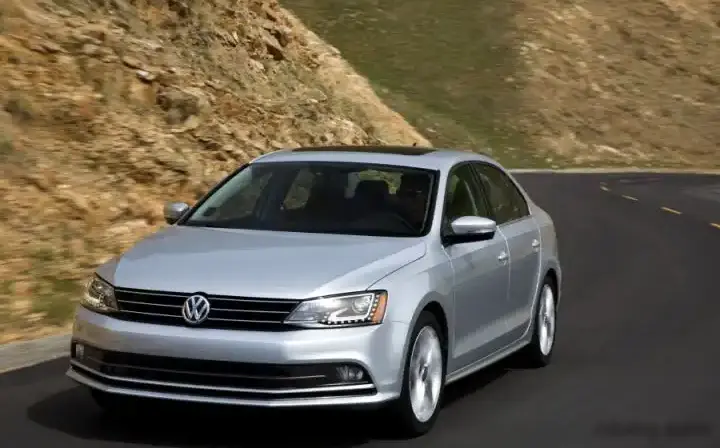
The Volkswagen Jetta VI facelift, produced from 2014 to 2015, represented a mid-cycle refresh of the sixth-generation Jetta (introduced in 2011). The 2.0-liter (115 hp) Tiptronic variant occupied a middle ground in the Jetta lineup, offering a balance between affordability and convenience. Positioned above the base 1.8L models and below the more powerful and sporty GLI, this configuration aimed to appeal to buyers seeking a comfortable and practical sedan with an automatic transmission. It was primarily sold in the North American market, where automatic transmissions were – and continue to be – highly preferred. This model was built on the A6 platform, shared with other Volkswagen Group vehicles like the Golf, Scirocco, and Audi A3.
Technical Specifications
| Brand | Volkswagen |
| Model | Jetta |
| Generation | Jetta VI (facelift 2014) |
| Type (Engine) | 2.0 (115 Hp) Tiptronic |
| Start of production | 2014 |
| End of production | 2015 |
| Powertrain Architecture | Internal Combustion engine |
| Body type | Sedan |
| Seats | 5 |
| Doors | 4 |
| Fuel consumption (economy) – urban (EPA) | 10.2 l/100 km (23.1 US mpg) |
| Fuel consumption (economy) – extra urban (EPA) | 6.9 l/100 km (34.1 US mpg) |
| Fuel Type | Petrol (Gasoline) |
| Weight-to-power ratio | 11.6 kg/Hp, 86.2 Hp/tonne |
| Weight-to-torque ratio | 7.8 kg/Nm, 127.4 Nm/tonne |
| Power | 115 Hp @ 5200 rpm |
| Power per litre | 58 Hp/l |
| Torque | 170 Nm @ 4000 rpm (125.39 lb.-ft. @ 4000 rpm) |
| Engine layout | Front, Transverse |
| Engine Model/Code | CBPA |
| Engine displacement | 1984 cm3 (121.07 cu. in.) |
| Number of cylinders | 4 |
| Engine configuration | Inline |
| Cylinder Bore | 82.5 mm (3.25 in.) |
| Piston Stroke | 92.8 mm (3.65 in.) |
| Compression ratio | 10.3:1 |
| Number of valves per cylinder | 2 |
| Fuel injection system | Multi-port manifold injection |
| Engine aspiration | Naturally aspirated engine |
| Valvetrain | SOHC |
| Engine oil capacity | 4 l (4.23 US qt | 3.52 UK qt) |
| Coolant | 5 l (5.28 US qt | 4.4 UK qt) |
| Kerb Weight | 1334 kg (2940.97 lbs.) |
| Max. weight | 1910 kg (4210.83 lbs.) |
| Max load | 576 kg (1269.86 lbs.) |
| Trunk (boot) space – minimum | 445 l (15.72 cu. ft.) |
| Fuel tank capacity | 55 l (14.53 US gal | 12.1 UK gal) |
| Length | 4659 mm (183.43 in.) |
| Width | 1778 mm (70 in.) |
| Height | 1453 mm (57.2 in.) |
| Wheelbase | 2651 mm (104.37 in.) |
| Front track | 1535 mm (60.43 in.) |
| Rear (Back) track | 1532 mm (60.31 in.) |
| Ride height (ground clearance) | 132 mm (5.2 in.) |
| Drag coefficient (Cd) | 0.30 |
| Minimum turning circle (turning diameter) | 11.1 m (36.42 ft.) |
| Drivetrain Architecture | The Internal combustion engine (ICE) drives the front wheels of the vehicle. |
| Drive wheel | Front wheel drive |
| Number of gears and type of gearbox | 6 gears, automatic transmission Tiptronic |
| Front suspension | Independent, type McPherson with coil spring and anti-roll bar |
| Rear suspension | Independent multi-link spring suspension with stabilizer |
| Front brakes | Ventilated discs, 287×25 mm |
| Rear brakes | Disc, 272×10 mm |
| Assisting systems | ABS (Anti-lock braking system) |
| Steering type | Steering rack and pinion |
| Power steering | Hydraulic Steering |
| Tires size | 195/65 R15 |
| Wheel rims size | 6J x 15 |
Powertrain & Engine Architecture
The heart of the Jetta 2.0 Tiptronic was the CBPA engine, a 1.984-liter inline-four cylinder gasoline engine. This engine was a member of Volkswagen’s EA888 family, known for its relatively simple design and durability. It featured a single overhead camshaft (SOHC) valvetrain operating two valves per cylinder. Fuel delivery was handled by a multi-port fuel injection system, a common setup for engines of this era. The CBPA engine produced 115 horsepower at 5200 rpm and 170 Nm (125 lb-ft) of torque at 4000 rpm. The engine’s relatively modest output was a trade-off for improved fuel economy and reduced complexity compared to the turbocharged engines offered in higher trims.
The “Tiptronic” transmission was a six-speed automatic gearbox. It offered both fully automatic operation and a manual shift mode, allowing drivers to select gears for more control. While not as sporty or efficient as a dual-clutch transmission (DCT), the Tiptronic provided smooth and predictable shifts, making it well-suited for everyday driving. The transmission was designed to prioritize comfort and ease of use over outright performance.
Driving Characteristics
The 2.0-liter Tiptronic Jetta offered a comfortable and predictable driving experience. Acceleration was adequate for daily commuting and highway merging, but it wasn’t particularly quick. The 0-60 mph time was estimated to be around 10-11 seconds. The automatic transmission’s gear ratios were tuned for fuel efficiency and smooth operation, rather than aggressive acceleration. Compared to the manual transmission version of the same engine, the Tiptronic model felt slightly less responsive due to the transmission’s inherent power loss and shift delays. Compared to the more powerful 2.5L five-cylinder engine available in some Jetta models, the 2.0L Tiptronic felt noticeably less potent, but it offered better fuel economy.
Equipment & Trim Levels
The 2.0 Tiptronic Jetta typically came standard with features like air conditioning, power windows and locks, a basic audio system, and steel wheels with wheel covers. Higher trim levels, such as the SE and SEL, added features like alloy wheels, a more advanced audio system, heated front seats, and a sunroof. Optional extras included a navigation system, leather upholstery, and a premium sound system. The interior generally featured durable, if somewhat basic, materials. The dashboard layout was functional and straightforward, prioritizing usability over aesthetics.
Chassis & Braking
The Jetta VI utilized an independent McPherson strut suspension in the front and an independent multi-link suspension in the rear. This setup provided a comfortable ride and decent handling characteristics. The front suspension included a stabilizer bar to reduce body roll. Braking duties were handled by ventilated discs in the front and solid discs in the rear. Anti-lock brakes (ABS) were standard. The suspension tuning was geared towards comfort, resulting in a relatively soft ride quality. The braking system was adequate for everyday driving, but it wasn’t particularly powerful.
Market Reception & Comparison
The 2.0-liter Tiptronic Jetta was generally well-received as a practical and affordable sedan. Critics praised its comfortable ride, spacious interior, and fuel efficiency. However, some reviewers noted its lack of excitement and relatively modest performance. Compared to the 1.8L models, the 2.0L offered a noticeable increase in power, while the 2.5L provided even more performance but at the cost of fuel economy. The Tiptronic transmission was seen as a convenient option for drivers who preferred the ease of an automatic, but it wasn’t as engaging as a manual transmission.
Legacy
The CBPA engine and Tiptronic transmission combination proved to be relatively reliable. Common issues included occasional transmission glitches and oil leaks. However, these were generally not major problems and could often be addressed with routine maintenance. Today, these Jettas are relatively affordable on the used car market. They represent a good value for buyers seeking a dependable and fuel-efficient sedan. While not a particularly exciting car, the 2.0 Tiptronic Jetta remains a practical and reasonably reliable choice for everyday transportation.