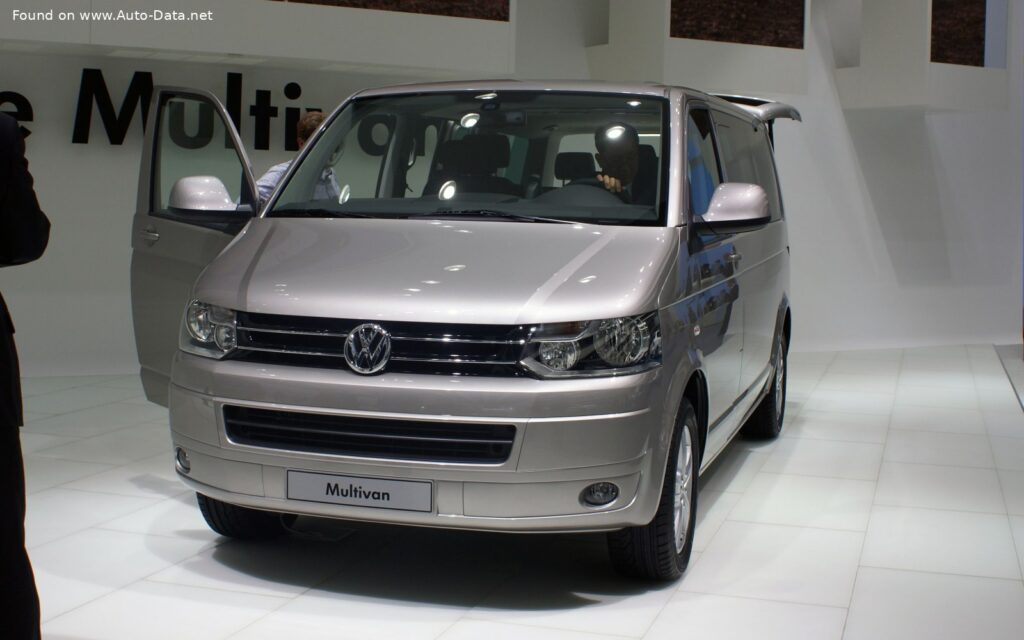
The Volkswagen Multivan (T5), particularly the facelifted version introduced in 2009, represented a significant evolution of Volkswagen’s popular van platform. Produced from 2009 through 2016, the T5 Multivan offered a blend of practicality, comfort, and increasingly sophisticated technology. Among the various engine options available, the 2.0 TDI with 180 horsepower (BMT – BlueMotion Technology) became a popular choice, balancing fuel efficiency with adequate performance for family and leisure use. This variant occupied a mid-range position within the T5 Multivan lineup, offering a step up in power and refinement compared to lower-powered diesel options, while remaining more accessible than the more expensive and performance-oriented gasoline engines.
Volkswagen Multivan T5 (2009-2016) 2.0 TDI (180 Hp) BMT: An Overview
The T5 facelift, launched in 2009, brought with it revised styling, improved interior materials, and updated engine technology. The 2.0 TDI 180 BMT engine was a key component of this refresh, designed to meet stricter Euro 5 emissions standards while delivering a compelling driving experience. The “BMT” designation indicated the inclusion of BlueMotion Technology, a suite of fuel-saving measures including optimized engine management, low rolling resistance tires, and aerodynamic enhancements. This engine was offered across a range of T5 Multivan configurations, including Comfortline, Highline, and Trendline trims, with varying levels of standard equipment.
Powertrain & Engine Architecture
The heart of the Multivan T5 2.0 TDI (180 Hp) BMT is the CFCA engine code, a 1968cc (120.09 cubic inches) inline four-cylinder diesel engine. This engine utilizes a common rail direct injection system, delivering fuel directly into the combustion chamber at extremely high pressure for improved efficiency and reduced emissions. A key feature of this engine is its bi-turbocharger setup. The two turbochargers – a smaller, more responsive unit for low-end torque and a larger unit for high-end power – work in sequence to provide a broad and usable powerband. The engine also incorporates an intercooler to cool the compressed intake air, further enhancing performance. The engine produces 180 horsepower at 4000 rpm and 400 Nm (295.02 lb-ft) of torque between 1500 and 2000 rpm. The engine features 4 valves per cylinder and a timing belt.
The 2.0 TDI 180 BMT was typically paired with a six-speed manual transmission, although a seven-speed dual-clutch transmission (DSG) was also available as an option. The manual transmission offered precise gear changes and a more engaging driving experience, while the DSG provided smoother, faster shifts and improved fuel economy. The drivetrain is front-wheel drive, which is standard for most T5 Multivan configurations. All-wheel drive (4MOTION) was available as an option, providing enhanced traction in challenging conditions.
Driving Characteristics
The 2.0 TDI 180 BMT-equipped Multivan T5 offered a good balance between performance and fuel economy. While not a sports van, the 180 horsepower and 400 Nm of torque provided sufficient power for comfortable cruising on the highway and effortless overtaking. The bi-turbocharger setup minimized turbo lag, delivering a responsive and linear power delivery. Acceleration from 0-100 km/h (0-62 mph) took approximately 11.4 seconds, and the top speed was around 191 km/h (118.68 mph). The six-speed manual transmission allowed drivers to keep the engine in its optimal powerband, while the optional DSG provided seamless gear changes. Compared to the lower-powered 2.0 TDI variants, the 180 BMT offered a noticeable improvement in performance, particularly when fully loaded with passengers and luggage. However, it didn’t quite match the outright acceleration of the gasoline engines, such as the 2.0 TSI.
Equipment & Trim Levels
The 2.0 TDI 180 BMT engine was available across various trim levels of the T5 Multivan, each offering a different level of standard equipment. The base Trendline trim typically included features such as air conditioning, power windows, central locking, and a basic audio system. The Comfortline trim added features like alloy wheels, a multi-function steering wheel, and upgraded interior trim. The Highline trim, the most luxurious option, included features such as leather upholstery, climate control, a premium audio system, and parking sensors. Optional extras available for the 2.0 TDI 180 BMT included a panoramic sunroof, navigation system, rear parking camera, and various driver assistance systems. Interior upholstery varied depending on the trim level, ranging from cloth in the Trendline to leather in the Highline. The dashboard configuration was generally consistent across all trims, with a functional and ergonomic layout.
Chassis & Braking
The T5 Multivan’s chassis was designed to provide a comfortable and stable ride, even when fully loaded. The front suspension utilized MacPherson struts, while the rear suspension employed a semi-independent trailing arm setup. Stabilizer bars were fitted to both the front and rear axles to reduce body roll during cornering. The braking system consisted of ventilated disc brakes on the front wheels and either disc or drum brakes on the rear wheels, depending on the trim level and optional equipment. Anti-lock braking system (ABS) was standard on all models. The steering system utilized a rack and pinion setup, providing precise and responsive steering feel. The weight distribution of the Multivan T5, combined with the robust suspension and braking system, contributed to its confident handling characteristics.
Market Reception & Comparison
The Volkswagen Multivan T5 2.0 TDI 180 BMT was generally well-received by automotive critics and consumers alike. It was praised for its blend of practicality, comfort, and fuel efficiency. The bi-turbocharger setup was particularly lauded for its responsiveness and broad powerband. Compared to the lower-powered diesel variants, the 180 BMT offered a significant improvement in performance, making it a more suitable choice for drivers who frequently carried passengers or luggage. Fuel economy was also a strong point, with combined fuel consumption figures of around 7.3 l/100 km (32.2 US mpg). In terms of reliability, the 2.0 TDI engine proved to be generally robust, although some owners reported issues with the diesel particulate filter (DPF) and turbocharger. Compared to the gasoline engines, the 2.0 TDI 180 BMT offered superior fuel economy and lower running costs.
Technical Specifications
| Brand | Volkswagen |
| Model | Multivan (T5, facelift 2009) |
| Type (Engine) | 2.0 TDI (180 Hp) BMT |
| Start of production | 2009 |
| End of production | 2016 |
| Fuel consumption (urban) | 8.9 l/100 km (26.4 US mpg) |
| Fuel consumption (extra urban) | 6.4 l/100 km (36.8 US mpg) |
| Fuel consumption (combined) | 7.3 l/100 km (32.2 US mpg) |
| CO2 emissions | 192 g/km |
| Fuel Type | Diesel |
| Acceleration 0 – 100 km/h | 11.4 sec |
| Acceleration 0 – 62 mph | 11.4 sec |
| Maximum speed | 191 km/h (118.68 mph) |
| Engine Model/Code | CFCA |
| Engine displacement | 1968 cm3 (120.09 cu. in.) |
| Number of cylinders | 4 |
| Engine configuration | Inline |
| Fuel injection system | Diesel Commonrail |
| Engine aspiration | BiTurbo, Intercooler |
| Kerb Weight | 2169 kg (4781.83 lbs.) |
| Max. weight | 3000 kg (6613.87 lbs.) |
| Number of gears | 6 |
| Gearbox type | Manual transmission |
Legacy
The Volkswagen Multivan T5 2.0 TDI 180 BMT remains a popular choice in the used car market today. Its reputation for reliability, practicality, and fuel efficiency has ensured strong demand. While older examples may require maintenance on components such as the DPF and turbocharger, the engine itself is generally considered to be robust. The T5 Multivan’s spacious interior, comfortable ride, and versatile configuration make it an ideal vehicle for families, adventurers, and anyone who needs a practical and reliable van. The 2.0 TDI 180 BMT variant strikes a particularly good balance between performance and economy, making it a well-rounded and desirable option in the used van market.