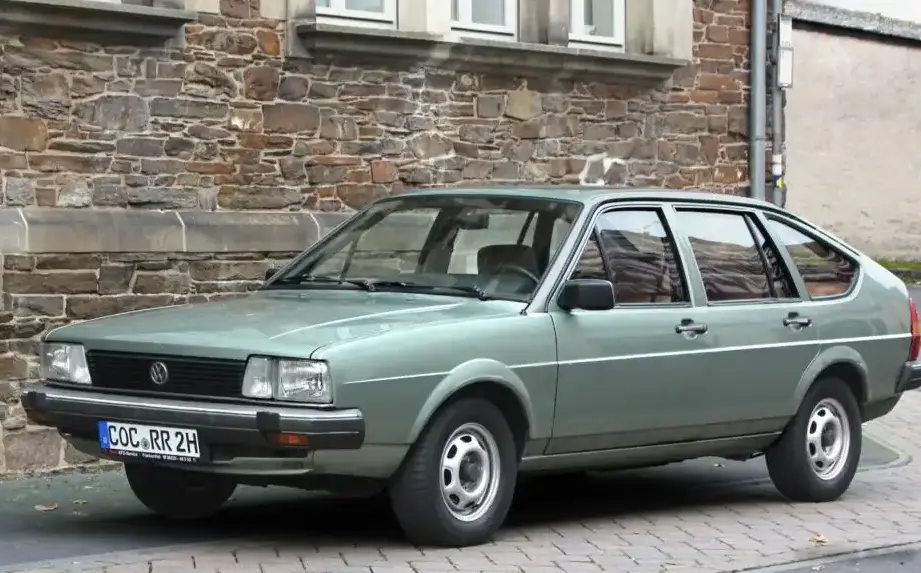
The Volkswagen Passat B2 1.6 D, produced from 1980 to 1988, represented a crucial entry point into the Passat range for European buyers. Positioned as the most economical variant, it catered to drivers prioritizing fuel efficiency and practicality over outright performance. This model, powered by a naturally aspirated 1.6-liter diesel engine producing 54 horsepower, was a mainstay of the B2 generation (1980-1988), which itself was a significant evolution of the original Passat, offering increased space and a more modern design. The B2 Passat was Volkswagen’s mid-size offering, competing with vehicles like the Ford Taunus, Opel Ascona, and Fiat Croma.
Technical Specifications
| Brand | Volkswagen |
| Model | Passat |
| Generation | Passat (B2) |
| Type (Engine) | 1.6 D (54 Hp) |
| Start of production | 1980 |
| End of production | 1988 |
| Powertrain Architecture | Internal Combustion engine |
| Body type | Hatchback |
| Seats | 5 |
| Doors | 5 |
| Fuel Type | Diesel |
| Acceleration 0 – 100 km/h | 20.5 sec |
| Acceleration 0 – 62 mph | 20.5 sec |
| Acceleration 0 – 60 mph | 19.5 sec |
| Maximum speed | 143 km/h (88.86 mph) |
| Weight-to-power ratio | 17.7 kg/Hp, 56.5 Hp/tonne |
| Weight-to-torque ratio | 9.4 kg/Nm, 106.8 Nm/tonne |
| Power | 54 Hp @ 4800 rpm |
| Power per litre | 34 Hp/l |
| Torque | 102 Nm @ 2000 rpm (75.23 lb.-ft. @ 2000 rpm) |
| Engine layout | Front, Longitudinal |
| Engine Model/Code | JK |
| Engine displacement | 1588 cm3 (96.91 cu. in.) |
| Number of cylinders | 4 |
| Engine configuration | Inline |
| Cylinder Bore | 76.5 mm (3.01 in.) |
| Piston Stroke | 86.4 mm (3.4 in.) |
| Compression ratio | 23:1 |
| Number of valves per cylinder | 2 |
| Fuel injection system | Precombustion chamber injection |
| Engine aspiration | Naturally aspirated engine |
| Valvetrain | OHC |
| Engine oil capacity | 3.5 l (3.7 US qt | 3.08 UK qt) |
| Coolant | 7 l (7.4 US qt | 6.16 UK qt) |
| Kerb Weight | 955 kg (2105.41 lbs.) |
| Max. weight | 1460 kg (3218.75 lbs.) |
| Max load | 505 kg (1113.33 lbs.) |
| Trunk (boot) space – minimum | 480 l (16.95 cu. ft.) |
| Trunk (boot) space – maximum | 1542 l (54.46 cu. ft.) |
| Fuel tank capacity | 70 l (18.49 US gal | 15.4 UK gal) |
| Length | 4435 mm (174.61 in.) |
| Width | 1685 mm (66.34 in.) |
| Height | 1385 mm (54.53 in.) |
| Wheelbase | 2550 mm (100.39 in.) |
| Front track | 1400 mm (55.12 in.) |
| Rear (Back) track | 1408 mm (55.43 in.) |
| Drivetrain Architecture | The Internal combustion engine (ICE) drives the front wheels of the vehicle. |
| Drive wheel | Front wheel drive |
| Number of gears and type of gearbox | 4 gears, manual transmission |
| Front suspension | Independent type McPherson |
| Rear suspension | Coil spring |
| Front brakes | Disc |
| Rear brakes | Drum |
| Steering type | Steering rack and pinion |
| Tires size | 175/70 R13 |
| Wheel rims size | 13 |
Powertrain & Engine Architecture
The heart of the Passat 1.6 D was the JK engine, a 1.6-liter inline-four diesel. This engine utilized precombustion chamber injection, a common diesel technology of the era. This system involved injecting fuel into a small precombustion chamber connected to the main cylinder, where it was partially ignited before entering the main combustion chamber. This aided in cold starting and reduced engine noise compared to direct injection systems. The engine featured a single overhead camshaft (OHC) operating two valves per cylinder. The 54 horsepower output was achieved at 4800 rpm, while peak torque of 102 Nm (75.23 lb-ft) arrived at 2000 rpm. The engine was mounted longitudinally in the front of the vehicle, driving the front wheels. The standard transmission was a four-speed manual gearbox, optimized for fuel economy rather than rapid acceleration.
Driving Characteristics
The Passat 1.6 D was not known for its performance. Acceleration was leisurely, with a 0-60 mph time hovering around 19.5 seconds. Top speed was around 88.86 mph. The four-speed manual transmission featured relatively long gear ratios, prioritizing fuel efficiency and reducing engine strain. Compared to the later 1.8-liter gasoline versions or the more powerful diesel variants, the 1.6 D felt significantly underpowered, especially when fully loaded or tackling inclines. However, its strength lay in its fuel economy and relaxed driving experience. The suspension, while basic, provided a reasonably comfortable ride, and the steering offered adequate feedback for everyday driving.
Equipment & Trim Levels
The 1.6 D typically represented the base trim level of the B2 Passat. Standard equipment included cloth upholstery, basic instrumentation, and manual windows and door locks. Optional extras included a sunroof, upgraded stereo systems, and more comfortable seating. Interior trim was generally functional and durable, reflecting the car’s focus on practicality. The dashboard layout was straightforward, with clearly marked gauges and controls. Air conditioning was a relatively rare option on this base model.
Chassis & Braking
The Passat B2 featured an independent McPherson strut front suspension and a coil spring rear suspension. This setup provided a good balance between ride comfort and handling. Front brakes were discs, offering adequate stopping power, while the rear brakes were drums, a cost-saving measure common on base models. The steering was a rack and pinion system, providing reasonable precision. The 1.6 D models typically rode on 13-inch wheels with 175/70 R13 tires. Stabilizer bars were often omitted on the base models to further reduce cost.
Market Reception & Comparison
The Passat 1.6 D was well-received in markets where fuel economy was a primary concern. Critics acknowledged its practicality and affordability, but often noted its lack of performance. Compared to the gasoline-powered Passat variants, the 1.6 D offered significantly better fuel economy, but at the expense of acceleration and overall refinement. The 1.6 D was often seen as a sensible choice for fleet operators and private buyers seeking a reliable and economical family car. Its simplicity also meant lower maintenance costs compared to more complex engine options.
Legacy
The JK engine, while not renowned for its power, proved to be remarkably durable. Many Passat 1.6 D models have survived to this day, a testament to the engine’s robust construction and relatively simple design. In the used car market, these models are often sought after by enthusiasts looking for a classic Volkswagen that is relatively affordable to maintain. While not a performance icon, the Passat 1.6 D played a vital role in establishing the B2 Passat as a popular and practical family car, and remains a recognizable and appreciated part of Volkswagen’s history.