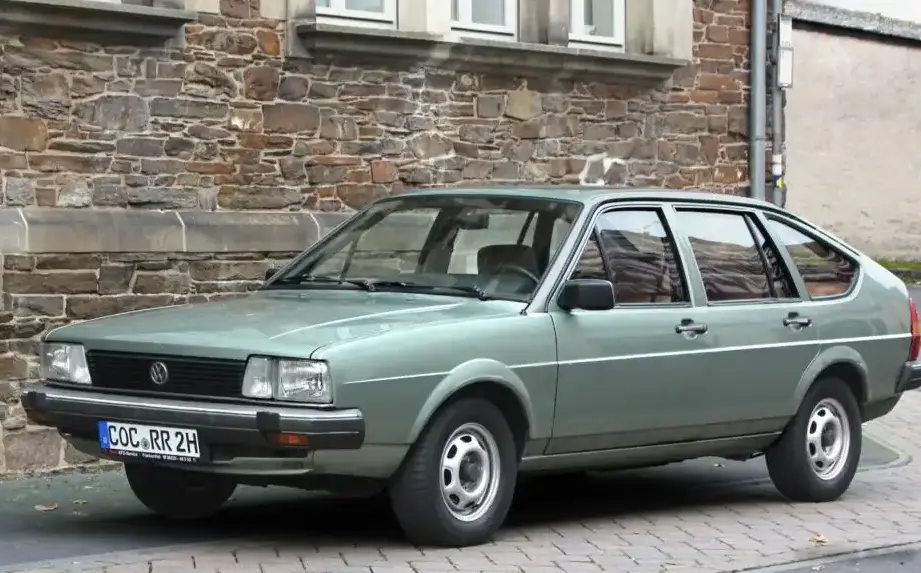
The Volkswagen Passat B2, produced between 1981 and 1988, represented a significant evolution in Volkswagen’s mid-size offering. Replacing the original Passat (Type 32), the B2 was a more modern, angular design built on the updated A2 platform, shared with the Audi 80. Within the B2 range, the 1.9-liter (115 hp) variant, available from 1981-1983, occupied a middle ground in the lineup, offering a balance between performance and affordability. It was positioned above the base 1.6-liter models and below the more powerful and expensive GTI and later 1.8L options. This model was primarily aimed at the European market, where fuel efficiency and practicality were highly valued.
Technical Specifications
| Brand | Volkswagen |
| Model | Passat |
| Generation | Passat (B2) |
| Type (Engine) | 1.9 (115 Hp) |
| Start of production | 1981 |
| End of production | 1983 |
| Powertrain Architecture | Internal Combustion engine |
| Body type | Hatchback |
| Seats | 5 |
| Doors | 5 |
| Fuel Type | Petrol (Gasoline) |
| Acceleration 0 – 100 km/h | 10.9 sec |
| Acceleration 0 – 62 mph | 10.9 sec |
| Acceleration 0 – 60 mph | 10.4 sec |
| Maximum speed | 188 km/h (116.82 mph) |
| Weight-to-power ratio | 8.9 kg/Hp, 112.2 Hp/tonne |
| Weight-to-torque ratio | 6.7 kg/Nm, 150.2 Nm/tonne |
| Power | 115 Hp @ 5900 rpm |
| Power per litre | 59.9 Hp/l |
| Torque | 154 Nm @ 3700 rpm (113.58 lb.-ft. @ 3700 rpm) |
| Engine Model/Code | WN |
| Engine displacement | 1921 cm3 (117.23 cu. in.) |
| Number of cylinders | 5 |
| Cylinder Bore | 79.5 mm (3.13 in.) |
| Piston Stroke | 77.4 mm (3.05 in.) |
| Compression ratio | 10:1 |
| Number of valves per cylinder | 2 |
| Fuel injection system | Multi-port manifold injection |
| Engine aspiration | Naturally aspirated engine |
| Valvetrain | OHC |
| Engine oil capacity | 3 l (3.17 US qt | 2.64 UK qt) |
| Coolant | 4 l (4.23 US qt | 3.52 UK qt) |
| Kerb Weight | 1025 kg (2259.74 lbs.) |
| Max. weight | 1550 kg (3417.17 lbs.) |
| Max load | 525 kg (1157.43 lbs.) |
| Trunk (boot) space – minimum | 480 l (16.95 cu. ft.) |
| Trunk (boot) space – maximum | 1542 l (54.46 cu. ft.) |
| Fuel tank capacity | 70 l (18.49 US gal | 15.4 UK gal) |
| Length | 4435 mm (174.61 in.) |
| Width | 1685 mm (66.34 in.) |
| Height | 1385 mm (54.53 in.) |
| Wheelbase | 2550 mm (100.39 in.) |
| Front track | 1400 mm (55.12 in.) |
| Rear (Back) track | 1408 mm (55.43 in.) |
| Drivetrain Architecture | The Internal combustion engine (ICE) drives the front wheels of the vehicle. |
| Drive wheel | Front wheel drive |
| Number of gears and type of gearbox | 5 gears, manual transmission |
| Front suspension | Independent type McPherson |
| Rear suspension | Coil spring |
| Front brakes | Ventilated discs |
| Rear brakes | Drum |
| Tires size | 175/70 R13 |
| Wheel rims size | 13 |
Powertrain & Engine Architecture
The heart of this Passat variant was the Volkswagen WN engine, a 1.9-liter inline-five cylinder gasoline engine. This engine was a relatively simple design, featuring a single overhead camshaft (OHC) operating two valves per cylinder. The WN engine utilized Bosch K-Jetronic multi-port fuel injection, a mechanical system known for its reliability and relatively good fuel economy for the time. While not as sophisticated as later electronic fuel injection systems, K-Jetronic provided precise fuel metering, contributing to the engine’s smooth operation. The five-cylinder configuration, while unusual for the class, offered a good balance of refinement and power. The engine produced 115 horsepower at 5900 rpm and 154 Nm (113.58 lb-ft) of torque at 3700 rpm. The engine was mated to a five-speed manual transmission, providing a reasonable level of control for the driver.
Driving Characteristics
The 1.9-liter Passat B2 offered a comfortable and practical driving experience. Acceleration was adequate, with a 0-60 mph time of around 10.4 seconds, but it wasn’t a particularly sporty car. The five-speed manual transmission allowed for efficient cruising on the Autobahn, while the engine provided enough power for overtaking maneuvers. Compared to the more powerful GTI models, the 1.9-liter felt noticeably slower, but it offered better fuel economy and a more relaxed driving experience. The gear ratios were well-chosen for everyday driving, with a focus on maximizing fuel efficiency. The front-wheel-drive layout provided predictable handling, although it wasn’t as engaging as rear-wheel-drive alternatives.
Equipment & Trim Levels
The 1.9-liter Passat B2 typically came with a fairly basic level of equipment. Standard features included cloth upholstery, a basic stereo system, and manual windows and door locks. Optional extras included power windows, central locking, a sunroof, and upgraded stereo systems. Interior trim levels varied depending on the market, but generally featured durable materials and a functional design. The dashboard layout was straightforward and easy to use, with clearly labeled controls. The Passat B2 offered a spacious interior for its class, with ample room for five passengers and a generous cargo area.
Chassis & Braking
The Passat B2 featured an independent McPherson strut front suspension and a coil spring rear suspension. This setup provided a comfortable ride and decent handling characteristics. The front brakes were ventilated discs, providing good stopping power, while the rear brakes were drums. The steering was rack-and-pinion, offering precise and responsive control. The suspension was tuned for comfort rather than outright performance, but it provided a stable and predictable ride even when fully loaded. Stabilizer bars were fitted to both the front and rear axles to reduce body roll during cornering.
Market Reception & Comparison
The 1.9-liter Passat B2 was generally well-received by critics as a practical and reliable family car. It offered a good balance of performance, fuel economy, and affordability. Compared to other cars in its class, such as the Ford Sierra and Opel Ascona, the Passat B2 was praised for its spacious interior, comfortable ride, and build quality. However, some critics noted that the engine lacked the refinement and power of some of its competitors. Fuel economy was a strong point, with the 1.9-liter engine returning around 30-35 mpg in mixed driving conditions. Reliability was generally good, although the K-Jetronic fuel injection system could require occasional maintenance.
Legacy
The Volkswagen Passat B2 1.9-liter (115 hp) remains a popular choice among classic car enthusiasts today. The WN engine is known for its durability and relatively simple maintenance requirements. Parts availability is generally good, although some components may be difficult to find. These cars are often sought after for their practicality, reliability, and classic styling. While not a high-performance model, the 1.9-liter Passat B2 offers a comfortable and enjoyable driving experience, making it a worthy addition to any classic car collection. Well-maintained examples continue to command reasonable prices in the used car market, reflecting their enduring appeal.