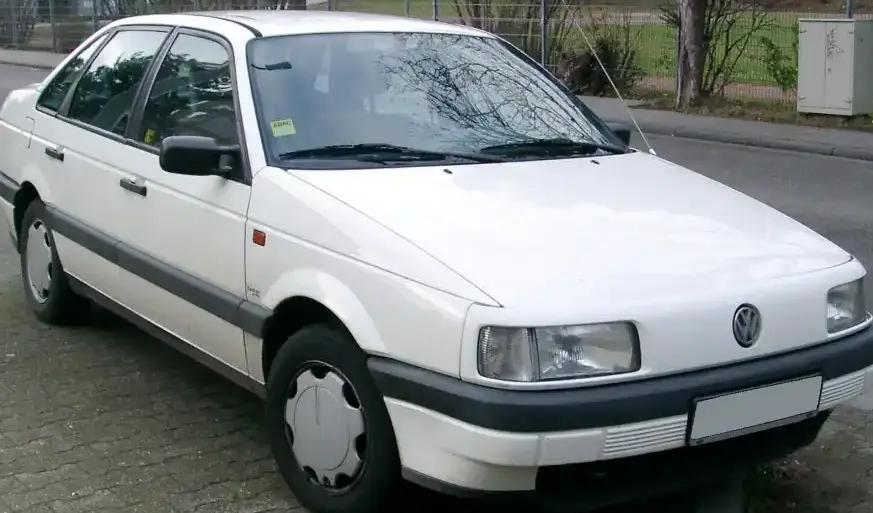
The Volkswagen Passat B3, manufactured between 1988 and 1993, marked a significant evolution in Volkswagen’s mid-size car lineup. The 1.6-liter (72 hp) variant, available throughout the B3’s production run, served as the entry-level model in many European markets. Positioned below the more potent 1.8 and 2.0-liter options, and distinctly different from the later TDI diesel versions, this trim prioritized affordability and fuel efficiency. It proved a popular choice for buyers seeking a dependable and practical family sedan. This specific configuration was most commonly paired with a 5-speed manual transmission, aiming to deliver basic transportation with Volkswagen’s renowned build quality.
Technical Specifications
| Brand | Volkswagen |
| Model | Passat |
| Generation | Passat (B3) |
| Type (Engine) | 1.6 (72 Hp) |
| Start of production | 1988 |
| End of production | 1991 |
| Powertrain Architecture | Internal Combustion engine |
| Body type | Sedan |
| Seats | 5 |
| Doors | 4 |
| Fuel consumption (urban) | 10 l/100 km (23.5 US mpg) |
| Fuel consumption (extra urban) | 5.5 l/100 km (42.8 US mpg) |
| Fuel Type | Petrol (Gasoline) |
| Acceleration 0 – 100 km/h | 16.1 sec |
| Acceleration 0 – 62 mph | 16.1 sec |
| Acceleration 0 – 60 mph | 15.3 sec |
| Maximum speed | 169 km/h (105.01 mph) |
| Weight-to-power ratio | 15.4 kg/Hp |
| Weight-to-torque ratio | 9.2 kg/Nm |
| Power | 72 Hp @ 5200 rpm |
| Torque | 120 Nm @ 2700 rpm (88.51 lb.-ft. @ 2700 rpm) |
| Engine layout | Front, Longitudinal |
| Engine Model/Code | 1F |
| Engine displacement | 1595 cm3 (97.33 cu. in.) |
| Number of cylinders | 4 |
| Engine configuration | Inline |
| Cylinder Bore | 81 mm (3.19 in.) |
| Piston Stroke | 77.4 mm (3.05 in.) |
| Compression ratio | 9:1 |
| Number of valves per cylinder | 2 |
| Fuel injection system | Carburettor |
| Engine aspiration | Naturally aspirated |
| Valvetrain | SOHC |
| Engine oil capacity | 4 l (4.23 US qt | 3.52 UK qt) |
| Coolant capacity | 5 l (5.28 US qt | 4.4 UK qt) |
| Kerb Weight | 1106 kg (2438.31 lbs.) |
| Max. weight | 1620 kg (3571.49 lbs.) |
| Max load | 514 kg (1133.18 lbs.) |
| Trunk (boot) space – minimum | 578 l (20.41 cu. ft.) |
| Trunk (boot) space – maximum | 1012 l (35.74 cu. ft.) |
| Fuel tank capacity | 70 l (18.49 US gal | 15.4 UK gal) |
| Max. roof load | 75 kg (165.35 lbs.) |
| Permitted trailer load with brakes (12%) | 1000 kg (2204.62 lbs.) |
| Permitted trailer load without brakes | 550 kg (1212.54 lbs.) |
| Length | 4573 mm (180.04 in.) |
| Width | 1704 mm (67.09 in.) |
| Height | 1428 mm (56.22 in.) |
| Wheelbase | 2623 mm (103.27 in.) |
| Front track | 1479 mm (58.23 in.) |
| Rear track | 1422 mm (55.98 in.) |
| Minimum turning circle | 10.7 m (35.1 ft.) |
| Drivetrain Architecture | Front wheel drive |
| Number of gears | 5 |
| Gearbox type | Manual transmission |
| Front suspension | Independent type McPherson |
| Rear suspension | Trailing arm |
| Front brakes | Disc |
| Rear brakes | Disc |
| Steering type | Steering rack and pinion |
| Power steering | Hydraulic |
| Tires size | 165/70 R14; 185/65 R14 |
| Wheel rims size | 5.5J x 14; 6J x 14 |
Powertrain & Engine Architecture
The Passat 1.6’s engine was the 1F, a 1595cc inline-four cylinder unit. It featured a single overhead camshaft (SOHC) valvetrain with two valves per cylinder. In contrast to later Passat models that adopted fuel injection, the 1.6 relied on a carburetor for fuel delivery, a cost-reduction strategy for the base model. While simpler, this carburetor setup resulted in slightly reduced performance and increased emissions compared to fuel-injected engines. The engine was longitudinally mounted within the engine bay, a traditional Volkswagen configuration that contributed to balanced weight distribution. The 5-speed manual transmission was the most common pairing, offering a reasonable range of gears for both city and highway driving. The transmission itself was robust and generally reliable, though shift quality could vary depending on maintenance and age.
Driving Characteristics
The 72 horsepower output of the 1.6-liter engine delivered modest, yet sufficient, performance. Acceleration from 0 to 60 mph took approximately 15.3 seconds, with a top speed around 105 mph. Compared to the 1.8 and 2.0-liter versions, the 1.6 felt noticeably slower, especially when carrying a full load or climbing hills. The carburetor’s response wasn’t as immediate as fuel injection, resulting in a slight delay in power delivery. However, the engine was relatively smooth and quiet for its displacement. The manual transmission’s gear ratios were well-suited for everyday driving, providing adequate torque in lower gears and reasonable fuel economy at highway speeds. The front-wheel-drive configuration offered predictable handling, though it lacked the all-weather capability of an all-wheel-drive system.
Equipment & Trim Levels
The 1.6-liter Passat typically represented the base trim level. Standard features included cloth upholstery, basic instrumentation, and manual windows and door locks. Air conditioning, power windows, and upgraded audio systems were usually optional extras. Interior plastics were durable but relatively basic in appearance. The dashboard layout was functional and straightforward, prioritizing usability over aesthetics. Exterior features were similarly modest, with steel wheels and limited chrome trim being common. Optional extras could include alloy wheels, a sunroof, and different paint colors.
Chassis & Braking
The Passat B3 featured an independent McPherson strut suspension at the front and a trailing arm suspension at the rear. This setup provided a comfortable ride, effectively absorbing bumps and road imperfections. Stabilizer bars were fitted to both axles, helping to minimize body roll during cornering. Braking was handled by disc brakes on all four wheels, providing adequate stopping power for the vehicle’s weight and performance. Power steering was standard, simplifying maneuvering at low speeds. Tire sizes typically ranged from 165/70 R14 to 185/65 R14, depending on the wheel size.
Market Reception & Comparison
The 1.6-liter Passat was generally well-received as an affordable and practical family car. Critics praised its build quality, comfortable ride, and spacious interior. However, the engine’s lack of power was a frequent criticism, particularly when compared to the more expensive trims. Fuel economy was a strong point, making it an attractive option for budget-conscious buyers. Compared to the 1.8 and 2.0-liter versions, the 1.6 offered a lower purchase price but sacrificed performance. The later TDI diesel models provided even better fuel economy but came with a higher initial cost and potential maintenance concerns related to the diesel injection system.
Legacy
The 1.6-liter Passat B3, while not the most powerful or technologically advanced version of the model, remains a popular choice among classic Volkswagen enthusiasts. The engine is known for its durability and relative simplicity, making it relatively easy to maintain. Parts availability is generally good, although some components are becoming increasingly scarce. Today, well-maintained examples of the 1.6-liter Passat B3 can be found at reasonable prices, offering a classic Volkswagen experience at an affordable cost. Its reputation for reliability and practicality has ensured its continued presence on roads and in the hearts of Volkswagen fans.