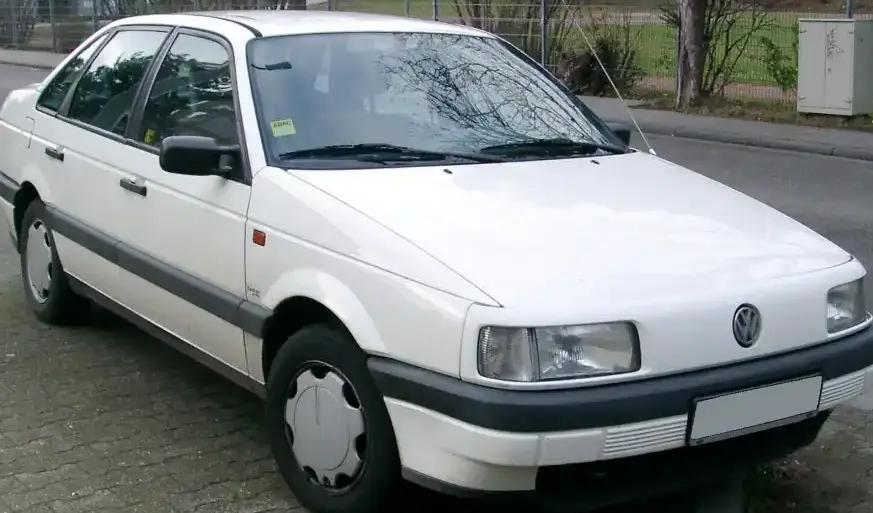
The Volkswagen Passat B3 1.6 TD, produced between 1988 and 1993, represented a significant step forward for Volkswagen’s mid-size offering. Positioned as an economical and practical option within the B3 Passat range (the third generation of the Passat, internally designated as the 1HX0/A3 platform), this diesel variant aimed to provide fuel efficiency and durability for everyday use. It served as a key model in European markets where diesel engines were highly favored, offering a balance between affordability and reasonable performance. While not the most powerful Passat available, the 1.6 TD found a niche among buyers prioritizing low running costs and reliability.
Technical Specifications
| Brand | Volkswagen |
| Model | Passat |
| Generation | Passat (B3) |
| Type (Engine) | 1.6 TD (80 Hp) |
| Start of production | 1988 |
| End of production | 1993 |
| Powertrain Architecture | Internal Combustion engine |
| Body type | Sedan |
| Seats | 4 |
| Doors | 4 |
| Fuel consumption (urban) | 7 l/100 km (33.6 US mpg, 40.4 UK mpg, 14.3 km/l) |
| Fuel consumption (extra urban) | 4.5 l/100 km (52.3 US mpg, 62.8 UK mpg, 22.2 km/l) |
| Fuel consumption (combined) | 6.5 l/100 km (36.2 US mpg, 43.5 UK mpg, 15.4 km/l) |
| Fuel Type | Diesel |
| Acceleration 0 – 100 km/h | 16 sec |
| Acceleration 0 – 62 mph | 16 sec |
| Acceleration 0 – 60 mph | 15.2 sec |
| Maximum speed | 170 km/h (105.63 mph) |
| Weight-to-power ratio | 14.9 kg/Hp, 67.2 Hp/tonne |
| Weight-to-torque ratio | 7.7 kg/Nm, 130.3 Nm/tonne |
| Power | 80 Hp @ 4500 rpm |
| Power per litre | 50.4 Hp/l |
| Torque | 155 Nm @ 2800 rpm (114.32 lb.-ft. @ 2800 rpm) |
| Engine layout | Front, Transverse |
| Engine Model/Code | RA, SB |
| Engine displacement | 1588 cm3 (96.91 cu. in.) |
| Number of cylinders | 4 |
| Engine configuration | Inline |
| Cylinder Bore | 76.5 mm (3.01 in.) |
| Piston Stroke | 86.4 mm (3.4 in.) |
| Compression ratio | 23:1 |
| Number of valves per cylinder | 2 |
| Fuel injection system | Precombustion chamber injection |
| Engine aspiration | Turbocharger, Intercooler |
| Valvetrain | OHC |
| Engine oil capacity | 4.5 l (4.76 US qt | 3.96 UK qt) |
| Coolant | 5 l (5.28 US qt | 4.4 UK qt) |
| Kerb Weight | 1190 kg (2623.5 lbs.) |
| Max. weight | 1740 kg (3836.04 lbs.) |
| Max load | 550 kg (1212.54 lbs.) |
| Trunk (boot) space – minimum | 580 l (20.48 cu. ft.) |
| Fuel tank capacity | 70 l (18.49 US gal | 15.4 UK gal) |
| Length | 4575 mm (180.12 in.) |
| Width | 1705 mm (67.13 in.) |
| Height | 1460 mm (57.48 in.) |
| Wheelbase | 2625 mm (103.35 in.) |
| Front track | 1480 mm (58.27 in.) |
| Rear (Back) track | 1420 mm (55.91 in.) |
| Drivetrain Architecture | The Internal combustion engine (ICE) drives the front wheels of the vehicle. |
| Drive wheel | Front wheel drive |
| Number of gears and type of gearbox | 5 gears, manual transmission |
| Front suspension | Coil spring |
| Rear suspension | Coil spring |
| Front brakes | Disc |
| Rear brakes | Drum |
| Assisting systems | ABS (Anti-lock braking system) |
| Steering type | Steering rack and pinion |
| Power steering | Hydraulic Steering |
| Tires size | 185/65 R14 |
| Wheel rims size | 6J x 14 |
Powertrain & Engine Architecture
The heart of the Passat B3 1.6 TD was the 1.6-liter inline-four diesel engine, typically identified by engine codes RA or SB. This engine utilized a precombustion chamber injection system, a common technology for diesel engines of the era. This system involved injecting fuel into a small precombustion chamber connected to the main cylinder, where it was partially ignited before entering the main combustion chamber. This improved cold-starting performance and reduced engine noise compared to direct injection systems. The engine was turbocharged and intercooled, boosting power output to 80 horsepower at 4500 rpm and 155 Nm (114 lb-ft) of torque at 2800 rpm. The five-speed manual transmission was the standard offering, providing a relatively long-legged gearing setup optimized for fuel economy. The engine’s overhead camshaft (OHC) configuration was relatively simple, contributing to its robustness and ease of maintenance.
Driving Characteristics
The 1.6 TD Passat offered a driving experience focused on practicality rather than performance. Acceleration was modest, taking around 16 seconds to reach 60 mph. However, the engine’s torque characteristics made it reasonably capable for everyday driving, providing sufficient power for highway cruising and overtaking maneuvers. The manual transmission’s gear ratios were spaced to maximize fuel efficiency, meaning the engine often operated at lower rpm. Compared to the more powerful gasoline-powered Passat variants (like the 1.8 or 2.0 liter models), the 1.6 TD felt noticeably slower. However, it offered significantly better fuel economy, making it a popular choice for high-mileage drivers. The steering was light and precise, typical of European cars of the period, and the suspension provided a comfortable ride, although it wasn’t particularly sporty.
Equipment & Trim Levels
The 1.6 TD Passat typically came with a fairly basic level of equipment. Standard features generally included power steering, central locking, and a basic stereo system. Interior upholstery was typically cloth, and the dashboard featured a functional, if somewhat austere, design. Optional extras included power windows, a sunroof, and upgraded audio systems. Trim levels varied depending on the market, but the 1.6 TD generally occupied the entry-level or mid-range position in the Passat lineup. It was aimed at buyers who prioritized value and practicality over luxury features.
Chassis & Braking
The Passat B3 featured a relatively conventional chassis design. Front suspension utilized coil springs and independent suspension, while the rear suspension employed a semi-independent torsion beam setup. Brakes were disc brakes at the front and drum brakes at the rear, a common configuration for vehicles in this class at the time. Anti-lock braking system (ABS) was often available as an option, enhancing safety. The suspension was tuned for comfort, providing a reasonably smooth ride over a variety of road surfaces. Stabilizer bars were fitted to both the front and rear axles to reduce body roll during cornering.
Market Reception & Comparison
The Passat B3 1.6 TD was generally well-received in European markets as a practical and economical family car. Critics praised its fuel efficiency and reliability, but noted its relatively modest performance. Compared to the gasoline-powered Passat variants, the 1.6 TD offered significantly better fuel economy, but at the expense of acceleration and overall refinement. Against competitors like the Ford Mondeo and Opel Vectra, the Passat 1.6 TD offered a competitive package, particularly for buyers seeking a diesel-powered option. Its reputation for durability and low running costs made it a popular choice for fleet operators and private buyers alike.
Legacy
The Volkswagen Passat B3 1.6 TD has proven to be a remarkably durable and reliable vehicle. Many examples are still on the road today, a testament to the quality of its engineering and construction. The 1.6 TD engine, while not particularly powerful, is known for its longevity and relatively simple maintenance requirements. In the used car market, these Passats are often sought after by enthusiasts and budget-conscious buyers looking for a dependable and economical vehicle. While parts availability may be becoming more challenging, the 1.6 TD Passat remains a popular and respected classic car, representing a significant chapter in Volkswagen’s history.