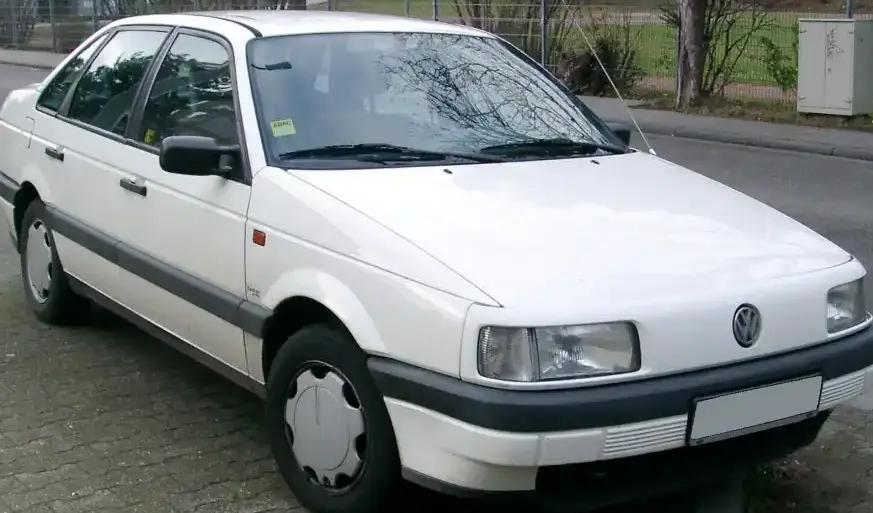
The Volkswagen Passat B3, produced from 1988 to 1993, represented a significant leap forward for Volkswagen’s mid-size offering. The 2.0-liter (115 hp) variant, available throughout its production run, occupied a middle ground in the B3 Passat lineup, positioned above the base 1.6-liter models and below the more powerful 1.8 and 2.1-liter options. This version aimed to balance affordability with acceptable performance and was a popular choice in European markets, where fuel economy and practicality were highly valued. It was a key component of Volkswagen’s strategy to offer a broad range of options to cater to diverse customer needs within the increasingly competitive D-segment.
Technical Specifications
| Brand | Volkswagen |
| Model | Passat |
| Generation | Passat (B3) |
| Type (Engine) | 2.0 (115 Hp) |
| Start of production | 1990 |
| End of production | 1993 |
| Powertrain Architecture | Internal Combustion engine |
| Body type | Sedan |
| Seats | 5 |
| Doors | 4 |
| Fuel consumption (urban) | 10.9 l/100 km (21.6 US mpg) |
| Fuel consumption (extra urban) | 6 l/100 km (39.2 US mpg) |
| Fuel consumption (combined) | 7.6 l/100 km (30.9 US mpg) |
| Fuel Type | Petrol (Gasoline) |
| Acceleration 0 – 100 km/h | 11.3 sec |
| Acceleration 0 – 62 mph | 11.3 sec |
| Acceleration 0 – 60 mph | 10.7 sec |
| Maximum speed | 195 km/h (121.17 mph) |
| Weight-to-power ratio | 10 kg/Hp |
| Weight-to-torque ratio | 6.7 kg/Nm |
| Power | 115 Hp @ 5400 rpm |
| Torque | 172 Nm @ 3200 rpm (126.86 lb.-ft. @ 3200 rpm) |
| Engine layout | Front, Longitudinal |
| Engine Model/Code | 2E |
| Engine displacement | 1984 cm3 (121.07 cu. in.) |
| Number of cylinders | 4 |
| Engine configuration | Inline |
| Cylinder Bore | 82.5 mm (3.25 in.) |
| Piston Stroke | 92.8 mm (3.65 in.) |
| Compression ratio | 10.3:1 |
| Number of valves per cylinder | 2 |
| Fuel injection system | Multi-port manifold injection |
| Engine aspiration | Naturally aspirated |
| Engine oil capacity | 4 l (4.23 US qt | 3.52 UK qt) |
| Coolant capacity | 5 l (5.28 US qt | 4.4 UK qt) |
| Kerb Weight | 1155 kg (2546.34 lbs.) |
| Max. weight | 1700 kg (3747.86 lbs.) |
| Max load | 545 kg (1201.52 lbs.) |
| Trunk (boot) space – minimum | 495 l (17.48 cu. ft.) |
| Trunk (boot) space – maximum | 820 l (28.96 cu. ft.) |
| Fuel tank capacity | 70 l (18.49 US gal | 15.4 UK gal) |
| Length | 4575 mm (180.12 in.) |
| Width | 1705 mm (67.13 in.) |
| Height | 1460 mm (57.48 in.) |
| Wheelbase | 2625 mm (103.35 in.) |
| Front track | 1480 mm (58.27 in.) |
| Rear track | 1420 mm (55.91 in.) |
| Drivetrain Architecture | Front wheel drive |
| Number of gears | 5 |
| Gearbox type | Manual transmission |
| Front suspension | Coil spring |
| Rear suspension | Coil spring |
| Front brakes | Disc |
| Rear brakes | Disc |
| Assisting systems | ABS (Anti-lock braking system) |
| Steering type | Steering rack and pinion |
| Power steering | Hydraulic |
| Tires size | 185/65 R14 |
| Wheel rims size | 6J x 14 |
Powertrain & Engine Architecture
The heart of the Passat 2.0 was the Volkswagen 2E engine, a 1984cc inline-four cylinder gasoline engine. This engine utilized a cast iron block and an aluminum cylinder head, a common configuration for the era. It featured a single overhead camshaft (SOHC) operating two valves per cylinder. Fuel delivery was handled by Bosch multi-port fuel injection, providing a more efficient and responsive driving experience compared to earlier carbureted models. The 2E engine was known for its relative simplicity and durability. The engine’s longitudinal mounting within the engine bay, coupled with front-wheel drive, was a defining characteristic of the B3 platform. The five-speed manual transmission was the standard offering, providing a direct connection between the engine and the front wheels.
Driving Characteristics
The 115 hp 2.0-liter engine in the B3 Passat delivered adequate, though not exhilarating, performance. Acceleration from 0 to 60 mph took around 10.7 seconds, and top speed was approximately 121 mph. Compared to the more powerful 1.8 and 2.1-liter versions, the 2.0 felt less eager to rev, with peak torque arriving at 3200 rpm. The five-speed manual transmission offered a reasonable spread of gears, allowing drivers to keep the engine within its optimal power band. While not a sports sedan, the 2.0-liter Passat provided a comfortable and composed driving experience, particularly on the open road. The steering was precise, and the suspension offered a good balance between ride comfort and handling.
Equipment & Trim Levels
The 2.0-liter Passat typically came with a fairly comprehensive list of standard features for its time. This included power steering, central locking, and a basic stereo system. Interior upholstery was typically cloth, with options for upgraded velour or leather available at extra cost. Trim levels varied depending on the market, but generally included options for power windows, sunroof, and alloy wheels. The dashboard layout was functional and straightforward, with clearly marked gauges and controls. Air conditioning was often an optional extra, as were features like cruise control.
Chassis & Braking
The B3 Passat utilized a MacPherson strut front suspension and a semi-independent torsion beam rear suspension. This setup provided a good compromise between ride comfort and handling. Brakes were disc brakes all around, offering adequate stopping power for the vehicle’s weight and performance. ABS (Anti-lock Braking System) was available as an option, enhancing safety in emergency braking situations. The chassis was relatively lightweight, contributing to the car’s nimble handling characteristics.
Market Reception & Comparison
The Passat 2.0 was generally well-received by automotive critics as a practical and reliable family sedan. It offered a good balance of performance, fuel economy, and comfort. Compared to the 1.6-liter base model, the 2.0 provided a noticeable improvement in performance, making it a more enjoyable car to drive. However, it lacked the outright performance of the more expensive 1.8 and 2.1-liter variants. Fuel economy was respectable for the time, averaging around 31 mpg on the combined cycle. Reliability was generally good, although routine maintenance was essential to keep the engine running smoothly.
Legacy
The Volkswagen Passat B3 2.0-liter remains a popular choice among classic car enthusiasts and collectors. The 2E engine is known for its durability and relative ease of maintenance. Parts availability is generally good, although some components may be becoming increasingly difficult to find. The B3 Passat represents a significant milestone in Volkswagen’s history, marking a transition to more modern design and engineering. Today, well-maintained examples of the 2.0-liter Passat can still provide reliable and enjoyable transportation, offering a glimpse into the automotive landscape of the early 1990s. Its simple design and robust construction have ensured its longevity, making it a lasting testament to Volkswagen’s engineering prowess.