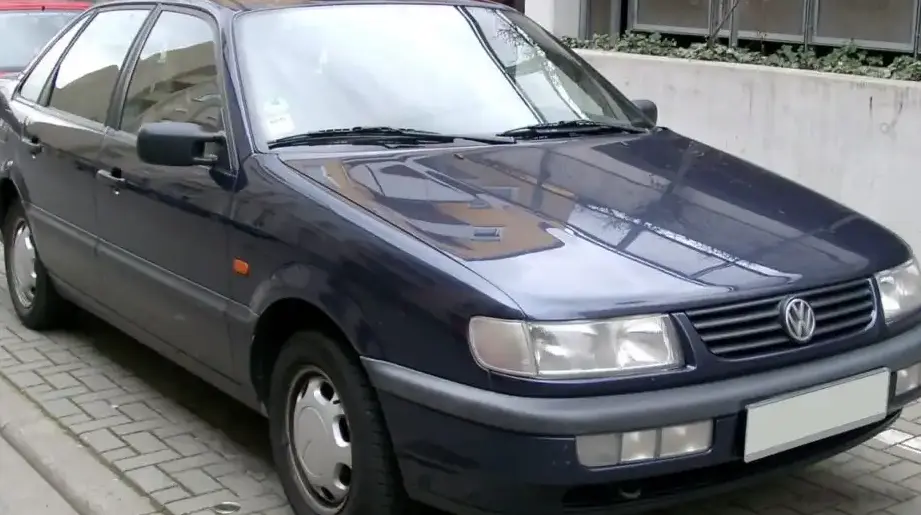
The Volkswagen Passat B4 2.8 VR6 Automatic, produced between 1993 and 1996, represented a significant step upmarket for Volkswagen’s mid-size offering. Positioned as the premium trim level within the B4 Passat range, it combined the unique VR6 engine with a four-speed automatic transmission, targeting buyers who desired performance and refinement without the involvement of a manual gearbox. This variant was primarily sold in Europe, where it competed with other executive sedans like the Ford Mondeo, Opel Vectra, and BMW 3 Series. The B4 generation, built on the 1HX0/A3 platform, aimed to offer a more sophisticated and spacious alternative to the aging B3 model.
Technical Specifications
| Brand | Volkswagen |
| Model | Passat |
| Generation | Passat (B4) |
| Type (Engine) | 2.8 VR6 (174 Hp) Automatic |
| Start of production | 1993 |
| End of production | 1996 |
| Powertrain Architecture | Internal Combustion engine |
| Body type | Sedan |
| Seats | 5 |
| Doors | 4 |
| Fuel consumption (urban) | 14.4 l/100 km (16.3 US mpg, 19.6 UK mpg, 6.9 km/l) |
| Fuel consumption (extra urban) | 8 l/100 km (29.4 US mpg, 35.3 UK mpg, 12.5 km/l) |
| Fuel Type | Petrol (Gasoline) |
| Acceleration 0 – 100 km/h | 10.4 sec |
| Acceleration 0 – 62 mph | 10.4 sec |
| Acceleration 0 – 60 mph | 9.9 sec |
| Maximum speed | 218 km/h (135.46 mph) |
| Emission standard | Euro 2 |
| Weight-to-power ratio | 7.8 kg/Hp, 128.4 Hp/tonne |
| Weight-to-torque ratio | 5.8 kg/Nm, 173.4 Nm/tonne |
| Power | 174 Hp @ 5800 rpm |
| Power per litre | 62.3 Hp/l |
| Torque | 235 Nm @ 4200 rpm (173.33 lb.-ft. @ 4200 rpm) |
| Engine layout | Front, Transverse |
| Engine Model/Code | AAA |
| Engine displacement | 2792 cm3 (170.38 cu. in.) |
| Number of cylinders | 6 |
| Engine configuration | VR-engine |
| Cylinder Bore | 81 mm (3.19 in.) |
| Piston Stroke | 90.3 mm (3.56 in.) |
| Compression ratio | 10:1 |
| Number of valves per cylinder | 2 |
| Fuel injection system | Multi-port manifold injection |
| Engine aspiration | Naturally aspirated engine |
| Valvetrain | DOHC |
| Engine oil capacity | 6 l (6.34 US qt | 5.28 UK qt) |
| Coolant | 8.2 l (8.66 US qt | 7.21 UK qt) |
| Kerb Weight | 1355 kg (2987.26 lbs.) |
| Max. weight | 1910 kg (4210.83 lbs.) |
| Max load | 555 kg (1223.57 lbs.) |
| Trunk (boot) space – minimum | 578 l (20.41 cu. ft.) |
| Trunk (boot) space – maximum | 990 l (34.96 cu. ft.) |
| Fuel tank capacity | 70 l (18.49 US gal | 15.4 UK gal) |
| Max. roof load | 75 kg (165.35 lbs.) |
| Permitted trailer load with brakes (12%) | 1500 kg (3306.93 lbs.) |
| Permitted trailer load without brakes | 700 kg (1543.24 lbs.) |
| Length | 4605 mm (181.3 in.) |
| Width | 1720 mm (67.72 in.) |
| Height | 1430 mm (56.3 in.) |
| Wheelbase | 2625 mm (103.35 in.) |
| Front track | 1485 mm (58.46 in.) |
| Rear (Back) track | 1428 mm (56.22 in.) |
| Front overhang | 915 mm (36.02 in.) |
| Rear overhang | 1065 mm (41.93 in.) |
| Minimum turning circle (turning diameter) | 10.7 m (35.1 ft.) |
| Drivetrain Architecture | The Internal combustion engine (ICE) drives the front wheels of the vehicle. |
| Drive wheel | Front wheel drive |
| Number of gears and type of gearbox | 4 gears, automatic transmission |
| Front suspension | Coil spring, Wishbone, Transverse stabilizer |
| Rear suspension | Wishbone, Transverse stabilizer, Coil spring |
| Front brakes | Ventilated discs |
| Rear brakes | Disc |
| Assisting systems | ABS (Anti-lock braking system) |
| Steering type | Steering rack and pinion |
| Power steering | Hydraulic Steering |
| Tires size | 205/50 R15 |
| Wheel rims size | 6J x 15 |
INTRODUCTION
The Volkswagen Passat B4 2.8 VR6 Automatic, produced from 1993 to 1996, was a flagship variant of the B4 Passat range. It aimed to deliver a blend of performance, comfort, and practicality, appealing to buyers seeking a more refined driving experience. The VR6 engine, a Volkswagen innovation, offered a compact V6 configuration, providing smooth power delivery and a distinctive exhaust note. The inclusion of a four-speed automatic transmission made this model particularly accessible to drivers who preferred the convenience of automatic operation. Within the B4 lineup, this variant sat at the top, offering more power and a more luxurious experience than the 1.8 and 2.0-liter four-cylinder models.
Powertrain & Engine Architecture
The heart of the Passat B4 2.8 VR6 Automatic is the AAA engine code, a 2.8-liter VR6 engine. This engine is notable for its unique 15-degree V-angle, which allowed it to be packaged within the engine bay like an inline-six while offering the balance and smoothness of a V6. It features a dual overhead camshaft (DOHC) valvetrain with two valves per cylinder and multi-port fuel injection. The engine produces 174 horsepower at 5800 rpm and 235 Nm (173.33 lb.-ft.) of torque at 4200 rpm. The four-speed automatic transmission, while providing convenience, was not known for its sportiness. It featured a traditional torque converter and aimed for smooth shifts rather than rapid acceleration. The transmission’s gear ratios were optimized for comfortable cruising, prioritizing fuel efficiency over outright performance.
Driving Characteristics
The driving experience in the Passat B4 2.8 VR6 Automatic is characterized by smooth, refined power delivery. While the 0-60 mph time of around 9.9 seconds isn’t particularly quick by modern standards, the engine’s torque provides ample power for everyday driving and overtaking maneuvers. The automatic transmission, while smooth, can feel somewhat sluggish compared to a manual gearbox, especially during kickdown. The gear ratios are spaced to prioritize fuel economy and comfort, resulting in a less engaging driving experience for enthusiasts. The front-wheel-drive layout provides predictable handling, but it can exhibit some understeer when pushed hard. Compared to the manual VR6, the automatic version feels slightly less responsive, but offers a more relaxed driving experience.
Equipment & Trim Levels
The 2.8 VR6 Automatic typically came well-equipped, reflecting its position as the premium trim level. Standard features often included central locking, electric windows, power steering, ABS brakes, and an upgraded interior trim. Interior upholstery was typically cloth, but leather options were available. The dashboard featured a comprehensive instrument cluster with gauges for engine temperature, fuel level, and speedometer. Optional extras included a sunroof, air conditioning, and a premium sound system. The level of equipment varied depending on the specific market and optional packages selected by the original buyer.
Chassis & Braking
The Passat B4 2.8 VR6 Automatic utilized a MacPherson strut front suspension and a semi-independent wishbone rear suspension. The suspension was tuned for comfort, providing a relatively smooth ride over uneven surfaces. Stabilizer bars were fitted to both the front and rear axles to reduce body roll during cornering. The braking system consisted of ventilated discs on the front wheels and solid discs on the rear wheels. ABS (Anti-lock Braking System) was standard, enhancing braking performance and stability. The chassis was designed to accommodate the heavier VR6 engine and automatic transmission, with slightly stiffer springs and dampers compared to the lower-powered models.
Market Reception & Comparison
The Passat B4 2.8 VR6 Automatic was generally well-received by automotive critics. It was praised for its smooth engine, comfortable ride, and spacious interior. However, the automatic transmission was sometimes criticized for its lack of responsiveness. Compared to the manual VR6, the automatic version offered less driver engagement but greater convenience. Fuel economy was also a concern, with the VR6 engine consuming significantly more fuel than the four-cylinder options. In terms of reliability, the VR6 engine proved to be generally robust, but the automatic transmission could be prone to issues if not properly maintained.
Legacy
Today, the Volkswagen Passat B4 2.8 VR6 Automatic is considered a desirable classic car, particularly among Volkswagen enthusiasts. The VR6 engine’s unique sound and smooth power delivery have earned it a loyal following. While maintenance costs can be higher than for the four-cylinder models, the VR6’s reliability is generally good. The automatic transmission requires regular servicing to ensure smooth operation. The B4 VR6 Automatic remains a relatively affordable way to experience a classic Volkswagen with a distinctive character and a touch of luxury.