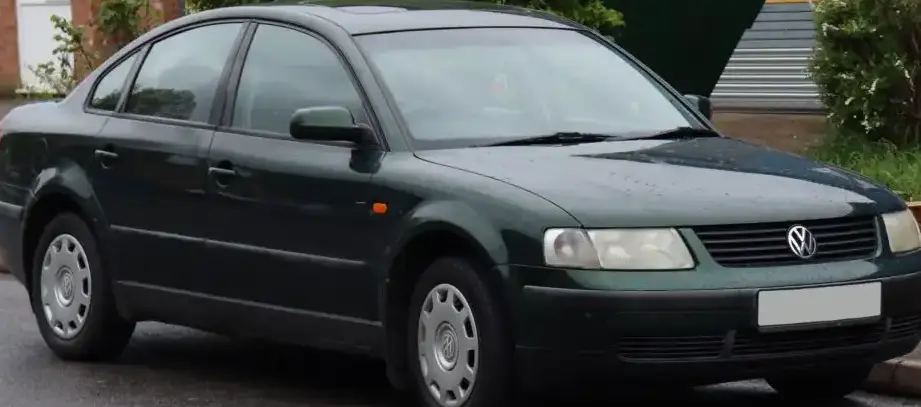
The Volkswagen Passat B5 1.6, produced between 1996 and 2000, represented the entry point into the fifth generation (B5) Passat lineup. Positioned as an affordable and practical family sedan, this variant was primarily aimed at the European market where fuel economy and reasonable running costs were highly valued. It utilized Volkswagen’s New Compact Class (NCC) platform, also known internally as the 1HX0, shared with other models like the Audi A4, SEAT Toledo, and Škoda Octavia. The 1.6-liter engine and five-speed automatic transmission combination offered a comfortable, if not particularly sporty, driving experience, making it a popular choice for everyday commuting and family transport.
Technical Specifications
| Brand | Volkswagen |
| Model | Passat |
| Generation | Passat (B5) |
| Type (Engine) | 1.6 (101 Hp) |
| Start of production | 1996 |
| End of production | 2000 |
| Powertrain Architecture | Internal Combustion engine |
| Body type | Sedan |
| Seats | 5 |
| Doors | 4 |
| Fuel consumption (urban) | 11.4 l/100 km (20.6 US mpg) |
| Fuel consumption (extra urban) | 6.2 l/100 km (37.9 US mpg) |
| Fuel Type | Petrol (Gasoline) |
| Acceleration 0 – 100 km/h | 12.3 sec |
| Acceleration 0 – 62 mph | 12.3 sec |
| Acceleration 0 – 60 mph | 11.7 sec |
| Maximum speed | 192 km/h (119.3 mph) |
| Weight-to-power ratio | 11.9 kg/Hp |
| Weight-to-torque ratio | 8.3 kg/Nm |
| Power | 101 Hp @ 5600 rpm |
| Power per litre | 63.3 Hp/l |
| Torque | 145 Nm @ 3800 rpm (106.95 lb.-ft. @ 3800 rpm) |
| Engine layout | Front, Longitudinal |
| Engine Model/Code | ADP, AHL, ANA, ARM |
| Engine displacement | 1595 cm3 (97.33 cu. in.) |
| Number of cylinders | 4 |
| Engine configuration | Inline |
| Cylinder Bore | 81 mm (3.19 in.) |
| Piston Stroke | 77.4 mm (3.05 in.) |
| Compression ratio | 10.3:1 |
| Number of valves per cylinder | 2 |
| Fuel injection system | Multi-port manifold injection |
| Engine aspiration | Naturally aspirated engine |
| Valvetrain | OHC |
| Engine oil capacity | 3 l (3.17 US qt | 2.64 UK qt) |
| Coolant capacity | 7 l (7.4 US qt | 6.16 UK qt) |
| Kerb Weight | 1200 kg (2645.55 lbs.) |
| Max. weight | 1750 kg (3858.09 lbs.) |
| Max load | 550 kg (1212.54 lbs.) |
| Trunk (boot) space – minimum | 475 l (16.77 cu. ft.) |
| Trunk (boot) space – maximum | 745 l (26.31 cu. ft.) |
| Fuel tank capacity | 62 l (16.38 US gal | 13.64 UK gal) |
| Length | 4670 mm (183.86 in.) |
| Width | 1740 mm (68.5 in.) |
| Height | 1460 mm (57.48 in.) |
| Wheelbase | 2700 mm (106.3 in.) |
| Front track | 1498 mm (58.98 in.) |
| Rear (Back) track | 1500 mm (59.06 in.) |
| Drivetrain Architecture | The Internal combustion engine (ICE) drives the front wheels of the vehicle. |
| Drive wheel | Front wheel drive |
| Number of gears and type of gearbox | 5 gears, automatic transmission |
| Front suspension | Coil spring |
| Rear suspension | Coil spring |
| Front brakes | Ventilated discs |
| Rear brakes | Disc |
| Assisting systems | ABS (Anti-lock braking system) |
| Steering type | Steering rack and pinion |
| Power steering | Hydraulic Steering |
| Tires size | 195/65 R15 |
| Wheel rims size | 6J x 15 |
Powertrain & Engine Architecture
The Passat B5 1.6 utilized a 1.6-liter, inline four-cylinder engine, available with several engine codes including ADP, AHL, ANA, and ARM. These engines were relatively simple in design, featuring a single overhead camshaft (OHC) operating two valves per cylinder. Fuel delivery was handled by a multi-port fuel injection system, providing adequate, though not exceptional, performance. The engine’s modest output was a direct result of its focus on fuel efficiency and affordability. The five-speed automatic transmission, typically a 09G unit, was chosen for its smooth operation and ease of use, catering to drivers prioritizing comfort over sporty handling. This transmission featured electronic control for optimized shift points, though it wasn’t known for its particularly quick or decisive shifts.
Driving Characteristics
The 1.6-liter engine paired with the automatic transmission delivered a comfortable but uninspiring driving experience. Acceleration was leisurely, taking around 12.3 seconds to reach 62 mph (100 km/h). The automatic transmission’s gear ratios were geared towards fuel economy, resulting in a noticeable lack of urgency when overtaking or climbing hills. Compared to the more powerful 1.8-liter turbocharged or VR6 variants, the 1.6 felt significantly underpowered. However, for everyday commuting and urban driving, the engine provided sufficient power, and the automatic transmission made for a relaxed and convenient driving experience. The relatively low power output also meant that the suspension wasn’t overly stressed, contributing to a comfortable ride quality.
Equipment & Trim Levels
The 1.6-liter Passat B5 typically came with a base level of equipment. Standard features generally included power windows, central locking, power steering, and an ABS anti-lock braking system. Interior upholstery was typically cloth, and the dashboard featured a functional, if somewhat plain, design. Optional extras included air conditioning, alloy wheels, a radio/cassette player, and upgraded interior trim. Higher trim levels, such as the Trendline or Comfortline, added more features as standard, but the 1.6-liter engine was rarely offered in the top-of-the-line trims.
Chassis & Braking
The Passat B5 1.6 featured a MacPherson strut front suspension and a multi-link rear suspension, providing a good balance of ride comfort and handling. The braking system consisted of ventilated discs on the front wheels and solid discs on the rear. The ABS system helped to maintain control during emergency braking situations. The suspension was tuned for comfort rather than sporty handling, and the stabilizer bars were relatively thin compared to those found on higher-performance models. This setup was appropriate for the car’s weight and power output, providing adequate stopping power and a stable ride.
Market Reception & Comparison
The Passat B5 1.6 was generally well-received as an affordable and practical family car. Critics praised its comfortable ride, spacious interior, and good fuel economy. However, the engine’s lack of power was a common criticism. Compared to the 1.8-liter turbocharged and VR6 variants, the 1.6 offered significantly less performance. The 1.9 TDI diesel version was also a popular alternative, offering superior fuel economy and torque. Despite its shortcomings in terms of performance, the 1.6-liter Passat B5 remained a popular choice for buyers seeking a reliable and affordable family sedan.
Legacy
The Volkswagen Passat B5 1.6, while not the most exciting variant in the lineup, proved to be a reliable and durable car. The 1.6-liter engine, though simple in design, was generally robust and capable of high mileage with proper maintenance. The automatic transmission, while not known for its speed, was also relatively reliable. Today, these cars can be found in the used car market at very affordable prices. They represent a good value for buyers seeking a practical and economical family car, but potential buyers should be aware of the engine’s limited power and the potential for age-related issues with the automatic transmission and suspension components. The simplicity of the engine and transmission also makes it relatively easy and affordable to repair, contributing to its continued appeal in the used car market.