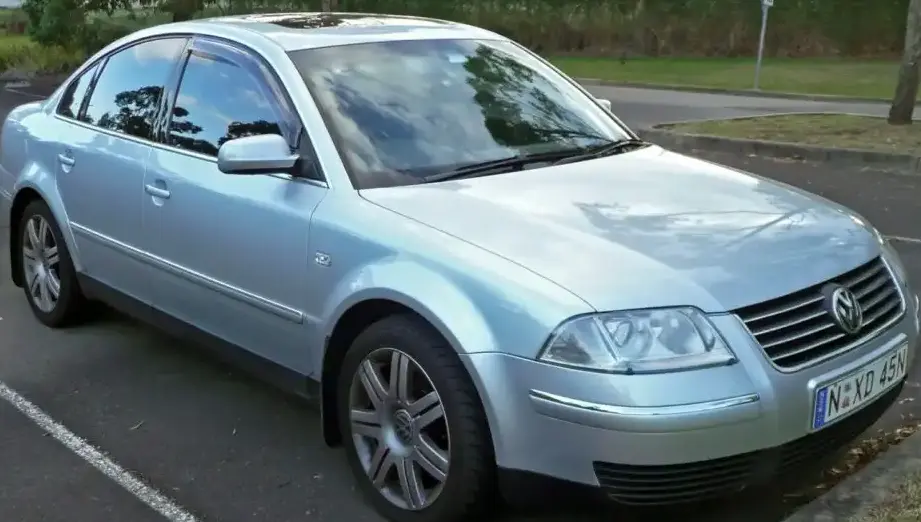
The Volkswagen Passat B5.5 2.3 V5, produced between 2000 and 2003, represented a significant mid-cycle refresh of the popular B5 Passat. This variant, characterized by its unique five-cylinder engine, occupied a middle ground in the Passat lineup, offering a blend of performance and refinement that appealed to buyers seeking something beyond the base four-cylinder models but without the expense of the flagship V6. It was primarily marketed in Europe, where the Passat served as a key competitor in the mid-size family car segment, offering a more premium alternative to rivals like the Ford Mondeo and Opel Vectra.
Technical Specifications
| Brand | Volkswagen |
| Model | Passat |
| Generation | Passat (B5.5) |
| Type (Engine) | 2.3 V5 (170 Hp) |
| Start of production | 2000 year |
| End of production | 2003 year |
| Powertrain Architecture | Internal Combustion engine |
| Body type | Sedan |
| Seats | 5 |
| Doors | 4 |
| Fuel consumption (economy) – urban (NEDC) | 13 l/100 km (18.1 US mpg, 21.7 UK mpg, 7.7 km/l) |
| Fuel consumption (economy) – extra urban (NEDC) | 7.2 l/100 km (32.7 US mpg, 39.2 UK mpg, 13.9 km/l) |
| Fuel consumption (economy) – combined (NEDC) | 9.3 l/100 km (25.3 US mpg, 30.4 UK mpg, 10.8 km/l) |
| CO2 emissions (NEDC) | 223 g/km |
| Fuel Type | Petrol (Gasoline) |
| Acceleration 0 – 100 km/h | 8.9 sec |
| Acceleration 0 – 62 mph | 8.9 sec |
| Acceleration 0 – 60 mph | 8.5 sec |
| Maximum speed | 228 km/h (141.67 mph) |
| Emission standard | Euro 4 |
| Weight-to-power ratio | 9 kg/Hp, 111.6 Hp/tonne |
| Weight-to-torque ratio | 6.9 kg/Nm, 144.5 Nm/tonne |
| Power | 170 Hp @ 6200 rpm |
| Power per litre | 73.1 Hp/l |
| Torque | 220 Nm @ 3200 rpm (162.26 lb.-ft. @ 3200 rpm) |
| Engine layout | Front, Longitudinal |
| Engine Model/Code | AZX |
| Engine displacement | 2324 cm3 (141.82 cu. in.) |
| Number of cylinders | 5 |
| Engine configuration | VR-engine |
| Cylinder Bore | 81 mm (3.19 in.) |
| Piston Stroke | 90.2 mm (3.55 in.) |
| Compression ratio | 10.8:1 |
| Number of valves per cylinder | 4 |
| Fuel injection system | Multi-port manifold injection |
| Engine aspiration | Naturally aspirated engine |
| Valvetrain | SOHC |
| Engine oil capacity | 4 l (4.23 US qt | 3.52 UK qt) |
| Coolant | 9 l (9.51 US qt | 7.92 UK qt) |
| Kerb Weight | 1523 kg (3357.64 lbs.) |
| Max. weight | 2000 kg (4409.25 lbs.) |
| Max load | 477 kg (1051.6 lbs.) |
| Trunk (boot) space – minimum | 475 l (16.77 cu. ft.) |
| Trunk (boot) space – maximum | 800 l (28.25 cu. ft.) |
| Fuel tank capacity | 62 l (16.38 US gal | 13.64 UK gal) |
| Max. roof load | 100 kg (220.46 lbs.) |
| Permitted trailer load with brakes (12%) | 1500 kg (3306.93 lbs.) |
| Permitted trailer load without brakes | 700 kg (1543.24 lbs.) |
| Permitted towbar download | 75 kg (165.35 lbs.) |
| Length | 4703 mm (185.16 in.) |
| Width | 1746 mm (68.74 in.) |
| Height | 1462 mm (57.56 in.) |
| Wheelbase | 2703 mm (106.42 in.) |
| Front track | 1515 mm (59.65 in.) |
| Rear (Back) track | 1515 mm (59.65 in.) |
| Minimum turning circle (turning diameter) | 11.4 m (37.4 ft.) |
| Drivetrain Architecture | The Internal combustion engine (ICE) drives the front wheels of the vehicle. |
| Drive wheel | Front wheel drive |
| Number of gears and type of gearbox | 5 gears, manual transmission |
| Front suspension | Independent multi-link suspension, Transverse stabilizer |
| Rear suspension | Trailing arm, Torsion |
| Front brakes | Ventilated discs |
| Rear brakes | Disc |
| Assisting systems | ABS (Anti-lock braking system) |
| Steering type | Steering rack and pinion |
| Power steering | Hydraulic Steering |
| Tires size | 205/55 R16 |
| Wheel rims size | 7J x 16 |
Powertrain & Engine Architecture
The heart of the Passat 2.3 V5 was the AZX engine code, a 2.3-liter naturally aspirated VR5 engine. This engine was notable for its compact design, achieved by arranging five cylinders in a narrow V-configuration. This layout allowed it to be relatively short, facilitating its fitment into front-wheel-drive platforms. The AZX featured a single overhead camshaft (SOHC) valvetrain operating four valves per cylinder, and utilized multi-port fuel injection. The engine produced 170 horsepower at 6200 rpm and 220 Nm (162 lb-ft) of torque at 3200 rpm. The five-cylinder configuration provided a unique exhaust note, distinct from both inline-four and V6 engines. The engine was paired with a 5-speed manual transmission as standard, offering a direct and engaging driving experience.
Driving Characteristics
The 2.3 V5 Passat offered a balanced driving experience. While not as overtly sporty as the higher-output V6 models, it provided ample power for everyday driving and comfortable highway cruising. Acceleration from 0-60 mph took around 8.5 seconds, and top speed was rated at 141.67 mph. The engine’s torque curve was relatively flat, providing good responsiveness across a wide range of engine speeds. Compared to the base 1.8-liter four-cylinder models, the V5 offered a noticeable improvement in performance, particularly in mid-range acceleration. However, it lacked the outright punch of the V6. The manual transmission provided precise gear changes, enhancing driver control.
Equipment & Trim Levels
The 2.3 V5 typically came equipped with a reasonable level of standard features. This included power windows, power mirrors, central locking, and an air conditioning system. Interior upholstery was typically cloth, although leather options were available. Higher trim levels added features such as alloy wheels, a sunroof, and upgraded audio systems. Optional extras included automatic climate control, heated seats, and a navigation system. The Passat B5.5 generally offered a well-appointed interior with a focus on comfort and practicality.
Chassis & Braking
The Passat B5.5 featured an independent multi-link front suspension and a trailing arm rear suspension. This setup provided a good balance between ride comfort and handling. The front suspension incorporated a transverse stabilizer bar to reduce body roll during cornering. Braking duties were handled by ventilated discs at the front and solid discs at the rear. Anti-lock braking system (ABS) was standard, enhancing safety. The steering was a rack and pinion system with hydraulic power assistance, providing precise and responsive steering feel.
Market Reception & Comparison
The Passat 2.3 V5 was generally well-received by automotive critics. It was praised for its smooth engine, comfortable ride, and spacious interior. However, some critics noted that the engine’s fuel economy was not particularly impressive, and the V5 engine was sometimes criticized for being more complex and potentially less reliable than the four-cylinder or V6 alternatives. Compared to the 1.8T models, the V5 offered a more linear power delivery but lacked the turbocharged punch. Against the V6, it provided a more affordable entry point with a slightly lower running cost.
Legacy
The Volkswagen Passat B5.5 2.3 V5 has developed a reputation as a reliable and durable vehicle, although the V5 engine itself can be more complex to maintain than other engines in the Passat lineup. Parts availability is generally good, but specialized knowledge may be required for certain repairs. Today, these Passats can be found on the used car market at relatively affordable prices, making them an attractive option for buyers seeking a comfortable and well-equipped mid-size sedan. The unique five-cylinder engine and its distinctive sound have also contributed to a small but dedicated following among enthusiasts.