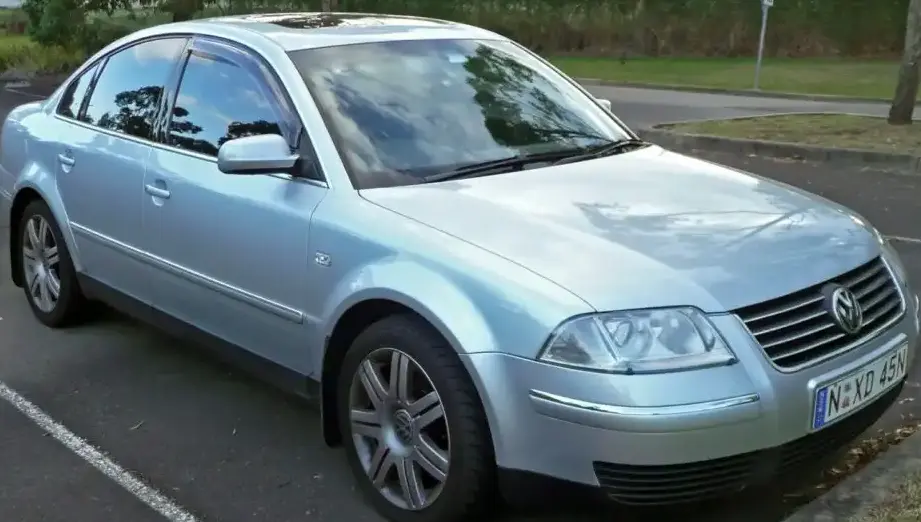
The Volkswagen Passat B5.5 2.3 V5 4MOTION, produced from 2000 to 2003, represents a unique offering within the Passat range. Positioned as a mid-to-upper trim level, it combined the distinctive VR5 engine with Volkswagen’s 4MOTION all-wheel-drive system. This variant aimed to provide a blend of performance, practicality, and all-weather capability, appealing to buyers seeking a more refined and capable family sedan. It was part of the B5.5 generation, a significant refresh of the popular B5 Passat, incorporating styling and technological updates.
Technical Specifications
| Brand | Volkswagen |
| Model | Passat |
| Generation | Passat (B5.5) |
| Type (Engine) | 2.3 V5 (170 Hp) 4MOTION |
| Start of production | 2000 year |
| End of production | 2003 year |
| Powertrain Architecture | Internal Combustion engine |
| Body type | Sedan |
| Seats | 5 |
| Doors | 4 |
| Fuel consumption (economy) – urban (NEDC) | 13.6 l/100 km (17.3 US mpg, 20.8 UK mpg, 7.4 km/l) |
| Fuel consumption (economy) – extra urban (NEDC) | 7.3 l/100 km (32.2 US mpg, 38.7 UK mpg, 13.7 km/l) |
| Fuel consumption (economy) – combined (NEDC) | 9.6 l/100 km (24.5 US mpg, 29.4 UK mpg, 10.4 km/l) |
| CO2 emissions (NEDC) | 230 g/km |
| Fuel Type | Petrol (Gasoline) |
| Acceleration 0 – 100 km/h | 9.6 sec |
| Acceleration 0 – 62 mph | 9.6 sec |
| Acceleration 0 – 60 mph | 9.1 sec |
| Maximum speed | 224 km/h (139.19 mph) |
| Emission standard | Euro 4 |
| Weight-to-power ratio | 9 kg/Hp, 111 Hp/tonne |
| Weight-to-torque ratio | 7 kg/Nm, 143.7 Nm/tonne |
| Power | 170 Hp @ 6200 rpm |
| Power per litre | 73.1 Hp/l |
| Torque | 220 Nm @ 3200 rpm (162.26 lb.-ft. @ 3200 rpm) |
| Engine layout | Front, Longitudinal |
| Engine Model/Code | AZX |
| Engine displacement | 2324 cm3 (141.82 cu. in.) |
| Number of cylinders | 5 |
| Engine configuration | VR-engine |
| Cylinder Bore | 81 mm (3.19 in.) |
| Piston Stroke | 90.2 mm (3.55 in.) |
| Compression ratio | 10.8:1 |
| Number of valves per cylinder | 4 |
| Fuel injection system | Multi-port manifold injection |
| Engine aspiration | Naturally aspirated engine |
| Valvetrain | SOHC |
| Engine oil capacity | 4 l (4.23 US qt | 3.52 UK qt) |
| Coolant | 9 l (9.51 US qt | 7.92 UK qt) |
| Kerb Weight | 1531 kg (3375.28 lbs.) |
| Max. weight | 2100 kg (4629.71 lbs.) |
| Max load | 569 kg (1254.43 lbs.) |
| Trunk (boot) space – minimum | 400 l (14.13 cu. ft.) |
| Trunk (boot) space – maximum | 725 l (25.6 cu. ft.) |
| Fuel tank capacity | 62 l (16.38 US gal | 13.64 UK gal) |
| Max. roof load | 100 kg (220.46 lbs.) |
| Permitted trailer load with brakes (12%) | 1600 kg (3527.4 lbs.) |
| Permitted trailer load without brakes | 750 kg (1653.47 lbs.) |
| Length | 4703 mm (185.16 in.) |
| Width | 1746 mm (68.74 in.) |
| Height | 1462 mm (57.56 in.) |
| Wheelbase | 2702 mm (106.38 in.) |
| Front track | 1515 mm (59.65 in.) |
| Rear (Back) track | 1515 mm (59.65 in.) |
| Minimum turning circle (turning diameter) | 11.4 m (37.4 ft.) |
| Drivetrain Architecture | The Internal combustion engine (ICE) drives permanently the four wheels of the vehicle. |
| Drive wheel | All wheel drive (4×4) |
| Number of gears and type of gearbox | 5 gears, manual transmission |
| Front suspension | Independent multi-link suspension, Transverse stabilizer |
| Rear suspension | Double wishbone, Transverse stabilizer |
| Front brakes | Ventilated discs |
| Rear brakes | Disc |
| Assisting systems | ABS (Anti-lock braking system) |
| Steering type | Steering rack and pinion |
| Power steering | Hydraulic Steering |
| Tires size | 205/55 R16 |
| Wheel rims size | 7J x 16 |
INTRODUCTION
The Volkswagen Passat B5.5 2.3 V5 4MOTION, manufactured between 2000 and 2003, was a compelling option in the mid-size sedan segment. Built on the 1HX0/A3 platform, the B5.5 represented a significant evolution of the B5 Passat, featuring revised styling, improved interior materials, and updated technology. The 2.3 V5 4MOTION trim specifically targeted drivers who desired a more premium experience coupled with the security and enhanced traction of all-wheel drive. It occupied a space between the more affordable 1.8T models and the higher-performance, but more expensive, Passat variants.
Powertrain & Engine Architecture
At the heart of the 2.3 V5 4MOTION lies the AZX engine code, a 2.3-liter naturally aspirated VR5 engine. This engine is characterized by its unique 15-degree V-angle, which allows it to be relatively narrow, enabling it to fit into engine bays designed for inline-five or even inline-four configurations. The engine utilizes multi-port fuel injection and a single overhead camshaft (SOHC) valvetrain. The VR5 design aimed to combine the smoothness of a V6 with the compactness of an inline-five. The 4MOTION system is a permanent all-wheel-drive system utilizing a Torsen differential, which automatically distributes torque between the front and rear axles based on traction conditions. The standard transmission for this variant was a 5-speed manual, offering precise control and a more engaging driving experience. While an automatic transmission was available, it was less common and often considered to detract from the engine’s potential.
Driving Characteristics
The 2.3 V5 4MOTION offered a balanced driving experience. With 170 horsepower and 220 Nm (162 lb-ft) of torque, acceleration from 0-60 mph took approximately 9.1 seconds. While not a sports car, the engine provided adequate power for everyday driving and overtaking maneuvers. The 4MOTION system significantly enhanced traction, particularly in inclement weather, providing a surefooted feel and increased confidence. The manual transmission allowed drivers to fully utilize the engine’s powerband, while the gear ratios were tuned for a blend of fuel efficiency and responsiveness. Compared to the 1.8T models, the V5 offered more low-end torque, making it feel more effortless in daily driving. However, it lacked the outright punch of the more powerful V6 variants.
Equipment & Trim Levels
The 2.3 V5 4MOTION typically came well-equipped, reflecting its position as a mid-to-upper trim level. Standard features often included air conditioning, power windows and locks, a CD stereo system, and alloy wheels. Interior upholstery was typically cloth, although leather options were available. The dashboard featured a straightforward layout with clear instrumentation. Optional extras included a sunroof, upgraded audio systems, and heated front seats. The 4MOTION system itself was a key feature, along with features like ABS (Anti-lock Braking System) for enhanced safety.
Chassis & Braking
The Passat B5.5 featured an independent multi-link suspension at the front and a double wishbone suspension at the rear, providing a comfortable and controlled ride. Stabilizer bars were fitted to both axles to reduce body roll during cornering. Braking duties were handled by ventilated discs at the front and solid discs at the rear, providing adequate stopping power. The 4MOTION system added to the vehicle’s stability during braking, particularly on slippery surfaces.
Market Reception & Comparison
The Passat B5.5 2.3 V5 4MOTION received generally positive reviews. Critics praised its comfortable ride, spacious interior, and the added security of all-wheel drive. However, some noted that the engine, while smooth and refined, wasn’t particularly exciting. Fuel economy was also a point of concern, with the combined cycle consumption averaging around 9.6 l/100 km (24.5 US mpg). Compared to the 1.8T models, the V5 offered more refinement and all-weather capability, but at a higher price point. The V6 variants provided more performance, but were significantly more expensive. The 1.9 TDI diesel models offered superior fuel economy, but lacked the smoothness and refinement of the V5.
Legacy
The Volkswagen Passat B5.5 2.3 V5 4MOTION has developed a reputation for being a reliable and durable vehicle. The VR5 engine, while somewhat complex, is generally considered to be robust when properly maintained. The 4MOTION system has also proven to be reliable, providing years of trouble-free operation. In the used car market, these models are often sought after by enthusiasts who appreciate their unique engine and all-wheel-drive capability. However, finding well-maintained examples can be challenging, as some vehicles may have suffered from neglect or improper maintenance. Parts availability is generally good, although some specific VR5 components may be more difficult to source.