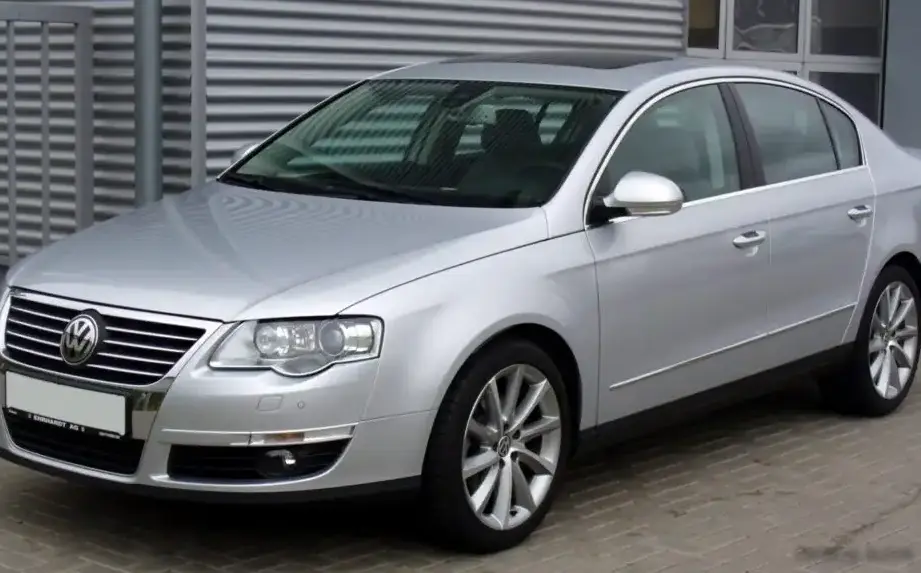
The Volkswagen Passat B6 1.4 TSI (122 hp) represents a significant entry point into the mid-size sedan market during its production run from October 2007 to July 2010. Positioned as a more accessible option within the B6 Passat range, this variant aimed to balance fuel efficiency with reasonable performance. It was a key offering in European markets, where smaller displacement, turbocharged engines were gaining popularity due to tax incentives and growing environmental awareness. The B6 generation Passat, built on the 1HX0/A3 platform, sought to refine the formula of its predecessor with improved build quality, more sophisticated technology, and a more contemporary design.
Technical Specifications
| Brand | Volkswagen |
| Model | Passat |
| Generation | Passat (B6) |
| Type (Engine) | 1.4 TSI (122 Hp) |
| Start of production | October, 2007 |
| End of production | July, 2010 |
| Powertrain Architecture | Internal Combustion engine |
| Body type | Sedan |
| Seats | 5 |
| Doors | 4 |
| Fuel consumption (urban) | 10 l/100 km (23.5 US mpg) |
| Fuel consumption (extra urban) | 6.1 l/100 km (38.6 US mpg) |
| Fuel consumption (combined) | 7.5 l/100 km (31.4 US mpg) |
| Fuel Type | Petrol (Gasoline) |
| Acceleration 0 – 100 km/h | 11.4 sec |
| Acceleration 0 – 62 mph | 11.4 sec |
| Acceleration 0 – 60 mph | 10.8 sec |
| Maximum speed | 203 km/h (126.14 mph) |
| Emission standard | Euro 4 |
| Weight-to-power ratio | 10.9 kg/Hp |
| Weight-to-torque ratio | 6.7 kg/Nm |
| Power | 122 Hp @ 5000 rpm |
| Torque | 200 Nm @ 1500-4000 rpm (147.51 lb.-ft.) |
| Engine layout | Front, Transverse |
| Engine Model/Code | CAXA |
| Engine displacement | 1390 cm3 (84.82 cu. in.) |
| Number of cylinders | 4 |
| Engine configuration | Inline |
| Cylinder Bore | 76.5 mm (3.01 in.) |
| Piston Stroke | 75.6 mm (2.98 in.) |
| Compression ratio | 10:1 |
| Number of valves per cylinder | 4 |
| Fuel injection system | Direct injection |
| Engine aspiration | Turbocharger, Intercooler |
| Valvetrain | DOHC |
| Engine oil capacity | 3.6 l (3.8 US qt | 3.17 UK qt) |
| Coolant | 5.6 l (5.92 US qt | 4.93 UK qt) |
| Kerb Weight | 1335 kg (2943.17 lbs.) |
| Max. weight | 2020 kg (4453.34 lbs.) |
| Max load | 685 kg (1510.17 lbs.) |
| Trunk (boot) space – minimum | 565 l (19.95 cu. ft.) |
| Trunk (boot) space – maximum | 1091 l (38.53 cu. ft.) |
| Fuel tank capacity | 70 l (18.49 US gal | 15.4 UK gal) |
| Max. roof load | 100 kg (220.46 lbs.) |
| Permitted trailer load with brakes (8%) | 1600 kg (3527.4 lbs.) |
| Permitted trailer load with brakes (12%) | 1400 kg (3086.47 lbs.) |
| Permitted trailer load without brakes | 740 kg (1631.42 lbs.) |
| Permitted towbar download | 90 kg (198.42 lbs.) |
| Length | 4765 mm (187.6 in.) |
| Width | 1820 mm (71.65 in.) |
| Width including mirrors | 1991 mm (78.39 in.) |
| Height | 1472 mm (57.95 in.) |
| Wheelbase | 2709 mm (106.65 in.) |
| Front track | 1552 mm (61.1 in.) |
| Rear (Back) track | 1551 mm (61.06 in.) |
| Front overhang | 965 mm (37.99 in.) |
| Rear overhang | 1091 mm (42.95 in.) |
| Ride height (ground clearance) | 114 mm (4.49 in.) |
| Drag coefficient (Cd) | 0.281 |
| Minimum turning circle (turning diameter) | 11.4 m (37.4 ft.) |
| Approach angle | 14.4° |
| Departure angle | 12.6° |
| Ramp-over (brakeover) angle | 10.8° |
| Drivetrain Architecture | The Internal combustion engine (ICE) drives the front wheels of the vehicle. |
| Drive wheel | Front wheel drive |
| Number of gears and type of gearbox | 6 gears, manual transmission |
| Front suspension | Spring Strut |
| Rear suspension | Coil spring |
| Front brakes | Ventilated discs |
| Rear brakes | Disc |
| Assisting systems | ABS (Anti-lock braking system) |
| Steering type | Steering rack and pinion |
| Power steering | Electric Steering |
| Tires size | 215/55 R16 |
| Wheel rims size | 6.5J x 16 |
Powertrain & Engine Architecture
The heart of the Passat B6 1.4 TSI was the CAXA engine code, a 1.4-liter inline-four cylinder gasoline engine. This engine was a key example of Volkswagen’s advancements in forced induction and direct injection technology. The CAXA featured a turbocharger with an intercooler, boosting power output to 122 horsepower. Direct fuel injection (FSI) was crucial, allowing for precise fuel delivery and improved combustion efficiency. The engine utilized a dual overhead camshaft (DOHC) valvetrain with four valves per cylinder, optimizing airflow for increased power. The 1.4 TSI engine was known for its relatively smooth operation and willingness to rev, despite its small displacement. The six-speed manual transmission was the standard offering, providing a good balance between fuel economy and driver engagement.
Driving Characteristics
The 1.4 TSI with the manual transmission offered adequate performance for everyday driving. Acceleration from 0-60 mph took around 10.8 seconds, which was competitive for its class but noticeably slower than the more powerful 2.0 TSI or VR6 variants. The turbocharger provided a noticeable boost in power during acceleration, but the engine could feel somewhat strained at higher speeds or when fully loaded. The gear ratios were tuned for fuel efficiency, meaning the engine often needed to be revved to access its peak power. Compared to the 2.0 TSI, the 1.4 TSI felt less refined and had a narrower powerband. However, it offered a more economical driving experience, particularly in urban environments.
Equipment & Trim Levels
The 1.4 TSI typically represented the entry-level trim in many European markets. Standard equipment generally included air conditioning, power windows, central locking, and an audio system. Safety features such as ABS, airbags, and electronic stability control were also standard. Optional extras included alloy wheels, a sunroof, upgraded audio systems, and parking sensors. Interior upholstery was typically cloth, with a functional but not luxurious design. The dashboard layout was consistent across the B6 range, featuring a clear instrument cluster and logically arranged controls.
Chassis & Braking
The Passat B6 1.4 TSI utilized a MacPherson strut front suspension and a multi-link rear suspension, providing a comfortable and controlled ride. The suspension was tuned for everyday driving, prioritizing comfort over outright sportiness. Brakes consisted of ventilated discs at the front and solid discs at the rear. ABS (Anti-lock Braking System) was standard, enhancing braking performance and stability. The steering was a rack-and-pinion system with electric power assistance, offering a light and precise feel.
Market Reception & Comparison
The Passat B6 1.4 TSI was generally well-received as an economical and practical family sedan. Critics praised its fuel efficiency and comfortable ride, but some noted its lack of outright performance compared to higher-powered variants. Compared to the 2.0 TDI diesel, the 1.4 TSI offered a quieter and smoother driving experience, but with slightly higher fuel consumption. Against competitors like the Ford Mondeo and Opel/Vauxhall Insignia, the Passat B6 1.4 TSI held its own in terms of build quality and refinement.
Legacy
The CAXA 1.4 TSI engine proved to be a relatively reliable unit, although early versions were sometimes prone to issues with the turbocharger and fuel injectors. Regular maintenance, including oil changes and timely replacement of wear items, is crucial for long-term reliability. Today, the Passat B6 1.4 TSI can be found on the used car market at affordable prices. It represents a good value proposition for buyers seeking a comfortable, economical, and reasonably well-equipped mid-size sedan. However, potential buyers should be aware of the potential for age-related issues and ensure a thorough inspection before purchase.