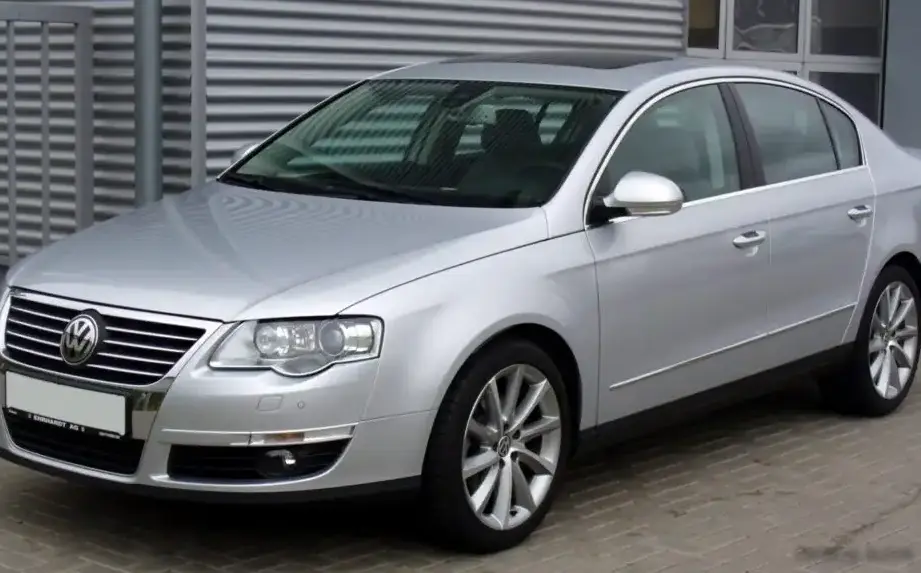
The Volkswagen Passat B6 1.6 TDI BMT (105 hp) was a variant of the sixth-generation Passat, produced between 2009 and 2010. Positioned as an entry-level diesel option, particularly in European markets, it aimed to offer fuel efficiency and reasonable running costs within the Passat range. This model utilized Volkswagen’s Common Rail TDI technology, focusing on maximizing economy rather than outright performance. It played a role in broadening the Passat’s appeal to a wider customer base seeking a practical and economical family sedan.
Technical Specifications
| Brand | Volkswagen |
| Model | Passat |
| Generation | Passat (B6) |
| Type (Engine) | 1.6 TDI BMT (105 Hp) |
| Start of production | 2009 |
| End of production | 2010 |
| Powertrain Architecture | Internal Combustion engine |
| Body type | Sedan |
| Seats | 5 |
| Doors | 4 |
| Fuel consumption (economy) – urban (NEDC) | 5.5 l/100 km (42.8 US mpg, 51.4 UK mpg, 18.2 km/l) |
| Fuel consumption (economy) – extra urban (NEDC) | 3.8 l/100 km (61.9 US mpg, 74.3 UK mpg, 26.3 km/l) |
| Fuel consumption (economy) – combined (NEDC) | 4.5 l/100 km (52.3 US mpg, 62.8 UK mpg, 22.2 km/l) |
| CO2 emissions (NEDC) | 118 g/km |
| Fuel Type | Diesel |
| Acceleration 0 – 100 km/h | 12.4 sec |
| Acceleration 0 – 62 mph | 12.4 sec |
| Acceleration 0 – 60 mph | 11.8 sec |
| Maximum speed | 193 km/h (119.92 mph) |
| Emission standard | Euro 5 |
| Weight-to-power ratio | 13.4 kg/Hp, 74.4 Hp/tonne |
| Weight-to-torque ratio | 5.6 kg/Nm, 177.2 Nm/tonne |
| Power | 105 Hp @ 4400 rpm |
| Power per litre | 65.7 Hp/l |
| Torque | 250 Nm @ 1500-2500 rpm (184.39 lb.-ft. @ 1500-2500 rpm) |
| Engine layout | Front, Transverse |
| Engine Model/Code | CAYC |
| Engine displacement | 1598 cm3 (97.52 cu. in.) |
| Number of cylinders | 4 |
| Engine configuration | Inline |
| Number of valves per cylinder | 4 |
| Fuel injection system | Diesel Commonrail |
| Engine aspiration | Turbocharger, Intercooler |
| Valvetrain | DOHC |
| Engine oil capacity | 4.3 l (4.54 US qt | 3.78 UK qt) |
| Kerb Weight | 1411 kg (3110.72 lbs.) |
| Max. weight | 2000 kg (4409.25 lbs.) |
| Max load | 589 kg (1298.52 lbs.) |
| Trunk (boot) space – minimum | 565 l (19.95 cu. ft.) |
| Trunk (boot) space – maximum | 1091 l (38.53 cu. ft.) |
| Fuel tank capacity | 70 l (18.49 US gal | 15.4 UK gal) |
| Max. roof load | 100 kg (220.46 lbs.) |
| Permitted trailer load with brakes (8%) | 1600 kg (3527.4 lbs.) |
| Permitted trailer load with brakes (12%) | 1400 kg (3086.47 lbs.) |
| Permitted trailer load without brakes | 740 kg (1631.42 lbs.) |
| Permitted towbar download | 90 kg (198.42 lbs.) |
| Length | 4765 mm (187.6 in.) |
| Width | 1820 mm (71.65 in.) |
| Width including mirrors | 1991 mm (78.39 in.) |
| Height | 1472 mm (57.95 in.) |
| Wheelbase | 2709 mm (106.65 in.) |
| Front track | 1552 mm (61.1 in.) |
| Rear (Back) track | 1551 mm (61.06 in.) |
| Ride height (ground clearance) | 114 mm (4.49 in.) |
| Minimum turning circle (turning diameter) | 11.4 m (37.4 ft.) |
| Front suspension | Independent type McPherson, Transverse stabilizer |
| Rear suspension | Independent multi-link suspension, Transverse stabilizer |
| Front brakes | Ventilated discs |
| Rear brakes | Disc |
| Assisting systems | ABS (Anti-lock braking system) |
| Steering type | Steering rack and pinion |
| Power steering | Electric Steering |
| Tires size | 205/55 R 16 |
| Wheel rims size | 6.5 J x 16 |
Powertrain & Engine Architecture
The Passat B6 1.6 TDI BMT utilized the CAYC engine code, a 1.6-liter inline-four cylinder diesel engine. This engine was part of Volkswagen’s efforts to offer smaller displacement diesel options with improved fuel economy. It featured a turbocharger with an intercooler to boost power output, and employed a Diesel Common Rail (CR) fuel injection system. The CR system allowed for precise control of fuel delivery, optimizing combustion and reducing emissions. The engine also incorporated a Diesel Particulate Filter (DPF) to further minimize particulate matter emissions, meeting the stringent Euro 5 emission standards. The BMT designation (BlueMotion Technology) indicated the inclusion of various fuel-saving technologies, such as start-stop functionality and regenerative braking. The engine’s valvetrain was a Double Overhead Camshaft (DOHC) design with four valves per cylinder, contributing to efficient gas exchange. This engine was typically paired with a 5-speed manual transmission, though a 7-speed DSG (Direct-Shift Gearbox) was also available as an option.
Driving Characteristics
The 105 hp output and 250 Nm of torque delivered by the 1.6 TDI BMT engine resulted in modest, but adequate, performance. Acceleration from 0-100 km/h (0-62 mph) took approximately 12.4 seconds, making it noticeably slower than Passat variants equipped with larger engines like the 2.0 TDI. The engine’s torque peak, available from 1500-2500 rpm, provided reasonable responsiveness for everyday driving situations. However, overtaking maneuvers required careful planning. The 5-speed manual transmission was geared for economy, with taller ratios contributing to lower fuel consumption at highway speeds. Compared to the more powerful TDI variants, the 1.6 TDI BMT felt less refined and exhibited more engine noise, particularly under heavy acceleration. The focus was clearly on fuel efficiency and practicality rather than sporty driving dynamics.
Equipment & Trim Levels
The 1.6 TDI BMT typically represented the entry-level diesel trim in the Passat B6 range. Standard equipment generally included air conditioning, electric front windows, central locking, and a basic audio system. Safety features such as ABS, front airbags, and seatbelt pretensioners were also standard. Interior upholstery was typically cloth, and the dashboard featured a functional, if somewhat basic, design. Optional extras included alloy wheels, a more advanced audio system, rear parking sensors, and climate control. Higher trim levels offered additional features like leather upholstery, upgraded infotainment systems, and automatic headlights and wipers.
Chassis & Braking
The Passat B6 1.6 TDI BMT utilized an independent suspension setup, with McPherson struts at the front and a multi-link suspension at the rear. This configuration provided a comfortable ride quality, absorbing bumps and imperfections in the road surface effectively. Stabilizer bars were fitted to both axles to reduce body roll during cornering. The braking system consisted of ventilated discs at the front and solid discs at the rear, providing adequate stopping power for the vehicle’s weight and performance. ABS (Anti-lock Braking System) was standard, enhancing braking stability in emergency situations.
Market Reception & Comparison
The Passat B6 1.6 TDI BMT was generally well-received by critics as a fuel-efficient and practical family car. Its low running costs and reasonable comfort levels made it an attractive option for drivers prioritizing economy. However, its modest performance was often criticized, particularly when compared to the more powerful TDI variants. Fuel economy figures of around 4.5 l/100 km (52.3 US mpg) were highly competitive for its class. Compared to the 2.0 TDI models, the 1.6 TDI BMT offered lower purchase price and running costs, but at the expense of performance and refinement. The 2.0 TDI was favored by drivers who frequently undertook long journeys or required more power for towing or carrying heavy loads.
Legacy
The 1.6 TDI BMT engine, while not known for its longevity or robustness compared to some of Volkswagen’s other diesel engines, proved to be reasonably reliable in properly maintained examples. Common issues included DPF blockages, particularly in vehicles primarily used for short journeys, and potential problems with the turbocharger. In the used car market, the Passat B6 1.6 TDI BMT remains an affordable option for those seeking a practical and economical family sedan. However, potential buyers should be aware of the potential maintenance costs associated with the DPF and turbocharger, and ensure that the vehicle has been regularly serviced.