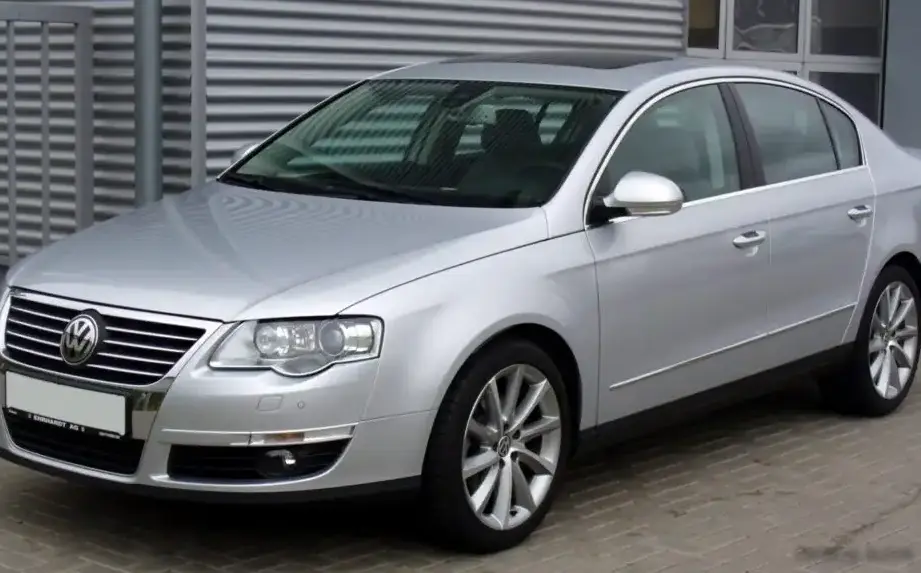
The Volkswagen Passat B6 2.0 FSI 4MOTION, produced from February 2005 to April 2010, represents a significant iteration of Volkswagen’s mid-size executive car. This variant, powered by the 150 horsepower 2.0-liter FSI engine and equipped with Volkswagen’s 4MOTION all-wheel-drive system, occupied a middle ground within the B6 Passat lineup, offering a blend of performance, practicality, and all-weather capability. It was primarily marketed in Europe and other regions where all-wheel drive was highly valued, providing a more secure driving experience in inclement conditions compared to front-wheel-drive Passat models.
Technical Specifications
| Brand | Volkswagen |
| Model | Passat |
| Generation | Passat (B6) |
| Type (Engine) | 2.0 FSI (150 Hp) 4MOTION |
| Start of production | February, 2005 |
| End of production | April, 2010 |
| Powertrain Architecture | Internal Combustion engine |
| Body type | Sedan |
| Seats | 5 |
| Doors | 4 |
| Fuel consumption (urban) | 11.9 l/100 km (19.8 US mpg, 23.7 UK mpg, 8.4 km/l) |
| Fuel consumption (extra urban) | 6.5 l/100 km (36.2 US mpg, 43.5 UK mpg, 15.4 km/l) |
| Fuel consumption (combined) | 8.5 l/100 km (27.7 US mpg, 33.2 UK mpg, 11.8 km/l) |
| Fuel Type | Petrol (Gasoline) |
| Acceleration 0 – 100 km/h | 10.2 sec |
| Acceleration 0 – 62 mph | 10.2 sec |
| Acceleration 0 – 60 mph | 9.7 sec |
| Maximum speed | 209 km/h (129.87 mph) |
| Emission standard | Euro 4 |
| Weight-to-power ratio | 9.4 kg/Hp, 105.9 Hp/tonne |
| Weight-to-torque ratio | 7.1 kg/Nm, 141.1 Nm/tonne |
| Power | 150 Hp @ 6000 rpm |
| Power per litre | 75.6 Hp/l |
| Torque | 200 Nm @ 3500 rpm (147.51 lb.-ft. @ 3500 rpm) |
| Engine layout | Front, Transverse |
| Engine Model/Code | BLR |
| Engine displacement | 1984 cm3 (121.07 cu. in.) |
| Number of cylinders | 4 |
| Engine configuration | Inline |
| Cylinder Bore | 82.5 mm (3.25 in.) |
| Piston Stroke | 92.8 mm (3.65 in.) |
| Compression ratio | 11.5:1 |
| Number of valves per cylinder | 4 |
| Fuel injection system | Direct injection |
| Engine aspiration | Naturally aspirated engine |
| Valvetrain | DOHC |
| Engine oil capacity | 4.6 l (4.86 US qt | 4.05 UK qt) |
| Coolant | 8 l (8.45 US qt | 7.04 UK qt) |
| Kerb Weight | 1417 kg (3123.95 lbs.) |
| Max. weight | 2100 kg (4629.71 lbs.) |
| Max load | 683 kg (1505.76 lbs.) |
| Trunk (boot) space – minimum | 541 l (19.11 cu. ft.) |
| Trunk (boot) space – maximum | 1067 l (37.68 cu. ft.) |
| Fuel tank capacity | 68 l (17.96 US gal | 14.96 UK gal) |
| Max. roof load | 100 kg (220.46 lbs.) |
| Permitted trailer load with brakes (8%) | 1800 kg (3968.32 lbs.) |
| Permitted trailer load with brakes (12%) | 1600 kg (3527.4 lbs.) |
| Permitted trailer load without brakes | 750 kg (1653.47 lbs.) |
| Permitted towbar download | 90 kg (198.42 lbs.) |
| Length | 4765 mm (187.6 in.) |
| Width | 1820 mm (71.65 in.) |
| Width including mirrors | 1991 mm (78.39 in.) |
| Height | 1472 mm (57.95 in.) |
| Wheelbase | 2709 mm (106.65 in.) |
| Front track | 1552 mm (61.1 in.) |
| Rear (Back) track | 1551 mm (61.06 in.) |
| Front overhang | 965 mm (37.99 in.) |
| Rear overhang | 1091 mm (42.95 in.) |
| Ride height (ground clearance) | 114 mm (4.49 in.) |
| Drag coefficient (Cd) | 0.281 |
| Minimum turning circle (turning diameter) | 11.4 m (37.4 ft.) |
| Approach angle | 14.4° |
| Departure angle | 12.6° |
| Ramp-over (brakeover) angle | 10.8° |
| Drivetrain Architecture | The Internal combustion engine (ICE) drives the front wheels permanently, and the rear wheels are driven through an electrically or mechanically operated clutch if necessary. |
| Drive wheel | All wheel drive (4×4) |
| Number of gears and type of gearbox | 6 gears, manual transmission |
| Front suspension | Spring Strut |
| Rear suspension | Coil spring |
| Front brakes | Ventilated discs |
| Rear brakes | Disc |
| Assisting systems | ABS (Anti-lock braking system) |
| Steering type | Steering rack and pinion |
| Tires size | 215/55 R16 |
| Wheel rims size | 6.5J x 16 |
INTRODUCTION
The Volkswagen Passat B6, launched in 2005, represented a significant step forward for the model, built on the 1HX0/A3 platform. The 2.0 FSI 4MOTION variant was introduced as a compelling option for drivers seeking a balance between performance, fuel efficiency, and all-weather capability. Positioned as a mid-range offering, it sat above the base 1.6-liter models and below the more powerful 3.2-liter V6 and diesel variants. This model aimed to appeal to families and business users who required a comfortable, reliable, and safe vehicle for everyday use, particularly in regions prone to challenging weather conditions.
Powertrain & Engine Architecture
At the heart of the Passat B6 2.0 FSI 4MOTION lies the BLR engine code, a 1.984-liter inline-four cylinder gasoline engine. The “FSI” designation stands for Fuel Stratified Injection, a direct injection system developed by Volkswagen. This system injects fuel directly into the combustion chamber, allowing for more precise fuel control, improved combustion efficiency, and increased power output compared to traditional port fuel injection. The engine features a double overhead camshaft (DOHC) valvetrain with four valves per cylinder, optimizing airflow for enhanced performance. The 4MOTION system utilizes a Haldex multi-plate clutch to distribute torque between the front and rear axles as needed, providing enhanced traction and stability. The standard transmission for this variant was a 6-speed manual, although a 6-speed automatic transmission was also available as an option.
Driving Characteristics
The 150 horsepower and 200 Nm (147.51 lb-ft) of torque delivered by the 2.0 FSI engine provided adequate performance for everyday driving. Acceleration from 0 to 60 mph took approximately 9.7 seconds, and the car had a top speed of 209 km/h (129.87 mph). While not a sports car, the 2.0 FSI 4MOTION offered a smooth and refined driving experience. The 4MOTION system significantly improved handling and stability, particularly on slippery surfaces. Compared to the front-wheel-drive Passats, the 4MOTION variant exhibited reduced understeer and enhanced cornering grip. The automatic transmission, when equipped, offered smooth gear changes, but some drivers found it to be less responsive than the manual gearbox. The gear ratios were tuned for a balance between fuel economy and performance, prioritizing comfortable cruising over outright acceleration.
Equipment & Trim Levels
The Passat B6 2.0 FSI 4MOTION typically came equipped with a respectable level of standard features. These included air conditioning, power windows, power mirrors, a CD stereo system, and alloy wheels. Higher trim levels offered additional features such as leather upholstery, a sunroof, automatic climate control, and a premium sound system. Safety features included ABS brakes, traction control, and multiple airbags. Optional extras included navigation systems, parking sensors, and heated seats. Interior upholstery was typically cloth, with leather available as an upgrade. The dashboard layout was functional and well-designed, with clear instrumentation and intuitive controls.
Chassis & Braking
The Passat B6 featured a MacPherson strut front suspension and a multi-link rear suspension, providing a comfortable ride and good handling characteristics. The 4MOTION variants often had slightly stiffer suspension components to compensate for the added weight of the all-wheel-drive system. Braking duties were handled by ventilated disc brakes at the front and solid disc brakes at the rear. ABS (Anti-lock Braking System) was standard, enhancing braking performance and stability. The steering system was a rack-and-pinion setup, providing precise and responsive steering feel.
Market Reception & Comparison
The Passat B6 2.0 FSI 4MOTION was generally well-received by automotive critics. It was praised for its comfortable ride, spacious interior, and all-weather capability. However, some critics noted that the 2.0 FSI engine could feel somewhat underpowered, especially when fully loaded. Compared to the more powerful 3.2-liter V6, the 2.0 FSI offered significantly better fuel economy, but at the expense of performance. The 2.0 TDI diesel variants were also popular, offering even better fuel economy and comparable torque, but with a different driving experience. The 4MOTION system added to the vehicle’s cost, but many buyers considered it a worthwhile investment for the added safety and security it provided.
Legacy
The Volkswagen Passat B6 2.0 FSI 4MOTION has proven to be a relatively reliable vehicle, although some owners have reported issues with the FSI direct injection system, such as carbon buildup on the intake valves. Regular maintenance, including the use of high-quality fuel and oil, is crucial for ensuring long-term reliability. Today, the B6 Passat 2.0 FSI 4MOTION can be found on the used car market at affordable prices. It remains a popular choice for buyers seeking a comfortable, practical, and capable mid-size sedan with all-wheel drive. Its blend of features, performance, and reliability continues to make it a compelling option in the used car segment.