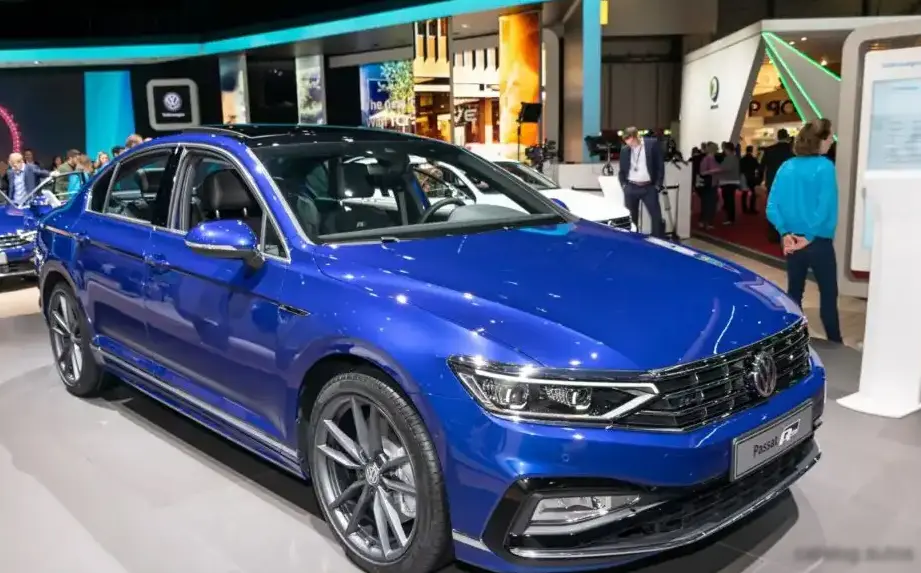
The Volkswagen Passat B8 facelift, specifically the 1.5 TSI (150 hp) variant equipped with a 7-speed Dual Clutch Gearbox (DSG) and Active Cylinder Technology (ACT), was a key offering in the European market from September 2019 to 2021. Positioned as a mid-range option within the B8 facelift lineup, it aimed to balance fuel efficiency with acceptable performance for everyday driving. This version represented Volkswagen’s continued refinement of the Passat, a model historically known for its practicality, comfort, and understated design. The B8 generation, and this facelift in particular, sought to modernize the Passat while retaining its core values, competing directly with rivals like the Ford Mondeo, Opel Insignia, and Skoda Superb.
Technical Specifications
| Brand | Volkswagen |
| Model | Passat |
| Generation | Passat (B8, facelift 2019) |
| Type (Engine) | 1.5 TSI (150 Hp) DSG ACT |
| Start of production | September, 2019 |
| End of production | 2021 |
| Powertrain Architecture | Internal Combustion engine |
| Body type | Sedan |
| Seats | 5 |
| Doors | 4 |
| Fuel consumption at Low speed (WLTP) | 8.5-8.6 l/100 km (27.7 – 27.4 US mpg, 33.2 – 32.8 UK mpg, 11.8 – 11.6 km/l) |
| Fuel consumption at Medium speed (WLTP) | 6.2-6.3 l/100 km (37.9 – 37.3 US mpg, 45.6 – 44.8 UK mpg, 16.1 – 15.9 km/l) |
| Fuel consumption at high speed (WLTP) | 5.3-5.4 l/100 km (44.4 – 43.6 US mpg, 53.3 – 52.3 UK mpg, 18.9 – 18.5 km/l) |
| Fuel consumption at very high speed (WLTP) | 6.1-6.2 l/100 km (38.6 – 37.9 US mpg, 46.3 – 45.6 UK mpg, 16.4 – 16.1 km/l) |
| Combined fuel consumption (WLTP) | 6.2-6.3 l/100 km (37.9 – 37.3 US mpg, 45.6 – 44.8 UK mpg, 16.1 – 15.9 km/l) |
| CO2 emissions (WLTP) | 140-143 g/km |
| Fuel consumption (economy) – urban (NEDC) | 6.6-6.7 l/100 km (35.6 – 35.1 US mpg, 42.8 – 42.2 UK mpg, 15.2 – 14.9 km/l) |
| Fuel consumption (economy) – extra urban (NEDC) | 4.3-4.5 l/100 km (54.7 – 52.3 US mpg, 65.7 – 62.8 UK mpg, 23.3 – 22.2 km/l) |
| Fuel consumption (economy) – combined (NEDC) | 5.1-5.3 l/100 km (46.1 – 44.4 US mpg, 55.4 – 53.3 UK mpg, 19.6 – 18.9 km/l) |
| CO2 emissions (NEDC) | 117-121 g/km |
| Fuel Type | Petrol (Gasoline) |
| Acceleration 0 – 100 km/h | 8.7 sec |
| Acceleration 0 – 62 mph | 8.7 sec |
| Acceleration 0 – 60 mph | 8.3 sec |
| Maximum speed | 220 km/h (136.7 mph) |
| Emission standard | EURO 6d – TEMP – EVAP – ISC |
| Weight-to-power ratio | 9.1 kg/Hp, 110.3 Hp/tonne |
| Weight-to-torque ratio | 5.4 kg/Nm, 183.8 Nm/tonne |
| Power | 150 Hp @ 5000-6000 rpm |
| Power per litre | 100.1 Hp/l |
| Torque | 250 Nm @ 1500-3500 rpm (184.39 lb.-ft. @ 1500-3500 rpm) |
| Engine layout | Front, Transverse |
| Engine Model/Code | DPCA |
| Engine displacement | 1498 cm3 (91.41 cu. in.) |
| Number of cylinders | 4 |
| Engine configuration | Inline |
| Number of valves per cylinder | 4 |
| Fuel injection system | Direct injection |
| Engine aspiration | Turbocharger, Intercooler |
| Engine oil capacity | 4.3 l (4.54 US qt | 3.78 UK qt) |
| Kerb Weight | 1360 kg (2998.29 lbs.) |
| Max. weight | 1990 kg (4387.2 lbs.) |
| Max load | 630 kg (1388.91 lbs.) |
| Trunk (boot) space – minimum | 586 l (20.69 cu. ft.) |
| Trunk (boot) space – maximum | 1152 l (40.68 cu. ft.) |
| Fuel tank capacity | 66 l (17.44 US gal | 14.52 UK gal) |
| Max. roof load | 100 kg (220.46 lbs.) |
| Permitted trailer load with brakes (8%) | 1900 kg (4188.78 lbs.) |
| Permitted trailer load with brakes (12%) | 1600 kg (3527.4 lbs.) |
| Permitted trailer load without brakes | 710 kg (1565.28 lbs.) |
| Permitted towbar download | 90 kg (198.42 lbs.) |
| Length | 4775-4873 mm (187.99 – 191.85 in.) |
| Width | 1832 mm (72.13 in.) |
| Width including mirrors | 2083 mm (82.01 in.) |
| Height | 1483 mm (58.39 in.) |
| Wheelbase | 2786 mm (109.69 in.) |
| Front track | 1578-1586 mm (62.13 – 62.44 in.) |
| Rear (Back) track | 1564-1572 mm (61.57 – 61.89 in.) |
| Minimum turning circle (turning diameter) | 11.7 m (38.39 ft.) |
| Drivetrain Architecture | The Internal combustion engine (ICE) drives the front wheels of the vehicle. |
| Drive wheel | Front wheel drive |
| Number of gears and type of gearbox | 7 gears, automatic transmission DSG |
| Front brakes | Ventilated discs |
| Rear brakes | Disc |
| Tires size | 215/60 R16; 215/55 R17 |
| Wheel rims size | 6.5 J x 16; 7J x 17 |
INTRODUCTION
The Volkswagen Passat B8 facelift, launched in 2019, represented a significant update to the already popular B8 generation. This refresh included styling changes, updated technology, and revised engine options. The 1.5 TSI 150 hp DSG ACT model was a crucial part of this update, offering a compelling blend of efficiency and performance. Built on the Volkswagen Group’s MQB platform (specifically the A3 variant), the Passat B8 aimed to provide a comfortable and refined driving experience, appealing to families and business users alike. The “ACT” designation refers to Active Cylinder Technology, a fuel-saving feature that deactivates two cylinders under light load conditions.
Powertrain & Engine Architecture
At the heart of this Passat variant lies the DPCA engine, a 1.5-liter turbocharged four-cylinder gasoline engine. This engine is part of Volkswagen’s EA211 family, known for its compact design and efficiency. The DPCA utilizes direct fuel injection, delivering fuel directly into the combustion chamber for improved combustion efficiency and reduced emissions. It also features an exhaust gas recirculation (EGR) system to further lower NOx emissions. The turbocharger, coupled with an intercooler, provides a boost in power and torque. The 150 hp peak power is achieved between 5000 and 6000 rpm, while the 250 Nm (184 lb-ft) of torque is available from 1500 to 3500 rpm. The engine is paired with a 7-speed dual-clutch transmission (DSG), offering quick and smooth gear changes. The DSG transmission contributes to both performance and fuel economy. The Active Cylinder Technology (ACT) shuts down cylinders 2 and 3 during low-load cruising, further enhancing fuel efficiency.
Driving Characteristics
The 1.5 TSI 150 hp DSG Passat offers a comfortable and refined driving experience. While not a performance-oriented model, it provides adequate acceleration for everyday driving situations. The 0-60 mph sprint takes approximately 8.3 seconds, and the top speed is 136.7 mph. The DSG transmission ensures smooth and responsive gear changes, and the ACT system is largely imperceptible during normal driving. Compared to the more powerful 2.0 TSI variants, this engine feels less urgent, particularly during overtaking maneuvers. However, it offers significantly better fuel economy. The gear ratios are tuned for efficiency, with taller gearing in higher gears to reduce engine speed at cruising speeds. The steering is light and precise, making it easy to maneuver in urban environments. The suspension is tuned for comfort, absorbing bumps and imperfections in the road surface effectively.
Equipment & Trim Levels
The 1.5 TSI 150 hp DSG ACT Passat typically came equipped with a generous amount of standard features. These included air conditioning, a touchscreen infotainment system with Apple CarPlay and Android Auto compatibility, Bluetooth connectivity, and a suite of safety features such as ABS, ESC, and multiple airbags. Higher trim levels offered additional features such as leather upholstery, heated seats, a panoramic sunroof, and advanced driver-assistance systems like adaptive cruise control and lane-keeping assist. Interior upholstery was typically cloth on base models, with leather options available on higher trims. Dashboard configuration was consistent across the range, featuring a modern and minimalist design.
Chassis & Braking
The Passat B8 utilizes a MacPherson strut front suspension and a multi-link rear suspension, providing a comfortable and controlled ride. The front brakes are ventilated discs, while the rear brakes are solid discs. ABS (Anti-lock Braking System) and ESC (Electronic Stability Control) are standard features, enhancing safety and stability. Stabilizer bars are fitted to both the front and rear axles to reduce body roll during cornering. The suspension tuning is geared towards comfort, prioritizing ride quality over outright handling performance. The weight distribution is relatively balanced, contributing to predictable handling characteristics.
Market Reception & Comparison
The 1.5 TSI 150 hp DSG Passat was generally well-received by critics, who praised its fuel efficiency, comfortable ride, and refined interior. It was seen as a sensible and practical choice for buyers who prioritized economy and comfort over outright performance. Compared to the 2.0 TSI variants, it offered lower running costs but less exhilarating performance. The 1.8 TSI models, while offering similar power output, were often considered less refined and less fuel-efficient. The diesel variants (like the 2.0 TDI) offered even better fuel economy but came with the potential for higher maintenance costs and concerns about diesel emissions.
Legacy
The 1.5 TSI engine has proven to be a reliable and durable powertrain, although some early versions experienced issues with particulate filter clogging. The DSG transmission, while generally reliable, requires regular maintenance (fluid changes) to ensure longevity. In the used car market, the 1.5 TSI 150 hp DSG Passat represents a good value proposition, offering a comfortable and well-equipped car at a reasonable price. Its fuel efficiency and relatively low running costs make it an attractive option for buyers looking for a practical and economical family car. The B8 Passat, in general, has established a reputation for reliability and build quality, ensuring continued demand in the used car market.