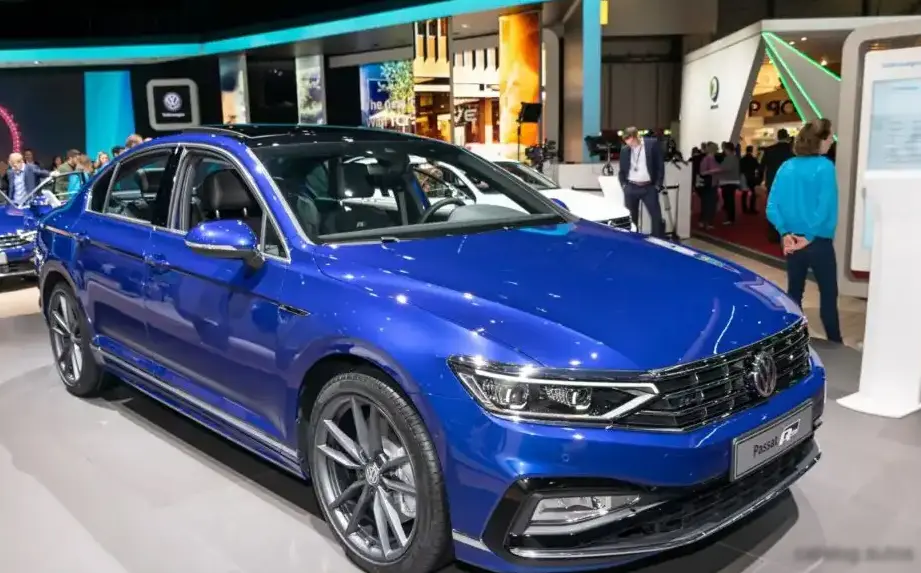
The Volkswagen Passat B8 facelift, produced from 2019 to 2021, represented a significant mid-cycle refresh of the eighth-generation Passat. Among the various engine and transmission options offered, the 2.0 TDI variant with 122 horsepower coupled with a 7-speed Dual Clutch Gearbox (DSG) held a prominent position in many European markets. This configuration aimed to balance fuel efficiency, reasonable performance, and affordability, making it a popular choice for fleet buyers and private customers alike. The B8 Passat, built on the MQB platform, continued Volkswagen’s tradition of offering a practical and comfortable mid-size sedan.
Technical Specifications
| Brand | Volkswagen |
| Model | Passat |
| Generation | Passat (B8, facelift 2019) |
| Type (Engine) | 2.0 TDI (122 Hp) DSG |
| Start of production | 2020 |
| End of production | 2021 |
| Powertrain Architecture | Internal Combustion engine |
| Body type | Sedan |
| Seats | 5 |
| Doors | 4 |
| Fuel consumption at Low speed (WLTP) | 6.3 l/100 km (37.3 US mpg, 44.8 UK mpg, 15.9 km/l) |
| Fuel consumption at Medium speed (WLTP) | 4.5 l/100 km (52.3 US mpg, 62.8 UK mpg, 22.2 km/l) |
| Fuel consumption at high speed (WLTP) | 4.0 l/100 km (58.8 US mpg, 70.6 UK mpg, 25 km/l) |
| Fuel consumption at very high speed (WLTP) | 4.8 l/100 km (49 US mpg, 58.9 UK mpg, 20.8 km/l) |
| Combined fuel consumption (WLTP) | 4.7 l/100 km (50 US mpg, 60.1 UK mpg, 21.3 km/l) |
| CO2 emissions (WLTP) | 123 g/km |
| Fuel consumption (economy) – urban | 5.0-5.1 l/100 km (47 – 46.1 US mpg, 56.5 – 55.4 UK mpg, 20 – 19.6 km/l) |
| Fuel consumption (economy) – extra urban | 3.5-3.7 l/100 km (67.2 – 63.6 US mpg, 80.7 – 76.3 UK mpg, 28.6 – 27 km/l) |
| Fuel consumption (economy) – combined | 4.0-4.2 l/100 km (58.8 – 56 US mpg, 70.6 – 67.3 UK mpg, 25 – 23.8 km/l) |
| CO2 emissions | 106-111 g/km |
| Fuel Type | Diesel |
| Maximum speed | 204 km/h (126.76 mph) |
| Emission standard | Euro 6d-ISC-FCM |
| Weight-to-power ratio | 11.9 kg/Hp, 84 Hp/tonne |
| Weight-to-torque ratio | 5.8 kg/Nm, 172.2 Nm/tonne |
| Power | 122 Hp |
| Power per litre | 62 Hp/l |
| Torque | 250 Nm @ 1500-3250 rpm (184.39 lb.-ft. @ 1500-3250 rpm) |
| Engine layout | Front, Transverse |
| Engine Model/Code | DTRA |
| Engine displacement | 1968 cm3 (120.09 cu. in.) |
| Number of cylinders | 4 |
| Engine configuration | Inline |
| Number of valves per cylinder | 4 |
| Fuel injection system | Diesel Commonrail |
| Engine aspiration | Turbocharger, Intercooler |
| Engine oil capacity | 5.5 l (5.81 US qt | 4.84 UK qt) |
| Kerb Weight | 1452 kg (3201.11 lbs.) |
| Max. weight | 2100 kg (4629.71 lbs.) |
| Max load | 648 kg (1428.6 lbs.) |
| Trunk (boot) space – minimum | 586 l (20.69 cu. ft.) |
| Trunk (boot) space – maximum | 1152 l (40.68 cu. ft.) |
| Fuel tank capacity | 59 l (15.59 US gal | 12.98 UK gal) |
| AdBlue tank | 16 l (4.23 US gal | 3.52 UK gal) |
| Max. roof load | 100 kg (220.46 lbs.) |
| Permitted trailer load with brakes (8%) | 1800 kg (3968.32 lbs.) |
| Permitted trailer load with brakes (12%) | 1500 kg (3306.93 lbs.) |
| Permitted trailer load without brakes | 750 kg (1653.47 lbs.) |
| Permitted towbar download | 90 kg (198.42 lbs.) |
| Length | 4775-4873 mm (187.99 – 191.85 in.) |
| Width | 1832 mm (72.13 in.) |
| Width including mirrors | 2083 mm (82.01 in.) |
| Height | 1483 mm (58.39 in.) |
| Wheelbase | 2786 mm (109.69 in.) |
| Front track | 1578-1586 mm (62.13 – 62.44 in.) |
| Rear (Back) track | 1564-1572 mm (61.57 – 61.89 in.) |
| Minimum turning circle (turning diameter) | 11.7 m (38.39 ft.) |
| Drivetrain Architecture | The Internal combustion engine (ICE) drives the front wheels of the vehicle. |
| Drive wheel | Front wheel drive |
| Number of gears and type of gearbox | 7 gears, automatic transmission DSG |
| Front brakes | Disc |
| Rear brakes | Disc |
| Assisting systems | ABS (Anti-lock braking system) |
| Steering type | Steering rack and pinion |
| Power steering | Electric Steering |
| Tires size | 215/60 R16; 215/55 R17 |
| Wheel rims size | 6.5J x 16; 7J x 17 |
INTRODUCTION
The Volkswagen Passat B8 facelift 2.0 TDI 122 hp DSG, produced between 2020 and 2021, was a key variant within the refreshed eighth-generation Passat lineup. Positioned as a mid-range offering, it catered to buyers seeking a balance between fuel economy, acceptable performance, and the convenience of an automatic transmission. This model built upon the foundation of the B8 Passat, which debuted in 2014, and benefited from the facelift’s updated styling, enhanced technology, and refined engine options. The 2.0 TDI engine, a staple in Volkswagen’s European offerings, was paired with the ubiquitous 7-speed DSG transmission, providing smooth and efficient gear changes.
Powertrain & Engine Architecture
The heart of this Passat variant is the DTRA engine code, a 2.0-liter four-cylinder turbocharged diesel engine. This engine utilizes a common rail direct injection system, delivering fuel directly into the combustion chamber at extremely high pressure for optimized combustion. The turbocharger, coupled with an intercooler, forces more air into the engine, boosting power output. The engine features four valves per cylinder, contributing to efficient gas exchange. The 7-speed DSG (Direct-Shift Gearbox) is a dual-clutch transmission that offers both automatic and manual shifting capabilities. It essentially combines two separate manual gearboxes within one housing, allowing for incredibly fast and seamless gear changes. The DSG in this application is tuned for fuel efficiency and smooth operation, prioritizing comfort over outright performance. The engine produces peak torque of 250 Nm (184.39 lb.-ft.) between 1500 and 3250 rpm, providing a broad and usable powerband.
Driving Characteristics
The 122 hp 2.0 TDI with the DSG transmission delivers adequate, though not exhilarating, performance. Acceleration from 0 to 100 km/h (0-62 mph) takes around 10.2 seconds, and the top speed is 204 km/h (126.76 mph). The DSG transmission contributes to a smooth driving experience, with quick and precise gear changes. Compared to the more powerful TDI variants (like the 150 hp or 200 hp versions), this model feels less responsive, particularly during overtaking maneuvers. However, the lower power output also translates to improved fuel economy. The gear ratios in the DSG are optimized for both fuel efficiency and everyday drivability, with taller gears for relaxed cruising on the highway. The engine is relatively quiet and refined, minimizing noise and vibration in the cabin.
Equipment & Trim Levels
The 2.0 TDI 122 hp DSG Passat typically came equipped with a respectable level of standard features. These generally included air conditioning, power windows, power mirrors, a touchscreen infotainment system with Bluetooth connectivity, and basic safety features like ABS, ESP (Electronic Stability Program), and multiple airbags. Higher trim levels, such as Comfortline or Highline, added features like automatic climate control, upgraded infotainment systems with navigation, leather upholstery, parking sensors, and adaptive cruise control. Optional extras included a panoramic sunroof, premium sound system, and various driver assistance systems.
Chassis & Braking
The Passat B8 utilizes a MacPherson strut front suspension and a multi-link rear suspension, providing a comfortable and controlled ride. The suspension is tuned to prioritize comfort over sporty handling. Brakes are disc brakes on all four wheels, providing adequate stopping power. ABS (Anti-lock Braking System) and ESP (Electronic Stability Program) are standard features, enhancing safety and stability. The steering is electric power-assisted, offering a light and precise feel. Stabilizer bars are fitted to both the front and rear axles to reduce body roll during cornering.
Market Reception & Comparison
The 2.0 TDI 122 hp DSG Passat was generally well-received by automotive critics as a practical and efficient family sedan. It was praised for its comfortable ride, spacious interior, and fuel economy. However, some critics noted that the engine lacked the punch of the more powerful TDI variants. Compared to the 1.5 TSI petrol engine, the 2.0 TDI offered better fuel economy and torque, but the petrol engine was generally smoother and more refined. The 2.0 TDI was also often compared to similar offerings from competitors like the Ford Mondeo, Opel Insignia, and Skoda Superb. Its fuel economy figures were competitive within its class, and its reliability was generally considered good.
Legacy
The 2.0 TDI engine, in various iterations, has proven to be a durable and reliable powertrain. However, like many modern diesel engines, it is susceptible to issues related to the diesel particulate filter (DPF) if not properly maintained. Regular servicing and the use of high-quality diesel fuel are crucial for ensuring long-term reliability. On the used car market, the B8 Passat 2.0 TDI 122 hp DSG remains a popular choice due to its practicality, fuel efficiency, and relatively affordable price. It represents a solid and dependable option for buyers seeking a comfortable and economical mid-size sedan.