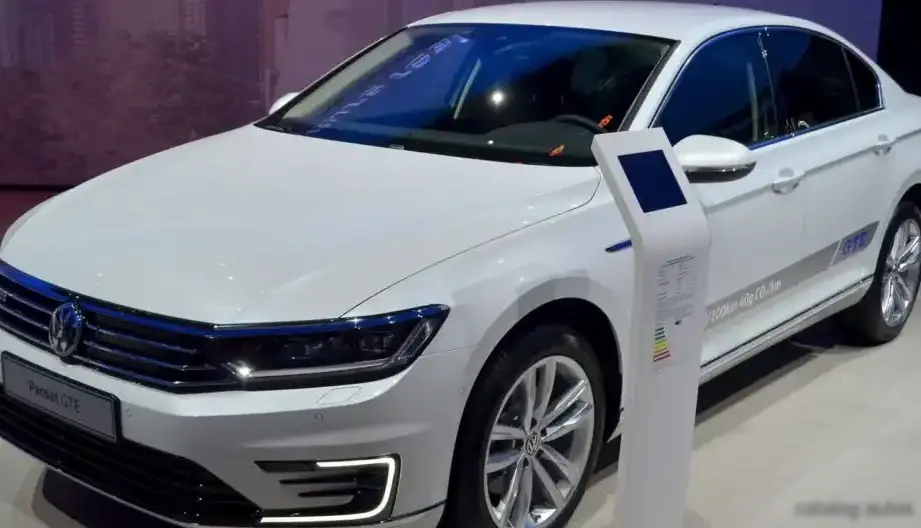
The Volkswagen Passat B8 GTE 1.4 TSI (218 hp) Plug-in Hybrid, produced from October 2015 to May 2018, represented Volkswagen’s foray into mainstream plug-in hybrid technology within the mid-size sedan segment. Positioned as a premium offering within the B8 Passat range, the GTE aimed to combine the practicality of a family sedan with the efficiency and reduced emissions of a hybrid powertrain. It was primarily marketed in Europe and other markets prioritizing fuel economy and environmental regulations, offering a compelling alternative to traditional gasoline-powered vehicles. The GTE utilized the modular transverse matrix (MQB) platform, specifically the A3 variant, shared with other Volkswagen Group vehicles like the Audi A3 and Skoda Octavia.
Technical Specifications
| Brand | Volkswagen |
| Model | Passat |
| Generation | Passat (B8) |
| Type (Engine) | GTE 1.4 TSI (218 Hp) Plug-in Hybrid DSG |
| Start of production | October, 2015 |
| End of production | May, 2018 |
| Powertrain Architecture | PHEV (Plug-in Hybrid Electric Vehicle) |
| Body type | Sedan |
| Seats | 5 |
| Doors | 4 |
| Fuel consumption (economy) – combined (NEDC) | 1.7-1.8 l/100 km (138.4 – 130.7 US mpg, 166.2 – 156.9 UK mpg, 58.8 – 55.6 km/l) |
| CO2 emissions (NEDC) | 38-40 g/km |
| Fuel Type | Petrol / electricity |
| Acceleration 0 – 100 km/h | 7.4 sec |
| Acceleration 0 – 62 mph | 7.4 sec |
| Acceleration 0 – 60 mph | 7 sec |
| Maximum speed | 225 km/h (139.81 mph) |
| Emission standard | Euro 6 |
| Weight-to-power ratio | 7.6 kg/Hp, 132.4 Hp/tonne |
| Weight-to-torque ratio | 4.1 kg/Nm, 242.9 Nm/tonne |
| Gross battery capacity | 9.9 kWh |
| Battery technology | Lithium-ion (Li-Ion) |
| Battery location | Below the floor, under the rear seats |
| All-electric range (NEDC) | 50 km (31.07 mi) |
| Average Energy consumption (NEDC) | 12.5-13.1 kWh/100 km (20.12 – 21.08 kWh/100 mi, 168 – 160 MPGe, 8 – 7.6 km/kWh, 5 – 4.7 mi/kWh) |
| Max speed (electric) | 130 km/h (80.78 mph) |
| Electric motor power | 115 Hp @ 2500 rpm |
| Electric motor Torque | 330 Nm (243.4 lb.-ft.) |
| Maximum revolutions of the electric motor | 6000 rpm |
| Electric motor location | Between the combustion engine and the transmission |
| System power | 218 Hp |
| System torque | 400 Nm (295.02 lb.-ft.) |
| Power | 156 Hp @ 5000-6000 rpm |
| Power per litre | 111.8 Hp/l |
| Torque | 250 Nm @ 1500-3500 rpm (184.39 lb.-ft. @ 1500-3500 rpm) |
| Engine layout | Front, Transverse |
| Engine Model/Code | CUKC |
| Engine displacement | 1395 cm3 (85.13 cu. in.) |
| Number of cylinders | 4 |
| Engine configuration | Inline |
| Cylinder Bore | 74.5 mm (2.93 in.) |
| Piston Stroke | 80 mm (3.15 in.) |
| Compression ratio | 10.5:1 |
| Number of valves per cylinder | 4 |
| Fuel injection system | Direct injection |
| Engine aspiration | Turbocharger, Intercooler |
| Valvetrain | DOHC |
| Engine oil capacity | 4 l (4.23 US qt | 3.52 UK qt) |
| Kerb Weight | 1647 kg (3631.01 lbs.) |
| Max. weight | 2200 kg (4850.17 lbs.) |
| Max load | 553 kg (1219.16 lbs.) |
| Trunk (boot) space – minimum | 402 l (14.2 cu. ft.) |
| Trunk (boot) space – maximum | 968 l (34.18 cu. ft.) |
| Fuel tank capacity | 50 l (13.21 US gal | 11 UK gal) |
| Max. roof load | 100 kg (220.46 lbs.) |
| Permitted trailer load with brakes (8%) | 1900 kg (4188.78 lbs.) |
| Permitted trailer load with brakes (12%) | 1600 kg (3527.4 lbs.) |
| Permitted trailer load without brakes | 750 kg (1653.47 lbs.) |
| Permitted towbar download | 90 kg (198.42 lbs.) |
| Length | 4767 mm (187.68 in.) |
| Width | 1832 mm (72.13 in.) |
| Width including mirrors | 2083 mm (82.01 in.) |
| Height | 1476 mm (58.11 in.) |
| Wheelbase | 2786 mm (109.69 in.) |
| Front track | 1578-1586 mm (62.13 – 62.44 in.) |
| Rear (Back) track | 1562-1570 mm (61.5 – 61.81 in.) |
| Ride height (ground clearance) | 145 mm (5.71 in.) |
| Minimum turning circle (turning diameter) | 11.7 m (38.39 ft.) |
| Drivetrain Architecture | The Internal combustion engine (ICE) and electric motor drive the front wheels of the car with the ability to work in full electric or mixed mode. |
| Drive wheel | Front wheel drive |
| Number of gears and type of gearbox | 6 gears, automatic transmission DSG |
| Front suspension | Independent type McPherson, Transverse stabilizer |
| Rear suspension | Independent multi-link suspension, Transverse stabilizer |
| Front brakes | Ventilated discs |
| Rear brakes | Disc |
| Assisting systems | ABS (Anti-lock braking system) |
| Steering type | Steering rack and pinion |
| Power steering | Electric Steering |
| Tires size | 215/55 R17; 235/45 R18 |
| Wheel rims size | 6.5J x 17; 7J x 17; 8J x 18 |
Powertrain & Engine Architecture
The Passat GTE’s powertrain centers around the CUKC 1.4-liter turbocharged, direct-injection four-cylinder gasoline engine. This engine, a member of Volkswagen’s EA211 family, produces 156 hp at 5000-6000 rpm and 250 Nm (184 lb-ft) of torque between 1500-3500 rpm. The engine utilizes a Miller cycle for improved efficiency and features an integrated exhaust manifold for faster warm-up times. Complementing the gasoline engine is an 85 kW (115 hp) electric motor, delivering 330 Nm (243 lb-ft) of torque. The electric motor is integrated between the engine and the six-speed DSG dual-clutch transmission. A 9.9 kWh lithium-ion battery pack, located under the rear seats, provides an all-electric range of up to 50 km (31 miles) under the New European Driving Cycle (NEDC) standard. The combined system output is 218 hp and 400 Nm (295 lb-ft) of torque. The GTE can operate in various modes: E-Mode (all-electric), Hybrid Auto, and GTE (sport mode maximizing performance).
Driving Characteristics
The 1.4 TSI GTE with the DSG automatic transmission offers a unique driving experience. In E-Mode, the car provides near-silent and emissions-free driving for shorter commutes. The electric motor’s instant torque provides brisk acceleration at lower speeds. Switching to Hybrid Auto mode seamlessly blends power from both the engine and motor, prioritizing efficiency. GTE mode unleashes the full 218 hp, resulting in a 0-62 mph (0-100 km/h) time of 7.4 seconds. While not as overtly sporty as some Passat variants, the GTE delivers a responsive and engaging driving experience. The DSG transmission provides quick and smooth gear changes, enhancing performance. Compared to the standard 1.4 TSI Passat, the GTE offers significantly improved acceleration and fuel economy, while the higher-output 2.0 TSI models provide more outright performance but at the cost of efficiency.
Equipment & Trim Levels
The Passat GTE typically came well-equipped as standard. Features included climate control, a touchscreen infotainment system with navigation, Bluetooth connectivity, and a suite of safety systems like ABS, ESP, and multiple airbags. GTE-specific styling cues included blue accents on the grille, badging, and interior trim. Upholstery was typically a combination of cloth and Alcantara, with leather options available. Optional extras included adaptive cruise control, a panoramic sunroof, and upgraded sound systems. The GTE trim level generally sat above the base Passat trims, offering a more premium and technologically advanced package.
Chassis & Braking
The Passat GTE utilizes a McPherson strut front suspension and a multi-link rear suspension, providing a comfortable and controlled ride. Stabilizer bars are fitted to both axles to reduce body roll. Braking duties are handled by ventilated discs at the front and solid discs at the rear. ABS (Anti-lock Braking System) and ESC (Electronic Stability Control) are standard features. The suspension tuning is generally geared towards comfort, but the added weight of the battery pack necessitates slightly firmer damping compared to standard Passat models.
Market Reception & Comparison
The Passat GTE was generally well-received by automotive critics, praised for its fuel efficiency, smooth ride, and refined interior. However, some reviewers noted that the all-electric range was somewhat limited compared to newer plug-in hybrids. Compared to the 1.4 TSI non-hybrid Passat, the GTE offered significantly better fuel economy and lower emissions, but at a higher purchase price. Against the 2.0 TDI diesel models, the GTE provided a cleaner alternative, although the diesel variants often offered superior real-world fuel economy on longer journeys.
Legacy
The Volkswagen Passat B8 GTE represented an important step in Volkswagen’s electrification strategy. While not without its limitations, the GTE demonstrated the viability of plug-in hybrid technology in a mainstream family sedan. The powertrain, while generally reliable, can exhibit issues with the DSG transmission and the high-voltage battery pack over time, requiring careful maintenance. On the used car market, the GTE holds its value reasonably well, appealing to buyers seeking a fuel-efficient and environmentally friendly vehicle with a touch of premium appeal. The lessons learned from the GTE paved the way for Volkswagen’s subsequent development of fully electric vehicles like the ID.3 and ID.4.