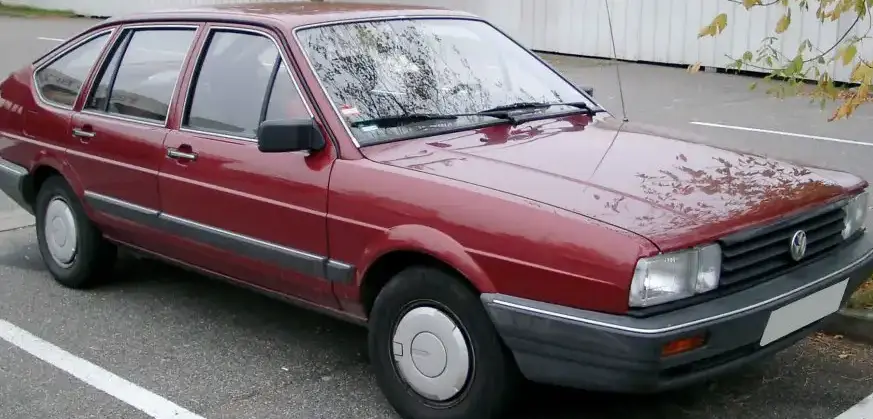
The Volkswagen Passat B2, produced from 1981 to 1988, represented a significant evolution in Volkswagen’s mid-size offerings. The facelifted version introduced in 1985 brought updated styling and refinements. Within the B2 range, the 1.6-liter (70 hp) variant, available from 1987 to 1988, served as the entry point into the Passat lineup, particularly in European markets. This model aimed to provide affordable and practical transportation, prioritizing fuel economy and ease of use over outright performance. It was positioned below the more powerful 1.8 and 2.0-liter options, and significantly below the performance-oriented GTI and VR6 models that would later define the Passat’s image.
Technical Specifications
| Brand | Volkswagen |
| Model | Passat |
| Generation | Passat Hatchback (B2; facelift 1985) |
| Type (Engine) | 1.6 (70 Hp) |
| Start of production | 1987 |
| End of production | 1988 |
| Powertrain Architecture | Internal Combustion engine |
| Body type | Hatchback |
| Seats | 5 |
| Doors | 5 |
| Fuel Type | Petrol (Gasoline) |
| Acceleration 0 – 100 km/h | 14.1 sec |
| Acceleration 0 – 62 mph | 14.1 sec |
| Acceleration 0 – 60 mph | 13.4 sec |
| Maximum speed | 162 km/h (100.66 mph) |
| Weight-to-power ratio | 14.2 kg/Hp, 70.6 Hp/tonne |
| Weight-to-torque ratio | 8.3 kg/Nm, 121 Nm/tonne |
| Power | 70 Hp @ 5200 rpm |
| Power per litre | 43.9 Hp/l |
| Torque | 120 Nm @ 2700 rpm (88.51 lb.-ft. @ 2700 rpm) |
| Engine layout | Front, Longitudinal |
| Engine Model/Code | PP |
| Engine displacement | 1595 cm3 (97.33 cu. in.) |
| Number of cylinders | 4 |
| Engine configuration | Inline |
| Cylinder Bore | 81 mm (3.19 in.) |
| Piston Stroke | 77.4 mm (3.05 in.) |
| Compression ratio | 9.5:1 |
| Number of valves per cylinder | 2 |
| Fuel injection system | Carburettor |
| Engine aspiration | Naturally aspirated engine |
| Valvetrain | OHC |
| Engine oil capacity | 3.5 l (3.7 US qt | 3.08 UK qt) |
| Kerb Weight | 992 kg (2186.99 lbs.) |
| Max. weight | 1460 kg (3218.75 lbs.) |
| Max load | 468 kg (1031.76 lbs.) |
| Trunk (boot) space – minimum | 480 l (16.95 cu. ft.) |
| Trunk (boot) space – maximum | 1542 l (54.46 cu. ft.) |
| Fuel tank capacity | 60 l (15.85 US gal | 13.2 UK gal) |
| Length | 4425 mm (174.21 in.) |
| Width | 1710 mm (67.32 in.) |
| Height | 1385 mm (54.53 in.) |
| Wheelbase | 2550 mm (100.39 in.) |
| Front track | 1414 mm (55.67 in.) |
| Rear (Back) track | 1422 mm (55.98 in.) |
| Drivetrain Architecture | The Internal combustion engine (ICE) drives the front wheels of the vehicle. |
| Drive wheel | Front wheel drive |
| Number of gears and type of gearbox | 4 gears, manual transmission |
| Front suspension | Independent type McPherson |
| Rear suspension | Coil spring |
| Front brakes | Disc |
| Rear brakes | Drum |
| Steering type | Steering rack and pinion |
| Tires size | 175/70 R13 |
| Wheel rims size | 13 |
Powertrain & Engine Architecture
The heart of the Passat 1.6 was the PP engine, a 1595cc inline four-cylinder unit. This engine utilized a single overhead camshaft (OHC) valvetrain with two valves per cylinder. Unlike the fuel-injected engines found in higher-spec Passats, the 1.6 relied on a carburetor for fuel delivery, a cost-saving measure that impacted performance but simplified maintenance. The engine produced 70 horsepower at 5200 rpm and 120 Nm (88.51 lb-ft) of torque at 2700 rpm. The engine was mounted longitudinally in the front of the vehicle, driving the front wheels. The four-speed manual transmission was the standard offering, providing a relatively simple and robust drivetrain.
Driving Characteristics
The 1.6-liter Passat was not known for its blistering acceleration. The 0-60 mph time of around 13.4 seconds reflects its modest power output. However, the engine was reasonably tractable, offering sufficient power for everyday driving. The four-speed gearbox, while not offering the close ratios of a five-speed, was well-suited to the engine’s characteristics. Compared to the 1.8 and 2.0-liter versions, the 1.6 felt noticeably slower, particularly when fully loaded or tackling inclines. The manual transmission allowed for a degree of driver control, but the carburetor’s response wasn’t as crisp or immediate as that of a fuel-injected engine. The focus was on providing a comfortable and economical driving experience rather than sporty performance.
Equipment & Trim Levels
The 1.6-liter Passat typically came with a fairly basic level of equipment. Standard features generally included cloth upholstery, a simple dashboard layout, and manual windows and door locks. Power steering was often an optional extra. The interior was functional and durable, prioritizing practicality over luxury. Optional extras could include a sunroof, upgraded audio systems, and more comfortable seating. The trim level was generally considered the base model, aimed at buyers seeking an affordable and reliable family car.
Chassis & Braking
The Passat B2 featured an independent McPherson strut front suspension and a coil spring rear suspension. This setup provided a reasonable balance between ride comfort and handling. The front brakes were discs, offering adequate stopping power, while the rear brakes were drums, a cost-saving measure common in entry-level models of the time. The steering was a rack and pinion system, providing reasonably precise control. The 175/70 R13 tires were standard, offering a good compromise between grip and fuel economy.
Market Reception & Comparison
The 1.6-liter Passat was generally well-received as an affordable and practical family car. Critics acknowledged its fuel efficiency and reliability, but often noted its lack of performance compared to the higher-spec models. Compared to the 1.8-liter version, the 1.6 offered lower running costs but sacrificed noticeable acceleration. The 2.0-liter models provided a significant performance boost but came at a higher price. The 1.6 appealed to buyers who prioritized economy and practicality over outright performance, making it a popular choice for families and those on a budget.
Legacy
The Passat B2 1.6, while not the most glamorous variant, proved to be a durable and reliable vehicle. The PP engine, despite its carburetor-based fuel system, was generally robust and relatively easy to maintain. Today, these cars are increasingly sought after by classic car enthusiasts and collectors. While finding well-maintained examples can be challenging, the 1.6 offers a relatively affordable entry point into Passat ownership. Its simplicity and reliability make it a rewarding classic to own and drive, offering a glimpse into a bygone era of automotive engineering. Parts availability can be a concern, but many components are still available through specialist suppliers and online marketplaces.