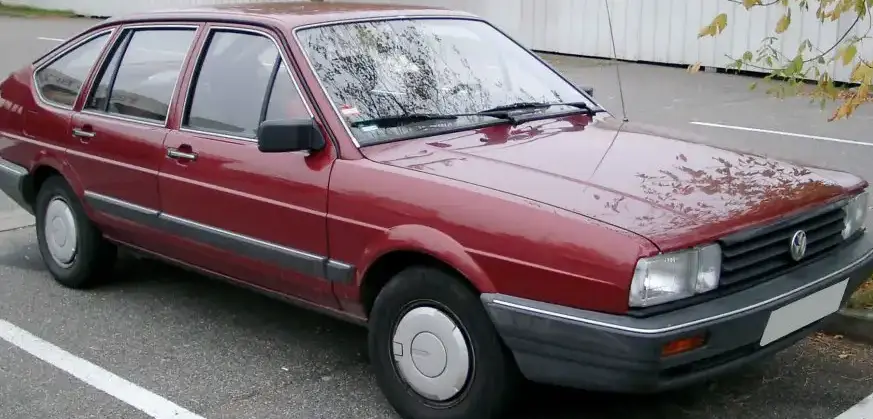
The Volkswagen Passat B2, produced from 1980 to 1988, represented a significant evolution for Volkswagen’s mid-size offering. The 1985 facelift brought updated styling and mechanical refinements. Among the engine options available, the 1.6 TD (70 hp) variant, powered by the CY diesel engine, occupied a specific niche within the lineup, primarily aimed at buyers prioritizing fuel economy and long-distance comfort over outright performance. Production of this specific configuration ran from 1985 to 1988, and it was primarily sold in European markets where diesel engines were highly favored due to taxation and fuel costs.
Technical Specifications
| Brand | Volkswagen |
| Model | Passat |
| Generation | Passat Hatchback (B2; facelift 1985) |
| Type (Engine) | 1.6 TD (70 Hp) |
| Start of production | 1985 |
| End of production | 1988 |
| Powertrain Architecture | Internal Combustion engine |
| Body type | Hatchback |
| Seats | 5 |
| Doors | 5 |
| Fuel Type | Diesel |
| Acceleration 0 – 100 km/h | 15.6 sec |
| Acceleration 0 – 62 mph | 15.6 sec |
| Acceleration 0 – 60 mph | 14.8 sec |
| Maximum speed | 157 km/h (97.56 mph) |
| Weight-to-power ratio | 14.7 kg/Hp, 67.9 Hp/tonne |
| Weight-to-torque ratio | 7.8 kg/Nm, 129 Nm/tonne |
| Power | 70 Hp @ 4500 rpm |
| Power per litre | 44.1 Hp/l |
| Torque | 133 Nm @ 2600 rpm (98.1 lb.-ft. @ 2600 rpm) |
| Engine layout | Front, Longitudinal |
| Engine Model/Code | CY |
| Engine displacement | 1588 cm3 (96.91 cu. in.) |
| Number of cylinders | 4 |
| Engine configuration | Inline |
| Cylinder Bore | 76.5 mm (3.01 in.) |
| Piston Stroke | 86.4 mm (3.4 in.) |
| Compression ratio | 23:1 |
| Number of valves per cylinder | 2 |
| Fuel injection system | Precombustion chamber injection |
| Engine aspiration | Turbocharger |
| Valvetrain | OHC |
| Engine oil capacity | 3.5 l (3.7 US qt | 3.08 UK qt) |
| Coolant | 7 l (7.4 US qt | 6.16 UK qt) |
| Kerb Weight | 1031 kg (2272.97 lbs.) |
| Max. weight | 1540 kg (3395.12 lbs.) |
| Max load | 509 kg (1122.15 lbs.) |
| Trunk (boot) space – minimum | 480 l (16.95 cu. ft.) |
| Trunk (boot) space – maximum | 1542 l (54.46 cu. ft.) |
| Fuel tank capacity | 60 l (15.85 US gal | 13.2 UK gal) |
| Length | 4425 mm (174.21 in.) |
| Width | 1710 mm (67.32 in.) |
| Height | 1385 mm (54.53 in.) |
| Wheelbase | 2550 mm (100.39 in.) |
| Front track | 1414 mm (55.67 in.) |
| Rear (Back) track | 1422 mm (55.98 in.) |
| Drivetrain Architecture | The Internal combustion engine (ICE) drives the front wheels of the vehicle. |
| Drive wheel | Front wheel drive |
| Number of gears and type of gearbox | 5 gears, manual transmission |
| Front suspension | Independent type McPherson |
| Rear suspension | Coil spring |
| Front brakes | Disc |
| Rear brakes | Drum |
| Steering type | Steering rack and pinion |
| Tires size | 175/70 R13 |
| Wheel rims size | 13 |
INTRODUCTION
The Volkswagen Passat B2 1.6 TD represented a practical and economical choice for European drivers in the mid-1980s. Positioned as an entry-level diesel option within the Passat range, it offered a balance between affordability, fuel efficiency, and the practicality of a five-door hatchback. It sat below the more powerful gasoline-powered variants, and also below the later, more sophisticated 1.9 TDI models that would follow. The B2 Passat, in general, was a significant departure from the rear-wheel-drive B1, adopting a front-wheel-drive layout based on the Volkswagen Golf A2 (1HX0/A3 platform), offering improved space utilization and handling characteristics.
Powertrain & Engine Architecture
The heart of the 1.6 TD was the CY engine, a 1.6-liter inline-four diesel engine. This engine utilized a precombustion chamber injection system, a common technology for diesel engines of the era. This system involved injecting fuel into a small precombustion chamber connected to the main cylinder, where it was partially ignited before entering the main combustion chamber. This improved cold-starting performance and reduced engine noise. The engine featured an overhead camshaft (OHC) valvetrain operating two valves per cylinder. A turbocharger was added to boost power output to 70 hp. The engine’s longitudinal mounting within the engine bay was a carryover from the B1 Passat, and dictated the front-wheel-drive drivetrain layout. The 1.6 TD was typically paired with a five-speed manual transmission, although a three-speed automatic transmission was also available, albeit less common. The automatic transmission was known for its smooth operation but contributed to reduced fuel economy and slower acceleration.
Driving Characteristics
The 1.6 TD with the manual transmission offered adequate, though not exhilarating, performance. Acceleration to 60 mph took around 14.8 seconds, and top speed was approximately 97.56 mph. The turbocharger helped to mitigate some of the inherent lag associated with diesel engines, providing a usable boost in torque at higher engine speeds. However, the engine’s 70 hp output meant that overtaking maneuvers required careful planning. The automatic transmission further diminished performance, increasing the 0-60 mph time and reducing overall responsiveness. Gear ratios were optimized for fuel economy rather than outright acceleration. The front-wheel-drive layout provided predictable handling, but the relatively soft suspension tuning prioritized ride comfort over sporty handling.
Equipment & Trim Levels
The 1.6 TD typically came with a relatively basic level of equipment, reflecting its position as an entry-level model. Standard features generally included cloth upholstery, a basic instrument cluster, and manual windows and door locks. Optional extras included power windows, central locking, a sunroof, and upgraded audio systems. Interior trim levels were generally functional and durable, prioritizing practicality over luxury. The dashboard layout was typical of Volkswagen designs of the era, with a clear and straightforward arrangement of controls.
Chassis & Braking
The Passat B2 featured an independent McPherson strut suspension at the front and a coil spring suspension at the rear. This setup provided a comfortable ride, although it wasn’t particularly sporty. The front brakes were discs, providing adequate stopping power, while the rear brakes were drums, a cost-saving measure common in this class of vehicle. Steering was via a rack and pinion system, offering precise and responsive control. The 1.6 TD models typically rode on 175/70 R13 tires mounted on 13-inch steel wheels. Stabilizer bars were fitted to both the front and rear axles to reduce body roll during cornering.
Market Reception & Comparison
The 1.6 TD Passat was well-received in European markets as a fuel-efficient and reliable family car. Critics praised its practicality, spacious interior, and comfortable ride. However, its relatively low power output was often cited as a drawback, particularly when compared to the more powerful gasoline-powered Passat variants, such as the GL models. The 1.9 TDI models, introduced later in the B2 Passat’s lifecycle, offered significantly improved performance and fuel economy, eventually eclipsing the 1.6 TD in popularity. Compared to competitors like the Ford Sierra and Opel Ascona, the Passat 1.6 TD offered a compelling combination of fuel efficiency and practicality, but lacked the sporting pretensions of some rivals.
Legacy
The 1.6 TD Passat B2, while not the most powerful or technologically advanced version of the B2, has proven to be a remarkably durable and reliable vehicle. Many examples are still on the road today, a testament to the quality of Volkswagen engineering. The CY engine, while relatively simple by modern standards, is known for its longevity and relatively low maintenance costs. In the used car market, the 1.6 TD Passat B2 is often sought after by enthusiasts looking for a classic Volkswagen that is both affordable and practical. Its simplicity and robust construction make it a relatively easy vehicle to maintain and repair, and its fuel efficiency remains competitive even by modern standards. However, finding parts can sometimes be a challenge, as production ceased over three decades ago.