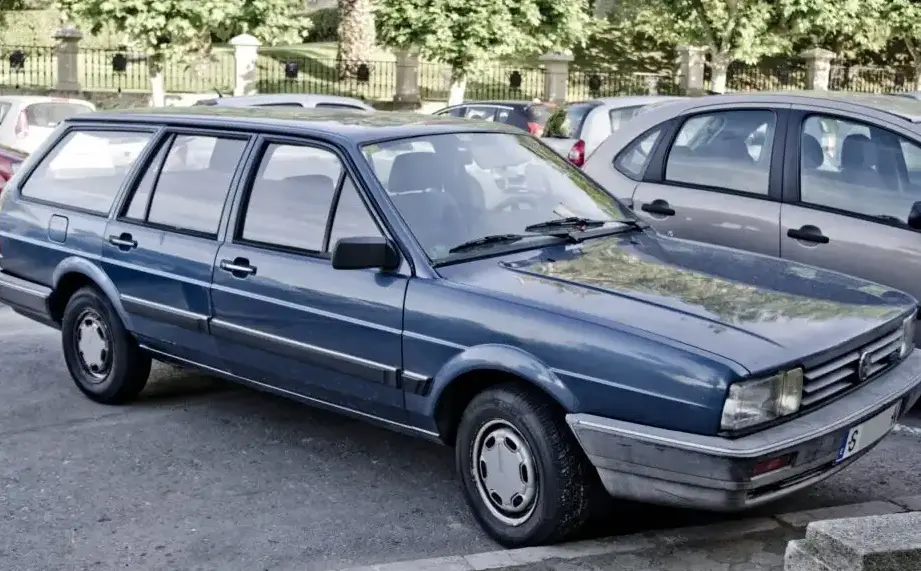
The Volkswagen Passat Variant (B2) 1.8, producing 87 horsepower, was a mainstay of the Passat lineup between 1986 and 1988. Positioned as an entry-level to mid-range offering within the B2 Passat Variant series, it provided a practical and economical option for families and those needing a versatile vehicle. This variant occupied a crucial space in the market, offering the practicality of a station wagon with a more accessible price point than the higher-performance or diesel-powered models. It was built on the Volkswagen Group’s B2 platform, also known as the 1HX0 platform, shared with the Audi 80 and other models.
Technical Specifications
| Brand | Volkswagen |
| Model | Passat |
| Generation | Passat Variant (B2) |
| Type (Engine) | 1.8 (87 Hp) |
| Start of production | 1986 |
| End of production | 1988 |
| Powertrain Architecture | Internal Combustion engine |
| Body type | Station wagon (estate) |
| Seats | 5 |
| Doors | 5 |
| Fuel Type | Petrol (Gasoline) |
| Power | 87 Hp |
| Engine Model/Code | RM |
| Engine aspiration | Naturally aspirated engine |
| Engine oil capacity | 3 l (3.17 US qt | 2.64 UK qt) |
| Coolant capacity | 4 l (4.23 US qt | 3.52 UK qt) |
| Trunk (boot) space – minimum | 540 l (19.07 cu. ft.) |
| Trunk (boot) space – maximum | 1811 l (63.95 cu. ft.) |
| Fuel tank capacity | 70 l (18.49 US gal | 15.4 UK gal) |
| Length | 4545 mm (178.94 in.) |
| Width | 1695 mm (66.73 in.) |
| Wheelbase | 2555 mm (100.59 in.) |
Powertrain & Engine Architecture
The Passat Variant 1.8 utilized the Volkswagen RM engine, a naturally aspirated, inline-four cylinder gasoline engine. Displacing 1781cc, this engine was a relatively simple design, prioritizing reliability and fuel economy over outright performance. The RM engine featured a single overhead camshaft (SOHC) valvetrain operating two valves per cylinder. Fuel delivery was managed by Bosch mechanical fuel injection, a system common for the era, providing a balance between efficiency and cost. This system wasn’t as sophisticated as later multi-point injection systems, but it proved durable and relatively easy to maintain. The engine’s compression ratio was typically around 8.5:1. The 87 horsepower output was achieved at approximately 5,500 rpm, with peak torque of around 137 Nm (101 lb-ft) arriving at 3,200 rpm. Paired with this engine was a three-speed automatic transmission, a common choice for buyers prioritizing convenience over driver involvement. This transmission was known for its smooth operation but wasn’t particularly geared for rapid acceleration.
Driving Characteristics
The 1.8L automatic Passat Variant offered a comfortable, if not particularly exhilarating, driving experience. Acceleration was adequate for everyday driving, but the automatic transmission and relatively low horsepower meant it wasn’t a sporty vehicle. The three-speed automatic transmission had relatively widely spaced gear ratios, which impacted both acceleration and fuel economy. The first gear was geared for initial acceleration, but the shifts to second and third were noticeable. Compared to the five-speed manual transmission available on other Passat variants, the automatic version felt noticeably slower. The suspension, typical of European cars of the period, provided a good balance between ride comfort and handling. The steering was relatively light, making it easy to maneuver in urban environments. However, it lacked the precision and feedback of more performance-oriented models.
Equipment & Trim Levels
The 1.8L automatic Passat Variant typically came with a fairly basic level of equipment, reflecting its position as an entry-level model. Standard features generally included cloth upholstery, a basic AM/FM radio, and manual windows and door locks. Air conditioning was often an optional extra, as were power windows and central locking. The dashboard layout was functional and straightforward, with clearly marked gauges for speed, fuel level, coolant temperature, and battery voltage. Interior trim was typically a durable, though somewhat plain, plastic. Optional extras could include a sunroof, upgraded stereo systems, and alloy wheels. The trim level was often simply designated as “base” or “L” depending on the market.
Chassis & Braking
The B2 Passat Variant featured an independent suspension system at the front, utilizing MacPherson struts and stabilizer bar. The rear suspension employed a semi-independent torsion beam axle, a cost-effective and space-saving design. Braking was typically accomplished with disc brakes at the front and drum brakes at the rear. The drum brakes on the rear were a cost-saving measure, and while adequate for normal driving, they didn’t offer the same stopping power as disc brakes. The braking system was hydraulically assisted, providing a reasonable level of stopping performance. Stabilizer bars were fitted to both the front and rear axles to reduce body roll during cornering.
Market Reception & Comparison
The 1.8L automatic Passat Variant was generally well-received as a practical and affordable family car. Critics praised its spacious interior, comfortable ride, and fuel efficiency. However, it was often criticized for its lack of performance, particularly when compared to the more powerful 1.8L or VR6 variants. The 1.9 TDI diesel version offered significantly better fuel economy, but at the cost of performance and refinement. The manual transmission versions of the 1.8L engine provided a more engaging driving experience, but the automatic was preferred by buyers prioritizing convenience. In terms of reliability, the RM engine was generally considered to be robust and durable, although regular maintenance was essential.
Legacy
The Passat Variant (B2) 1.8 automatic has become a relatively sought-after classic car, particularly among enthusiasts who appreciate its simplicity and reliability. The RM engine is known for its longevity, and many examples are still on the road today. However, finding well-maintained examples can be challenging, as many have suffered from neglect or have been modified over the years. Parts availability is generally good, although some specific trim pieces may be difficult to source. The 1.8L automatic Passat Variant represents a significant chapter in Volkswagen’s history, offering a glimpse into the design and engineering philosophies of the 1980s. It remains a practical and enjoyable classic car for those seeking a comfortable and reliable station wagon.