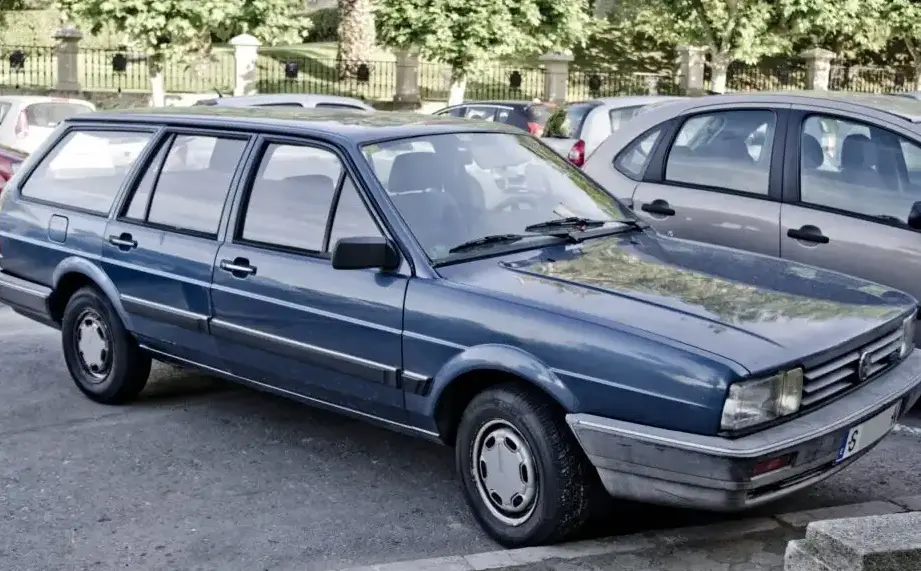
The Volkswagen Passat Variant (B2) 1.8 Syncro, produced between 1986 and 1988, represented a unique offering within the broader B2 Passat lineup. This variant combined the practicality of the Passat estate (wagon) body style with Volkswagen’s Syncro all-wheel-drive system and a 1.8-liter gasoline engine producing 90 horsepower. Positioned as a mid-range option, it catered to buyers seeking enhanced traction and stability, particularly in regions with inclement weather, without the higher cost of the more powerful GL or GTI models. The B2 Passat, launched in 1981, was a significant evolution of the original Passat, offering increased interior space and improved refinement. The Variant (estate) version further expanded the Passat’s appeal to families and those requiring greater cargo capacity.
Technical Specifications
| Brand | Volkswagen |
| Model | Passat |
| Generation | Passat Variant (B2) |
| Type (Engine) | 1.8 Syncro (90 Hp) |
| Start of production | 1986 |
| End of production | 1988 |
| Powertrain Architecture | Internal Combustion engine |
| Body type | Station wagon (estate) |
| Seats | 5 |
| Doors | 5 |
| Fuel consumption (urban) | 11.3 l/100 km (20.8 US mpg, 25 UK mpg, 8.8 km/l) |
| Fuel consumption (extra urban) | 7.2 l/100 km (32.7 US mpg, 39.2 UK mpg, 13.9 km/l) |
| Fuel Type | Petrol (Gasoline) |
| Acceleration 0 – 100 km/h | 12.8 sec |
| Acceleration 0 – 62 mph | 12.8 sec |
| Acceleration 0 – 60 mph | 12.2 sec |
| Maximum speed | 169 km/h (105.01 mph) |
| Weight-to-power ratio | 13.1 kg/Hp, 76.3 Hp/tonne |
| Weight-to-torque ratio | 8.1 kg/Nm, 122.9 Nm/tonne |
| Power | 90 Hp @ 5200 rpm |
| Power per litre | 50.5 Hp/l |
| Torque | 145 Nm @ 3300 rpm (106.95 lb.-ft. @ 3300 rpm) |
| Engine layout | Front, Longitudinal |
| Engine Model/Code | DS, JV |
| Engine displacement | 1781 cm3 (108.68 cu. in.) |
| Number of cylinders | 4 |
| Engine configuration | Inline |
| Cylinder Bore | 81 mm (3.19 in.) |
| Piston Stroke | 86.4 mm (3.4 in.) |
| Compression ratio | 10:1 |
| Number of valves per cylinder | 2 |
| Fuel injection system | Carburettor |
| Engine aspiration | Naturally aspirated engine |
| Valvetrain | SOHC |
| Engine oil capacity | 3 l (3.17 US qt | 2.64 UK qt) |
| Kerb Weight | 1180 kg (2601.45 lbs.) |
| Max. weight | 1710 kg (3769.9 lbs.) |
| Max load | 530 kg (1168.45 lbs.) |
| Trunk (boot) space – minimum | 540 l (19.07 cu. ft.) |
| Trunk (boot) space – maximum | 1811 l (63.95 cu. ft.) |
| Fuel tank capacity | 70 l (18.49 US gal | 15.4 UK gal) |
| Max. roof load | 75 kg (165.35 lbs.) |
| Permitted trailer load with brakes (12%) | 1500 kg (3306.93 lbs.) |
| Permitted trailer load without brakes | 620 kg (1366.87 lbs.) |
| Permitted towbar download | 85 kg (187.39 lbs.) |
| Length | 4545 mm (178.94 in.) |
| Width | 1695 mm (66.73 in.) |
| Height | 1385 mm (54.53 in.) |
| Wheelbase | 2555 mm (100.59 in.) |
| Front track | 1413 mm (55.63 in.) |
| Rear (Back) track | 1436 mm (56.54 in.) |
| Minimum turning circle | 10.7 m (35.1 ft.) |
| Drivetrain Architecture | All wheel drive (4×4) |
| Number of gears | 5 gears, manual transmission |
| Front suspension | Double wishbone, Transverse stabilizer |
| Rear suspension | Trailing arm, Transverse stabilizer |
| Front brakes | Ventilated discs |
| Rear brakes | Disc |
| Assisting systems | ABS (Anti-lock braking system) |
| Steering type | Steering rack and pinion |
| Power steering | Hydraulic Steering |
| Tires size | 195/60 R14 |
| Wheel rims size | 6J x 14 |
Powertrain & Engine Architecture
The 1.8-liter inline-four engine, designated DS or JV depending on the specific production year and market, formed the heart of this Passat Variant. This engine was a relatively simple design, utilizing a single overhead camshaft (SOHC) valvetrain with two valves per cylinder. Fuel delivery was managed by a carburetor, a common feature for engines of this era, rather than fuel injection. This carburetor setup, while less precise than injection, contributed to the engine’s relative simplicity and ease of maintenance. The longitudinal engine placement, coupled with the Syncro all-wheel-drive system, required a more complex drivetrain layout than front-wheel-drive Passat variants. The 5-speed manual transmission was specifically chosen to handle the increased torque demands of the all-wheel-drive system. The Syncro system itself employed a viscous coupling to distribute power between the front and rear axles, providing enhanced traction without requiring driver intervention.
Driving Characteristics
The 90 horsepower output of the 1.8-liter engine, combined with the added weight of the Syncro drivetrain, resulted in a 0-60 mph acceleration time of around 12.2 seconds. While not particularly quick by modern standards, this performance was adequate for everyday driving and provided sufficient power for highway cruising. The all-wheel-drive system significantly improved handling and stability, especially on slippery surfaces. The gear ratios in the 5-speed manual transmission were geared towards fuel efficiency and relaxed cruising, rather than outright performance. Compared to the more powerful GTI or VR6 variants, the 1.8 Syncro offered a more economical and less demanding driving experience. The carburetor, while reliable, could sometimes result in slightly less responsive throttle response compared to fuel-injected engines.
Equipment & Trim Levels
The 1.8 Syncro variant typically came equipped with a reasonable level of standard features. Interior upholstery was usually cloth, with a practical and durable finish. The dashboard layout was functional and straightforward, with clearly marked gauges and controls. Power steering was standard, making maneuvering easier, particularly at low speeds. Optional extras included a sunroof, upgraded audio systems, and alloy wheels. The Syncro models often featured a slightly more robust suspension setup to cope with the demands of the all-wheel-drive system. The overall trim level was generally positioned as a step above the base Passat models, offering a balance of comfort and practicality.
Chassis & Braking
The Passat B2 featured an independent suspension setup, with a double wishbone configuration at the front and a trailing arm arrangement at the rear. A transverse stabilizer bar was fitted to both axles, helping to reduce body roll during cornering. The braking system consisted of ventilated discs at the front and solid discs at the rear, providing adequate stopping power for the vehicle’s weight and performance. The inclusion of ABS (Anti-lock Braking System) was a notable safety feature for the time, further enhancing stability during emergency braking situations.
Market Reception & Comparison
The Passat Variant 1.8 Syncro was generally well-received by automotive critics as a practical and capable family car. Its all-wheel-drive system was praised for providing enhanced traction and stability, making it a popular choice in regions with harsh winters or challenging road conditions. Fuel economy was considered reasonable for a vehicle of its size and drivetrain configuration. Compared to the more expensive VR6 or GTI models, the 1.8 Syncro offered a more affordable entry point into the Passat range, while still providing a good level of equipment and performance. Reliability was generally good, although the carburetor required periodic maintenance and adjustment.
Legacy
The Volkswagen Passat Variant (B2) 1.8 Syncro has developed a loyal following among enthusiasts and classic car collectors. The combination of practicality, all-wheel-drive capability, and relative simplicity has made it a desirable used car. The 1.8-liter engine, while not particularly powerful, is known for its durability and ease of maintenance. Parts availability is generally good, although some specific Syncro components can be more difficult to source. Today, these vehicles represent a piece of automotive history, offering a glimpse into a time when all-wheel-drive technology was becoming increasingly accessible to mainstream buyers.