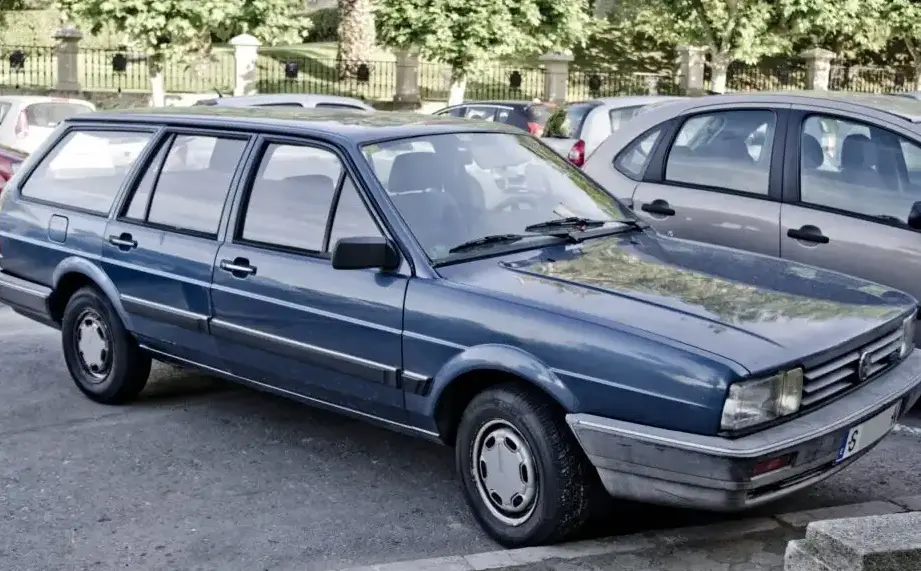
The Volkswagen Passat Variant (B2) 2.0 Syncro, produced between 1985 and 1988, represents a significant evolution of Volkswagen’s popular mid-size offering. This variant, a station wagon (estate) body style, was part of the broader B2 Passat generation (1981-1988), known internally as the 32B series. The “Syncro” designation denotes Volkswagen’s all-wheel-drive system, making this a relatively uncommon and desirable version, particularly in European markets where inclement weather demanded enhanced traction. It occupied a niche position within the B2 lineup, offering a blend of practicality, space, and all-weather capability not found in the standard front-wheel-drive models.
Technical Specifications
| Brand | Volkswagen |
| Model | Passat |
| Generation | Passat Variant (B2) |
| Type (Engine) | 2.0 Syncro (115 Hp) |
| Start of production | 1985 |
| End of production | 1988 |
| Powertrain Architecture | Internal Combustion engine |
| Body type | Station wagon (estate) |
| Seats | 5 |
| Doors | 5 |
| Fuel consumption (economy) – urban | 12.5 l/100 km (18.8 US mpg, 22.6 UK mpg, 8 km/l) |
| Fuel consumption (economy) – extra urban | 7.6 l/100 km (30.9 US mpg, 37.2 UK mpg, 13.2 km/l) |
| Fuel Type | Petrol (Gasoline) |
| Acceleration 0 – 100 km/h | 11.1 sec |
| Acceleration 0 – 62 mph | 11.1 sec |
| Acceleration 0 – 60 mph | 10.5 sec |
| Maximum speed | 182 km/h (113.09 mph) |
| Weight-to-power ratio | 11 kg/Hp, 90.9 Hp/tonne |
| Weight-to-torque ratio | 7.7 kg/Nm, 129.6 Nm/tonne |
| Power | 115 Hp @ 5500 rpm |
| Power per litre | 57.7 Hp/l |
| Torque | 164 Nm @ 3200 rpm (120.96 lb.-ft. @ 3200 rpm) |
| Engine layout | Front, Longitudinal |
| Engine Model/Code | JS, HP |
| Engine displacement | 1994 cm3 (121.68 cu. in.) |
| Number of cylinders | 5 |
| Engine configuration | Inline |
| Cylinder Bore | 81 mm (3.19 in.) |
| Piston Stroke | 77.4 mm (3.05 in.) |
| Compression ratio | 10:1 |
| Number of valves per cylinder | 2 |
| Fuel injection system | Multi-port manifold injection |
| Engine aspiration | Naturally aspirated engine |
| Valvetrain | SOHC |
| Engine oil capacity | 3.5 l (3.7 US qt | 3.08 UK qt) |
| Kerb Weight | 1265 kg (2788.85 lbs.) |
| Max. weight | 1800 kg (3968.32 lbs.) |
| Max load | 535 kg (1179.47 lbs.) |
| Trunk (boot) space – minimum | 540 l (19.07 cu. ft.) |
| Trunk (boot) space – maximum | 1811 l (63.95 cu. ft.) |
| Fuel tank capacity | 70 l (18.49 US gal | 15.4 UK gal) |
| Max. roof load | 75 kg (165.35 lbs.) |
| Permitted trailer load with brakes (12%) | 1500 kg (3306.93 lbs.) |
| Permitted trailer load without brakes | 670 kg (1477.1 lbs.) |
| Permitted towbar download | 75 kg (165.35 lbs.) |
| Length | 4545 mm (178.94 in.) |
| Width | 1695 mm (66.73 in.) |
| Height | 1465 mm (57.68 in.) |
| Wheelbase | 2555 mm (100.59 in.) |
| Front track | 1413 mm (55.63 in.) |
| Rear (Back) track | 1436 mm (56.54 in.) |
| Minimum turning circle | 11.3 m (37.07 ft.) |
| Drivetrain Architecture | All wheel drive (4×4) |
| Number of gears and type of gearbox | 5 gears, manual transmission |
| Front suspension | Double wishbone, Transverse stabilizer |
| Rear suspension | Trailing arm, Transverse stabilizer |
| Front brakes | Ventilated discs |
| Rear brakes | Disc |
| Steering type | Steering rack and pinion |
| Power steering | Hydraulic Steering |
| Tires size | 195/65 R14 |
| Wheel rims size | 6J x 14 |
Powertrain & Engine Architecture
The 2.0 Syncro Passat Variant was powered by Volkswagen’s 1.994-liter inline five-cylinder engine, designated as the JS or HP code depending on minor variations. This engine, a staple of the era, featured a single overhead camshaft (SOHC) valvetrain operating two valves per cylinder. Fuel delivery was handled by a Bosch multi-port fuel injection system, a significant improvement over earlier carbureted designs, contributing to better fuel efficiency and smoother operation. The engine produced 115 horsepower at 5500 rpm and 164 Nm (120.96 lb-ft) of torque at 3200 rpm. The longitudinal engine placement was crucial for accommodating the Syncro all-wheel-drive system. The five-speed manual transmission was the only gearbox option available with this engine and drivetrain combination. The Syncro system itself employed a viscous coupling to distribute power between the front and rear axles, providing automatic all-wheel drive engagement when slip was detected.
Driving Characteristics
The 2.0 Syncro Passat Variant offered a noticeably different driving experience compared to the standard front-wheel-drive models. While not a sports car, the 115 hp engine provided adequate power for comfortable cruising and overtaking. Acceleration to 60 mph took around 10.5 seconds, and the top speed was approximately 113 mph. The all-wheel-drive system significantly enhanced traction, particularly on slippery surfaces like snow or gravel. The five-speed manual transmission allowed for precise control over the engine’s powerband. Compared to the more common 1.8-liter versions, the 2.0 Syncro offered a more relaxed driving experience, with more torque available at lower engine speeds. However, the added weight of the Syncro system and the larger engine did result in slightly reduced fuel economy.
Equipment & Trim Levels
The 2.0 Syncro Passat Variant typically came with a reasonably well-equipped specification, reflecting its position as a higher-end variant. Standard features included power-assisted steering, front disc brakes, and a comfortable interior with cloth upholstery. Optional extras included a sunroof, central locking, electric windows, and upgraded audio systems. Trim levels varied depending on the market, but generally, the Syncro models were positioned above the base models in terms of standard equipment. The interior featured a functional, if somewhat dated, dashboard layout with clear instrumentation.
Chassis & Braking
The B2 Passat Variant featured an independent suspension system with double wishbones at the front and a trailing arm setup at the rear. A transverse stabilizer bar was fitted to both axles to reduce body roll during cornering. The 2.0 Syncro models typically had slightly stiffer suspension components to cope with the added weight of the all-wheel-drive system. Braking was provided by ventilated discs at the front and solid discs at the rear. The hydraulic power steering offered a good balance between assistance and road feel.
Market Reception & Comparison
The 2.0 Syncro Passat Variant was generally well-received by automotive critics, who praised its all-weather capability and spacious interior. However, it was also noted that the Syncro system added to the vehicle’s cost and complexity. Compared to the more affordable front-wheel-drive models, the 2.0 Syncro was a more expensive proposition. Fuel economy was also slightly lower due to the added weight and larger engine. However, for buyers in regions with harsh winters or challenging road conditions, the Syncro’s enhanced traction made it a compelling choice. Compared to the later Passat B3 generation, the B2 Syncro offered a more classic, robust feel.
Legacy
The Volkswagen Passat B2 2.0 Syncro remains a popular choice among classic car enthusiasts. The inline five-cylinder engine is known for its durability, and the Syncro all-wheel-drive system is highly regarded for its effectiveness. While maintenance can be more complex than with simpler front-wheel-drive models, parts availability is generally good. Today, well-maintained examples command a premium in the used car market, particularly those with low mileage and a complete service history. The B2 Syncro Passat Variant represents a unique and capable vehicle that continues to appeal to drivers who appreciate its blend of practicality, performance, and all-weather capability.