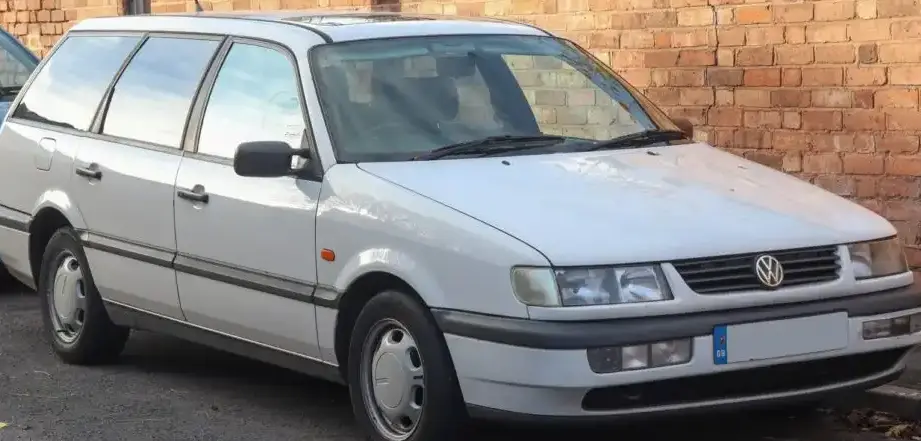
The Volkswagen Passat Variant (B4) 2.0, producing 115 horsepower, was a mainstay of the Passat lineup between 1993 and 1994. Positioned as a mid-range offering within the B4 generation (1993-1996), it catered to buyers seeking a practical and reasonably efficient station wagon. The B4 Passat Variant represented a significant evolution of the Passat, building upon the success of its predecessor while introducing updated styling and mechanical refinements. It was a key model for Volkswagen in Europe, offering a versatile and spacious vehicle for families and those requiring substantial cargo capacity.
Technical Specifications
| Brand | Volkswagen |
| Model | Passat |
| Generation | Passat Variant (B4) |
| Type (Engine) | 2.0 (115 Hp) |
| Start of production | 1993 |
| End of production | 1994 |
| Powertrain Architecture | Internal Combustion engine |
| Body type | Station wagon (estate) |
| Seats | 5 |
| Doors | 5 |
| Fuel consumption (urban) | 10.9 l/100 km (21.6 US mpg, 25.9 UK mpg, 9.2 km/l) |
| Fuel consumption (extra urban) | 6.2 l/100 km (37.9 US mpg, 45.6 UK mpg, 16.1 km/l) |
| Fuel consumption (combined) | 8.3 l/100 km (28.3 US mpg, 34 UK mpg, 12 km/l) |
| Fuel Type | Petrol (Gasoline) |
| Acceleration 0 – 100 km/h | 12 sec |
| Acceleration 0 – 62 mph | 12 sec |
| Acceleration 0 – 60 mph | 11.4 sec |
| Maximum speed | 191 km/h (118.68 mph) |
| Emission standard | Euro 2 |
| Weight-to-power ratio | 11 kg/Hp, 91.3 Hp/tonne |
| Weight-to-torque ratio | 7.6 kg/Nm, 131.7 Nm/tonne |
| Power | 115 Hp @ 5400 rpm |
| Power per litre | 58 Hp/l |
| Torque | 166 Nm @ 3200 rpm (122.44 lb.-ft. @ 3200 rpm) |
| Engine layout | Front, Transverse |
| Engine Model/Code | 2E |
| Engine displacement | 1984 cm3 (121.07 cu. in.) |
| Number of cylinders | 4 |
| Engine configuration | Inline |
| Cylinder Bore | 82.5 mm (3.25 in.) |
| Piston Stroke | 92.8 mm (3.65 in.) |
| Compression ratio | 10:1 |
| Number of valves per cylinder | 2 |
| Fuel injection system | Multi-port manifold injection |
| Engine aspiration | Naturally aspirated engine |
| Valvetrain | SOHC |
| Engine oil capacity | 4 l (4.23 US qt | 3.52 UK qt) |
| Coolant | 5 l (5.28 US qt | 4.4 UK qt) |
| Kerb Weight | 1260 kg (2777.82 lbs.) |
| Max. weight | 1800 kg (3968.32 lbs.) |
| Max load | 540 kg (1190.5 lbs.) |
| Trunk (boot) space – minimum | 465 l (16.42 cu. ft.) |
| Trunk (boot) space – maximum | 1500 l (52.97 cu. ft.) |
| Fuel tank capacity | 70 l (18.49 US gal | 15.4 UK gal) |
| Max. roof load | 75 kg (165.35 lbs.) |
| Permitted trailer load with brakes (12%) | 1500 kg (3306.93 lbs.) |
| Permitted trailer load without brakes | 650 kg (1433 lbs.) |
| Length | 4595 mm (180.91 in.) |
| Width | 1720 mm (67.72 in.) |
| Height | 1445 mm (56.89 in.) |
| Wheelbase | 2625 mm (103.35 in.) |
| Front track | 1479-1485 mm (58.23 – 58.46 in.) |
| Rear (Back) track | 1422-1428 mm (55.98 – 56.22 in.) |
| Front overhang | 915 mm (36.02 in.) |
| Rear overhang | 1055 mm (41.54 in.) |
| Minimum turning circle | 10.7 m (35.1 ft.) |
| Drivetrain Architecture | The Internal combustion engine (ICE) drives the front wheels of the vehicle. |
| Drive wheel | Front wheel drive |
| Number of gears and type of gearbox | 5 gears, manual transmission |
| Front suspension | Coil spring, Wishbone, Transverse stabilizer |
| Rear suspension | Wishbone, Transverse stabilizer, Coil spring |
| Front brakes | Ventilated discs |
| Rear brakes | Disc |
| Assisting systems | ABS (Anti-lock braking system) |
| Steering type | Steering rack and pinion |
| Power steering | Hydraulic Steering |
| Tires size | 195/60 R14; 205/50 R15 |
| Wheel rims size | 6J x 14; 6J x 15 |
Powertrain & Engine Architecture
The heart of the Passat Variant 2.0 was the 2E engine, a 1.984-liter (121.07 cubic inches) inline-four cylinder gasoline engine. This engine utilized a single overhead camshaft (SOHC) valvetrain with two valves per cylinder. Fuel delivery was managed by a multi-port fuel injection system, providing a balance between efficiency and performance. The 2E engine was known for its relative simplicity and durability. The engine produced 115 horsepower at 5400 rpm and 166 Nm (122.44 lb-ft) of torque at 3200 rpm. This power was delivered to the front wheels through a five-speed manual transmission, although an automatic transmission was also available. The automatic transmission was a four-speed unit, designed for smooth operation and ease of use.
Driving Characteristics
The 2.0-liter engine with the five-speed manual transmission offered a reasonably engaging driving experience. Acceleration from 0 to 60 mph took around 11.4 seconds, and the top speed was approximately 118.68 mph. While not a sports car, the 2.0 provided sufficient power for everyday driving and overtaking maneuvers. The automatic transmission, while offering convenience, did slightly diminish performance, resulting in a slower 0-60 mph time of around 12 seconds. The gear ratios in the automatic were tuned for fuel efficiency and smooth cruising, rather than outright acceleration. The suspension provided a comfortable ride, absorbing bumps and imperfections in the road well. Steering was precise and responsive, making the Passat Variant easy to handle.
Equipment & Trim Levels
The Passat Variant 2.0 typically came equipped with features such as power steering, central locking, and electric windows. Interior upholstery was generally cloth, with options for upgraded materials available. Dashboard configuration was functional and straightforward, with clearly labeled controls. Optional extras included air conditioning, a sunroof, and upgraded audio systems. The 2.0 trim level generally sat in the middle of the Passat range, offering a good balance of features and affordability. It was a step up from the base models but lacked some of the luxury features found in the higher-spec trims.
Chassis & Braking
The B4 Passat Variant featured a front-wheel-drive layout with independent suspension at all four corners. The front suspension utilized coil springs and wishbones, while the rear suspension employed a wishbone setup with coil springs. This configuration provided a comfortable ride and good handling characteristics. Braking duties were handled by ventilated discs at the front and discs at the rear. An Anti-lock Braking System (ABS) was standard, enhancing safety and control during emergency braking situations. The chassis was robust and well-engineered, providing a solid foundation for the vehicle.
Market Reception & Comparison
The Passat Variant 2.0 was generally well-received by automotive critics. It was praised for its spacious interior, comfortable ride, and practical design. However, some critics noted that the 2.0-liter engine could feel underpowered when fully loaded or driving uphill. Compared to the more powerful VR6 engine, the 2.0 offered significantly less performance but also better fuel economy. The 1.9 TDI diesel variant provided even better fuel economy but lacked the refinement of the gasoline engine. The 2.0 was often seen as a sensible choice for buyers prioritizing practicality and affordability over outright performance.
Legacy
The Volkswagen Passat Variant B4 2.0 has proven to be a relatively reliable vehicle over the long term. The 2E engine is known for its durability, and with proper maintenance, it can withstand high mileage. Today, these vehicles are increasingly sought after by classic car enthusiasts and collectors. Parts availability is generally good, making maintenance and repairs relatively straightforward. While not as iconic as some other classic Volkswagens, the Passat Variant 2.0 remains a popular and practical choice for those seeking a spacious and reliable station wagon.