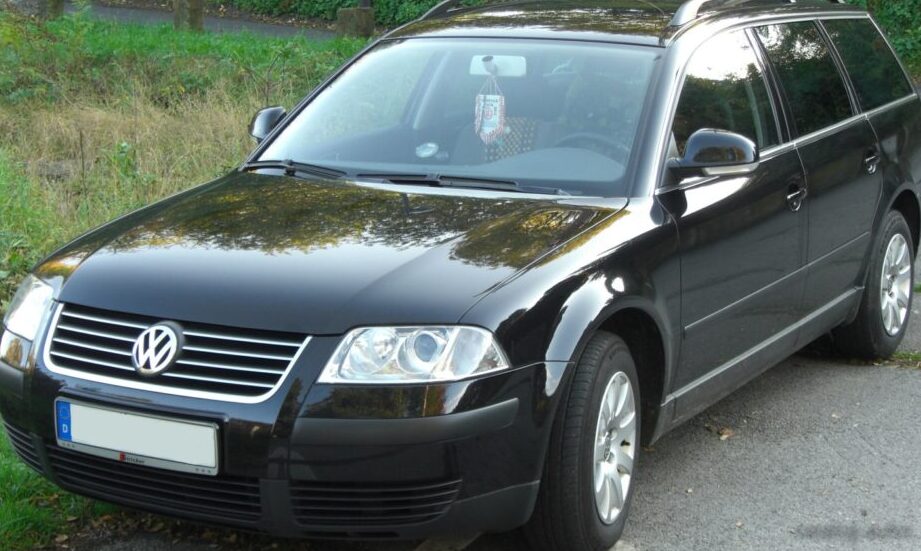
The Volkswagen Passat Variant (B5.5) 1.8 Turbo 20V with the Tiptronic automatic transmission, produced between 2000 and 2005, represents a significant iteration of Volkswagen’s popular mid-size wagon. Positioned as a comfortable and practical option within the B5.5 Passat range (which spanned 1997-2005 with the facelift occurring in 2000), this variant aimed to provide a balance between performance, fuel efficiency, and convenience. It was a key offering in the European market, where wagons held a stronger appeal than in North America, and offered a more accessible entry point into the Passat lineup compared to the more powerful and expensive VR6 models or the diesel variants.
Technical Specifications
| Brand | Volkswagen |
| Model | Passat |
| Generation | Passat Variant (B5.5) |
| Type (Engine) | 1.8 Turbo 20V (150 Hp) Tiptronic |
| Start of production | 2000 year |
| End of production | 2005 year |
| Powertrain Architecture | Internal Combustion engine |
| Body type | Station wagon (estate) |
| Seats | 5 |
| Doors | 5 |
| Fuel consumption (economy) – urban (NEDC) | 13.7 l/100 km (17.2 US mpg, 20.6 UK mpg, 7.3 km/l) |
| Fuel consumption (economy) – extra urban (NEDC) | 7.4 l/100 km (31.8 US mpg, 38.2 UK mpg, 13.5 km/l) |
| Fuel consumption (economy) – combined (NEDC) | 9.8 l/100 km (24 US mpg, 28.8 UK mpg, 10.2 km/l) |
| CO2 emissions (NEDC) | 235 g/km |
| Fuel Type | Petrol (Gasoline) |
| Acceleration 0 – 100 km/h | 10.8 sec |
| Acceleration 0 – 62 mph | 10.8 sec |
| Acceleration 0 – 60 mph | 10.3 sec |
| Maximum speed | 208 km/h (129.25 mph) |
| Emission standard | Euro 4 |
| Weight-to-power ratio | 11 kg/Hp, 90.5 Hp/tonne |
| Weight-to-torque ratio | 7.9 kg/Nm, 126.7 Nm/tonne |
| Power | 150 Hp @ 5700 rpm |
| Power per litre | 84.2 Hp/l |
| Torque | 210 Nm @ 1750 rpm (154.89 lb.-ft. @ 1750 rpm) |
| Engine layout | Front, Longitudinal |
| Engine Model/Code | AWT |
| Engine displacement | 1781 cm3 (108.68 cu. in.) |
| Number of cylinders | 4 |
| Engine configuration | Inline |
| Cylinder Bore | 81 mm (3.19 in.) |
| Piston Stroke | 86.4 mm (3.4 in.) |
| Compression ratio | 9.5:1 |
| Number of valves per cylinder | 5 |
| Fuel injection system | Multi-port manifold injection |
| Engine aspiration | Turbocharger, Intercooler |
| Valvetrain | DOHC |
| Engine oil capacity | 3.5 l (3.7 US qt | 3.08 UK qt) |
| Coolant | 7 l (7.4 US qt | 6.16 UK qt) |
| Kerb Weight | 1657 kg (3653.06 lbs.) |
| Max. weight | 2060 kg (4541.52 lbs.) |
| Max load | 403 kg (888.46 lbs.) |
| Trunk (boot) space – minimum | 495 l (17.48 cu. ft.) |
| Trunk (boot) space – maximum | 1600 l (56.5 cu. ft.) |
| Fuel tank capacity | 62 l (16.38 US gal | 13.64 UK gal) |
| Max. roof load | 100 kg (220.46 lbs.) |
| Permitted trailer load with brakes (12%) | 1500 kg (3306.93 lbs.) |
| Permitted trailer load without brakes | 650 kg (1433 lbs.) |
| Permitted towbar download | 75 kg (165.35 lbs.) |
| Length | 4682 mm (184.33 in.) |
| Width | 1746 mm (68.74 in.) |
| Height | 1498 mm (58.98 in.) |
| Wheelbase | 2703 mm (106.42 in.) |
| Minimum turning circle | 11.4 m (37.4 ft.) |
| Drivetrain Architecture | The Internal combustion engine (ICE) drives the front wheels of the vehicle. |
| Drive wheel | Front wheel drive |
| Number of gears and type of gearbox | 5 gears, automatic transmission Tiptronic |
| Front suspension | Independent multi-link suspension, Transverse stabilizer |
| Rear suspension | Trailing arm, Torsion |
| Front brakes | Ventilated discs |
| Rear brakes | Disc |
| Assisting systems | ABS (Anti-lock braking system) |
| Steering type | Steering rack and pinion |
| Power steering | Hydraulic Steering |
| Tires size | 195/65 R15 |
| Wheel rims size | 6J x 15 |
INTRODUCTION
The Passat Variant (B5.5) 1.8 Turbo 20V Tiptronic, launched in 2000 as part of the B5.5 facelift, offered a compelling package for buyers seeking a practical and reasonably efficient wagon. Built on the Volkswagen Group’s 1HX0/A3 platform, shared with models like the Audi A3 and the SEAT Leon, the B5.5 Passat represented a refinement of the earlier B5 generation. The 1.8 Turbo engine, coupled with the Tiptronic automatic transmission, was a popular choice, particularly for those prioritizing ease of driving over outright performance. This configuration aimed to deliver a comfortable and refined driving experience, suitable for both daily commutes and longer journeys.
Powertrain & Engine Architecture
At the heart of this Passat variant lies the 1.8-liter, 20-valve turbocharged inline-four cylinder engine, designated the AWT engine code. This engine utilizes multi-port fuel injection and a K04 turbocharger with an intercooler to boost power output. The 20-valve configuration (five valves per cylinder – three intake, two exhaust) contributes to improved breathing and higher-end power. The Tiptronic transmission is a five-speed automatic with a manual shift mode, allowing drivers some control over gear selection. It’s a conventional torque converter automatic, known for its smoothness but not necessarily its sportiness. The engine management system is a Bosch Motronic, responsible for controlling fuel injection, ignition timing, and turbocharger boost. The longitudinal engine layout, common in front-wheel-drive Volkswagen Group vehicles, contributes to a balanced weight distribution.
Driving Characteristics
The 150 horsepower and 155 lb-ft of torque produced by the 1.8 Turbo engine, when paired with the Tiptronic transmission, resulted in a 0-60 mph time of around 10.3 seconds and a top speed of 129 mph. While not a particularly quick car by modern standards, it offered adequate performance for everyday driving. The Tiptronic transmission, while smooth, could feel somewhat sluggish in automatic mode, particularly during kickdown maneuvers. Utilizing the manual shift mode allowed for more responsive acceleration, but it lacked the immediacy of a dual-clutch transmission. Compared to the more powerful 1.8T 20V 4Motion (all-wheel drive) or the VR6 models, this variant felt less eager to accelerate. However, it offered better fuel economy and a more relaxed driving experience. The gear ratios were tuned for comfort and efficiency rather than outright performance.
Equipment & Trim Levels
The 1.8 Turbo Tiptronic Passat Variant typically came equipped with a reasonable level of standard features. These included air conditioning, power windows and locks, a CD stereo system, and alloy wheels. Interior upholstery was typically cloth, although leather options were available. Trim levels varied by market, but generally, this configuration sat in the mid-range of the Passat lineup. Optional extras included a sunroof, upgraded audio systems, heated seats, and parking sensors. The dashboard layout was typical of the B5.5 Passat, with a functional and straightforward design.
Chassis & Braking
The Passat Variant (B5.5) featured an independent multi-link front suspension and a trailing arm rear suspension. This setup provided a comfortable ride and decent handling characteristics. Front brakes were ventilated discs, while rear brakes were solid discs. Anti-lock Braking System (ABS) was standard. Stabilizer bars were fitted to both the front and rear axles to reduce body roll. The suspension tuning was geared towards comfort, prioritizing ride quality over sharp handling. The weight distribution, aided by the longitudinal engine layout, contributed to predictable handling characteristics.
Market Reception & Comparison
The Passat Variant 1.8 Turbo Tiptronic was generally well-received by automotive critics as a practical and comfortable family wagon. It was praised for its spacious interior, comfortable ride, and reasonable fuel economy. However, some critics noted the Tiptronic transmission could feel slow to respond. Compared to the 1.9 TDI diesel variant, the 1.8 Turbo offered less fuel economy but more readily available power. The VR6 models provided significantly more performance but at a higher price point and with increased fuel consumption. The 1.8 Turbo Tiptronic represented a good compromise for buyers seeking a balance between performance, economy, and convenience.
Legacy
The AWT 1.8 Turbo engine, when properly maintained, proved to be a relatively reliable unit. Common issues included occasional turbocharger failures and oil leaks. The Tiptronic transmission, while generally durable, could experience issues with valve body wear over time. Today, the Passat Variant (B5.5) 1.8 Turbo Tiptronic can be found on the used car market at affordable prices. It remains a popular choice for those seeking a practical and spacious wagon, but potential buyers should be aware of the potential maintenance costs associated with an older vehicle. Its blend of practicality, comfort, and reasonable running costs ensures it continues to hold a place in the hearts of many Volkswagen enthusiasts.