Technical Specifications
| Brand | Volkswagen |
| Model | Passat |
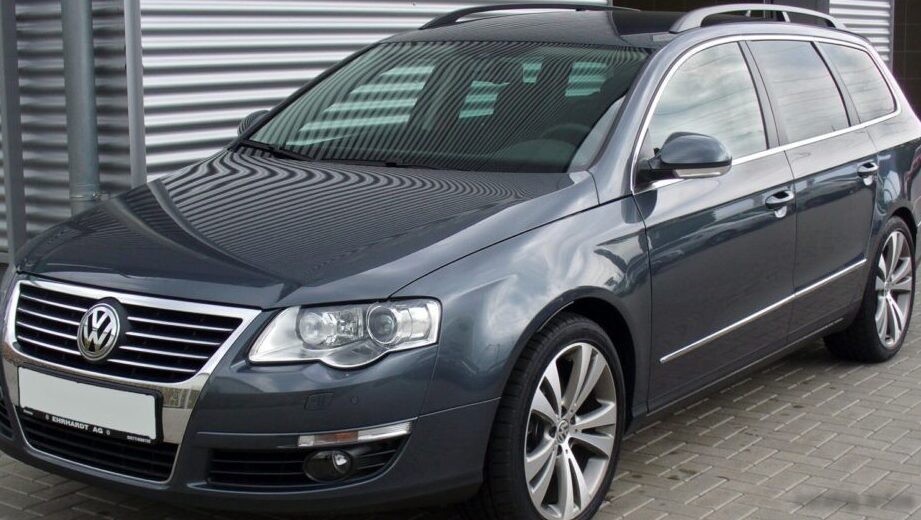
| Generation | Passat Variant (B6) |
| Type (Engine) | 2.0 TDI 16V (140 Hp) PDE 4MOTION |
| Start of production | February, 2005 |
| End of production | February, 2008 |
| Powertrain Architecture | Internal Combustion engine |
| Body type | Station wagon (estate) |
| Seats | 5 |
| Doors | 5 |
| Fuel consumption (urban) | 8.8 l/100 km (26.7 US mpg, 32.1 UK mpg, 11.4 km/l) |
| Fuel consumption (extra urban) | 5.7 l/100 km (41.3 US mpg, 49.6 UK mpg, 17.5 km/l) |
| Fuel consumption (combined) | 6.8 l/100 km (34.6 US mpg, 41.5 UK mpg, 14.7 km/l) |
| Fuel Type | Diesel |
| Acceleration 0 – 100 km/h | 10.5 sec |
| Acceleration 0 – 62 mph | 10.5 sec |
| Acceleration 0 – 60 mph | 10 sec |
| Maximum speed | 201 km/h (124.9 mph) |
| Emission standard | Euro 4 |
| Weight-to-power ratio | 11.5 kg/Hp, 87 Hp/tonne |
| Weight-to-torque ratio | 5 kg/Nm, 198.9 Nm/tonne |
| Power | 140 Hp @ 4000 rpm |
| Power per litre | 71.1 Hp/l |
| Torque | 320 Nm @ 1750 rpm (236.02 lb.-ft. @ 1750 rpm) |
| Engine layout | Front, Transverse |
| Engine Model/Code | EA188 / BKP |
| Engine displacement | 1968 cm3 (120.09 cu. in.) |
| Number of cylinders | 4 |
| Engine configuration | Inline |
| Cylinder Bore | 81 mm (3.19 in.) |
| Piston Stroke | 95.5 mm (3.76 in.) |
| Compression ratio | 18.5:1 |
| Number of valves per cylinder | 4 |
| Fuel injection system | Pump-nozzle (Unit Injector) |
| Engine aspiration | Turbocharger, Intercooler |
| Valvetrain | DOHC |
| Engine oil capacity | 4 l (4.23 US qt | 3.52 UK qt) |
| Coolant | 8 l (8.45 US qt | 7.04 UK qt) |
| Kerb Weight | 1609 kg (3547.24 lbs.) |
| Max. weight | 2240 kg (4938.35 lbs.) |
| Max load | 631 kg (1391.12 lbs.) |
| Trunk (boot) space – minimum | 588 l (20.77 cu. ft.) |
| Trunk (boot) space – maximum | 1716 l (60.6 cu. ft.) |
| Fuel tank capacity | 68 l (17.96 US gal | 14.96 UK gal) |
| Max. roof load | 100 kg (220.46 lbs.) |
| Permitted trailer load with brakes (12%) | 2000 kg (4409.25 lbs.) |
| Permitted trailer load without brakes | 750 kg (1653.47 lbs.) |
| Permitted towbar download | 90 kg (198.42 lbs.) |
| Length | 4774 mm (187.95 in.) |
| Width | 1820 mm (71.65 in.) |
| Width including mirrors | 2004 mm (78.9 in.) |
| Height | 1517 mm (59.72 in.) |
| Wheelbase | 2709 mm (106.65 in.) |
| Front track | 1552 mm (61.1 in.) |
| Rear (Back) track | 1551 mm (61.06 in.) |
| Minimum turning circle | 11.4 m (37.4 ft.) |
| Drivetrain Architecture | All wheel drive (4×4) |
| Drive wheel | All wheel drive (4×4) |
| Number of gears | 6 gears, manual transmission |
| Front suspension | Spring Strut |
| Rear suspension | Coil spring |
| Front brakes | Ventilated discs |
| Rear brakes | Disc |
| Assisting systems | ABS (Anti-lock braking system) |
| Steering type | Steering rack and pinion |
| Tires size | 215/55 R16 |
| Wheel rims size | 6.5J x 16 |
The Volkswagen Passat Variant (B6) 2.0 TDI 16V with 140 horsepower and a Pump-nozzle Diesel Engine (PDE) system coupled with 4MOTION all-wheel drive was produced between February 2005 and February 2008. This variant held a significant position within the B6 Passat range, offering a blend of practicality, fuel efficiency, and all-weather capability. It was positioned as a mid-range offering, appealing to buyers seeking a more robust and capable estate car than the base models, but without the higher price tag of the performance-oriented trims. The B6 generation Passat, built on the 1HX0/A3 platform, represented a substantial evolution in design and technology for Volkswagen’s mid-size offering.
Powertrain & Engine Architecture
At the heart of the Passat Variant 2.0 TDI 4MOTION lies the EA188 engine family, specifically the BKP code. This 1968cc, four-cylinder diesel engine utilizes a transverse mounting configuration. The BKP engine is a 16-valve design, employing a dual overhead camshaft (DOHC) valvetrain. A key feature of this engine is its Pump-nozzle (PDE) fuel injection system, a technology developed by Bosch. PDE systems deliver highly precise fuel metering and injection timing, contributing to improved combustion efficiency and reduced emissions. The engine is turbocharged and intercooled, boosting power output to 140 horsepower and 320 Nm (236 lb-ft) of torque at a relatively low 1750 rpm. The 4MOTION all-wheel-drive system employs a viscous coupling to distribute power between the front and rear axles as needed, enhancing traction in slippery conditions. The transmission offered was a 6-speed manual, providing a good balance between fuel economy and driver control.
Driving Characteristics
The 2.0 TDI 16V 4MOTION Passat Variant offered a composed and capable driving experience. While not a performance-oriented model, the 140 hp engine and 320 Nm of torque provided adequate power for everyday driving and comfortable highway cruising. The 6-speed manual transmission allowed drivers to keep the engine in its optimal power band. Acceleration from 0-60 mph took around 10 seconds, which was respectable for a wagon of its size and weight. The 4MOTION system provided enhanced stability and grip, particularly on wet or loose surfaces. Compared to the lower-powered 1.9 TDI variants, the 2.0 TDI offered noticeably more punch, especially during overtaking maneuvers. However, it didn’t possess the outright performance of the more expensive petrol-powered models like the 1.8T or the VR6.
Equipment & Trim Levels
The 2.0 TDI 4MOTION Passat Variant typically came equipped with a reasonable level of standard features. These included air conditioning, power windows, central locking, and an integrated audio system. Interior upholstery was generally cloth, although leather options were available as upgrades. Trim levels varied depending on the market, but common options included alloy wheels, a multi-function steering wheel, and parking sensors. Higher trim levels might also include features like automatic climate control, a sunroof, and upgraded audio systems. The dashboard layout was functional and ergonomically designed, with clear instrumentation and intuitive controls.
Chassis & Braking
The B6 Passat Variant featured a MacPherson strut front suspension and a multi-link rear suspension, providing a comfortable ride and good handling characteristics. The 4MOTION models generally had slightly stiffer suspension settings compared to front-wheel-drive variants to accommodate the added weight and improve stability. Braking systems consisted of ventilated discs at the front and solid discs at the rear, with ABS (Anti-lock Braking System) as standard. The braking performance was adequate for the vehicle’s weight and performance capabilities.
Market Reception & Comparison
The Passat Variant 2.0 TDI 16V 4MOTION was generally well-received by automotive critics. It was praised for its practicality, fuel efficiency, and all-weather capability. The 4MOTION system was a significant selling point for buyers in regions with harsh winters or challenging road conditions. Compared to the 1.9 TDI models, the 2.0 TDI offered a noticeable improvement in performance, although it came at a slightly higher price. Fuel economy was competitive, averaging around 34.6 US mpg in combined driving. Reliability was generally good, although PDE fuel injection systems could be prone to issues if not properly maintained.
Legacy
The Volkswagen Passat Variant (B6) 2.0 TDI 16V 4MOTION remains a popular choice in the used car market today. Its combination of practicality, fuel efficiency, and all-wheel-drive capability continues to appeal to buyers. While the PDE fuel injection system requires diligent maintenance, the engine is generally robust and reliable if properly cared for. The B6 Passat Variant is considered a well-built and comfortable estate car, offering a good balance of features and value. Parts availability is generally good, making it a relatively easy vehicle to maintain and repair.