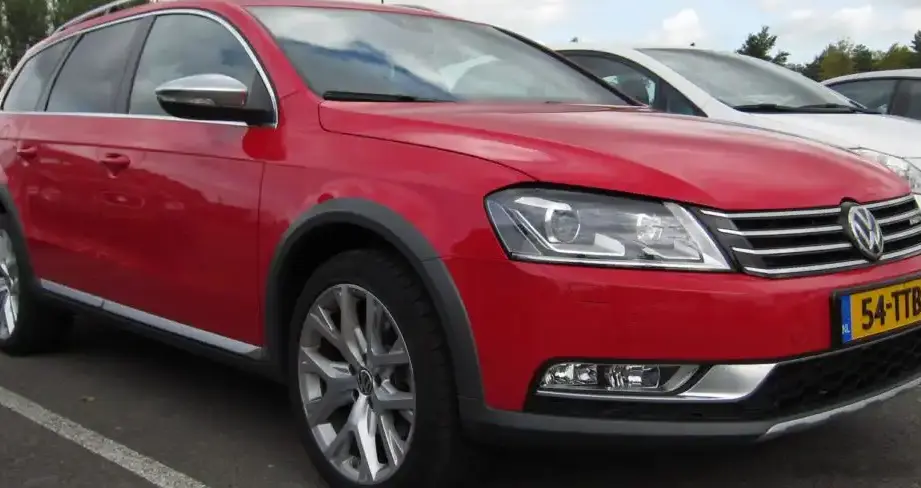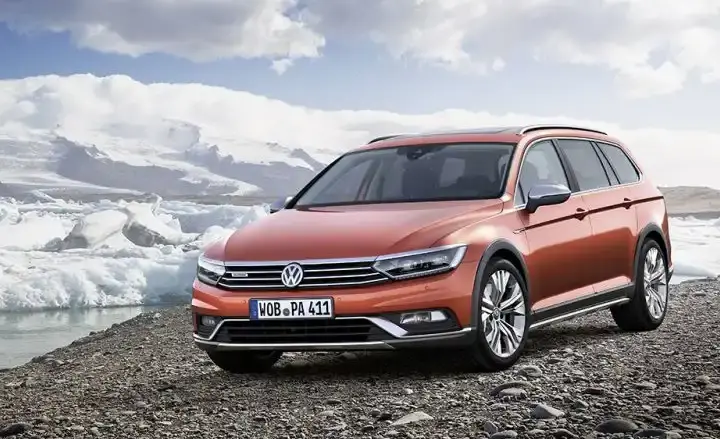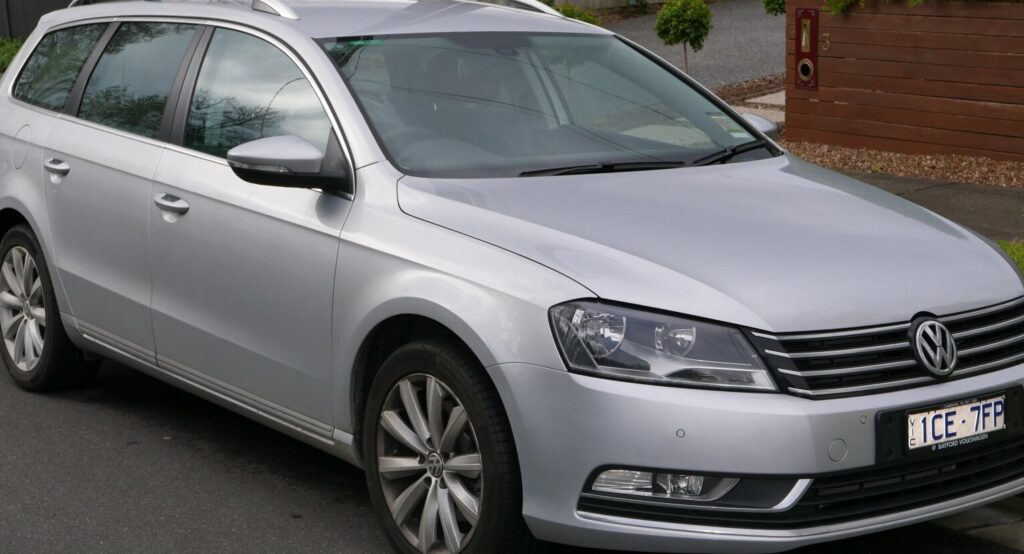
The Volkswagen Passat Variant (B7) 1.4 TSI (150 hp) DSG EcoFuel, produced between 2010 and 2014, represents a specific configuration within the seventh generation (B7) of Volkswagen’s popular Passat estate (wagon) model. This variant was primarily aimed at the European market, offering a blend of practicality, fuel efficiency, and moderate performance. It occupied a mid-range position in the B7 Passat lineup, slotting in below the more powerful 1.8 TSI and 2.0 TDI models, but offering a more refined and economical alternative to the base 1.6-liter petrol engine. The “EcoFuel” designation indicates the vehicle’s capability to run on Compressed Natural Gas (CNG), further enhancing its environmental credentials.
Technical Specifications
| Brand | Volkswagen |
| Model | Passat |
| Generation | Passat Variant (B7) |
| Type (Engine) | 1.4 TSI (150 Hp) DSG EcoFuel |
| Start of production | 2010 |
| End of production | 2014 |
| Powertrain Architecture | Internal Combustion engine |
| Body type | Station wagon (estate) |
| Seats | 5 |
| Doors | 5 |
| Fuel consumption (economy) – urban (NEDC) | 8.8 l/100 km (26.7 US mpg, 32.1 UK mpg, 11.4 km/l) |
| Fuel consumption (economy) – urban (CNG) (NEDC) | 5.8 kg/100 km |
| Fuel consumption (economy) – extra urban (NEDC) | 5.6 l/100 km (42 US mpg, 50.4 UK mpg, 17.9 km/l) |
| Fuel consumption (economy) – extra urban (CNG) (NEDC) | 3.5 kg/100 km |
| Fuel consumption (economy) – combined (NEDC) | 6.8 l/100 km (34.6 US mpg, 41.5 UK mpg, 14.7 km/l) |
| Fuel consumption (economy) – combined (CNG) (NEDC) | 4.3 kg/100 km |
| CO2 emissions (NEDC) | 158 g/km |
| CO2 emissions (CNG) (NEDC) | 119 g/km |
| Fuel Type | Petrol / CNG |
| Acceleration 0 – 100 km/h | 9.9 sec |
| Acceleration 0 – 62 mph | 9.9 sec |
| Acceleration 0 – 60 mph | 9.4 sec |
| Maximum speed | 212 km/h (131.73 mph) |
| Emission standard | Euro 5 |
| Weight-to-power ratio | 10.5 kg/Hp, 95.4 Hp/tonne |
| Weight-to-torque ratio | 7.1 kg/Nm, 139.9 Nm/tonne |
| Power | 150 Hp @ 5500 rpm |
| Power per litre | 107.9 Hp/l |
| Torque | 220 Nm @ 1500-4500 rpm (162.26 lb.-ft. @ 1500-4500 rpm) |
| Engine layout | Front, Transverse |
| Engine Model/Code | EA111 / CDGA |
| Engine displacement | 1390 cm3 (84.82 cu. in.) |
| Number of cylinders | 4 |
| Engine configuration | Inline |
| Cylinder Bore | 76.5 mm (3.01 in.) |
| Piston Stroke | 75.6 mm (2.98 in.) |
| Compression ratio | 10:1 |
| Number of valves per cylinder | 4 |
| Fuel injection system | Direct injection and Multi-port manifold injection |
| Engine aspiration | Turbocharging and Supercharger, Intercooler |
| Valvetrain | DOHC |
| Engine oil capacity | 3.6 l (3.8 US qt | 3.17 UK qt) |
| Kerb Weight | 1572 kg (3465.67 lbs.) |
| Max. weight | 2170 kg (4784.03 lbs.) |
| Max load | 598 kg (1318.36 lbs.) |
| Trunk (boot) space – minimum | 523 l (18.47 cu. ft.) |
| Trunk (boot) space – maximum | 1651 l (58.3 cu. ft.) |
| Fuel tank capacity | 70 l (18.49 US gal | 15.4 UK gal) |
| Max. roof load | 100 kg (220.46 lbs.) |
| Permitted trailer load with brakes (8%) | 1700 kg (3747.86 lbs.) |
| Permitted trailer load with brakes (12%) | 1500 kg (3306.93 lbs.) |
| Permitted trailer load without brakes | 750 kg (1653.47 lbs.) |
| Permitted towbar download | 90 kg (198.42 lbs.) |
| Length | 4771 mm (187.83 in.) |
| Width | 1820 mm (71.65 in.) |
| Width including mirrors | 2062 mm (81.18 in.) |
| Height | 1516 mm (59.69 in.) |
| Wheelbase | 2712 mm (106.77 in.) |
| Front track | 1552 mm (61.1 in.) |
| Rear (Back) track | 1551 mm (61.06 in.) |
| Front overhang | 941 mm (37.05 in.) |
| Rear overhang | 1118 mm (44.02 in.) |
| Ride height (ground clearance) | 135 mm (5.31 in.) |
| Minimum turning circle (turning diameter) | 11.4 m (37.4 ft.) |
| Drivetrain Architecture | The Internal combustion engine (ICE) drives the front wheels of the vehicle. |
| Drive wheel | Front wheel drive |
| Number of gears and type of gearbox | 7 gears, automatic transmission DSG |
| Front suspension | Independent, type McPherson with coil spring and anti-roll bar |
| Rear suspension | Independent multi-link spring suspension with stabilizer |
| Front brakes | Ventilated discs, 312×25 mm |
| Rear brakes | Disc, 286×12 mm |
| Assisting systems | ABS (Anti-lock braking system) |
| Steering type | Steering rack and pinion |
| Power steering | Electric Steering |
| Tires size | 205/55 R16; 215/55 R16; 235/45 R17; 235/40 R18 |
| Wheel rims size | 6.5J x 16; 7J x 16; 7.5J x 17; 8J x 18 |
INTRODUCTION
The Volkswagen Passat Variant (B7) 1.4 TSI (150 hp) DSG EcoFuel, launched in 2010 as part of the B7 Passat refresh, offered a compelling package for European buyers seeking a versatile and economical family car. Built on the Volkswagen Group’s A3 platform (shared with models like the Audi A3 and Skoda Octavia), the B7 Passat brought subtle styling updates and improved technology compared to its B6 predecessor. This particular variant, with its 1.4-liter turbocharged engine and dual-clutch DSG transmission, was designed to appeal to those prioritizing fuel efficiency and ease of driving, while still providing adequate performance for everyday use. The EcoFuel option allowed drivers to take advantage of lower CNG fuel costs and reduced emissions where infrastructure permitted.
Powertrain & Engine Architecture
At the heart of this Passat variant lies the EA111 1.4-liter turbocharged four-cylinder engine, specifically the CDGA engine code. This engine is notable for its combination of a turbocharger *and* a supercharger – a relatively uncommon setup. The supercharger provides instant boost at low engine speeds, eliminating turbo lag and improving responsiveness, while the turbocharger takes over at higher RPMs for sustained power delivery. The engine utilizes direct fuel injection and multi-port manifold injection, optimizing combustion efficiency. It produces 150 horsepower at 5500 rpm and 220 Nm (162 lb-ft) of torque between 1500 and 4500 rpm. The engine is transversely mounted at the front of the vehicle. The dual-clutch seven-speed DSG (Direct-Shift Gearbox) transmission provides quick and smooth gear changes, contributing to both performance and fuel economy. The DSG transmission is electronically controlled and offers both automatic and manual shift modes.
Driving Characteristics
The 1.4 TSI (150 hp) DSG EcoFuel Passat Variant delivers a comfortable and refined driving experience. While not a performance-oriented model, the combined supercharger and turbocharger setup provides surprisingly brisk acceleration, with a 0-62 mph (0-100 km/h) time of around 9.9 seconds. The DSG transmission shifts quickly and seamlessly, enhancing the feeling of responsiveness. Compared to the higher-output 1.8 TSI or 2.0 TDI variants, this model feels less eager to accelerate, but the difference is often negligible in everyday driving situations. The DSG transmission’s gear ratios are tuned for fuel efficiency, meaning the engine doesn’t always feel like it’s in its optimal power band. The EcoFuel capability, when utilized, further enhances fuel economy, but CNG availability was a limiting factor for many drivers.
Equipment & Trim Levels
The Passat Variant (B7) 1.4 TSI (150 hp) DSG EcoFuel typically came equipped with a reasonable level of standard features. These included air conditioning, power windows, central locking, an audio system with CD player, and alloy wheels. Higher trim levels, such as Trendline, Comfortline, and Highline, added features like automatic climate control, a touchscreen infotainment system, parking sensors, and upgraded interior upholstery. Interior materials were generally of good quality, reflecting the Passat’s position as a mid-range family car. Optional extras included leather seats, a sunroof, and a navigation system.
Chassis & Braking
The B7 Passat Variant featured a MacPherson strut front suspension and a multi-link rear suspension, providing a comfortable ride and good handling characteristics. Stabilizer bars were fitted to both the front and rear axles to reduce body roll. Braking duties were handled by ventilated discs at the front and solid discs at the rear. ABS (Anti-lock Braking System) was standard. The suspension setup was tuned to prioritize comfort over outright sportiness, making it well-suited for long-distance cruising.
Market Reception & Comparison
The Passat Variant (B7) 1.4 TSI (150 hp) DSG EcoFuel was generally well-received by automotive critics. It was praised for its fuel efficiency, comfortable ride, and refined interior. However, some reviewers noted that the engine could feel strained when fully loaded or driving uphill. Compared to the 1.8 TSI variant, the 1.4 TSI offered lower running costs but less outright performance. The 2.0 TDI, while more expensive, provided superior fuel economy and torque. The EcoFuel option was a niche appeal, dependent on the availability of CNG fueling stations.
Legacy
The EA111 1.4 TSI engine, while generally reliable, has been known to exhibit issues with carbon buildup on the intake valves, particularly in vehicles that primarily undertake short journeys. Regular servicing and the use of quality fuel are essential to mitigate this risk. The DSG transmission, while sophisticated, can require expensive repairs if not properly maintained. Today, the Passat Variant (B7) 1.4 TSI (150 hp) DSG EcoFuel represents a relatively affordable and practical used car option. Its fuel efficiency and spacious interior continue to appeal to buyers seeking a versatile family vehicle. The EcoFuel variant, while less common, offers a unique opportunity for those seeking to reduce their carbon footprint and take advantage of lower CNG fuel costs.