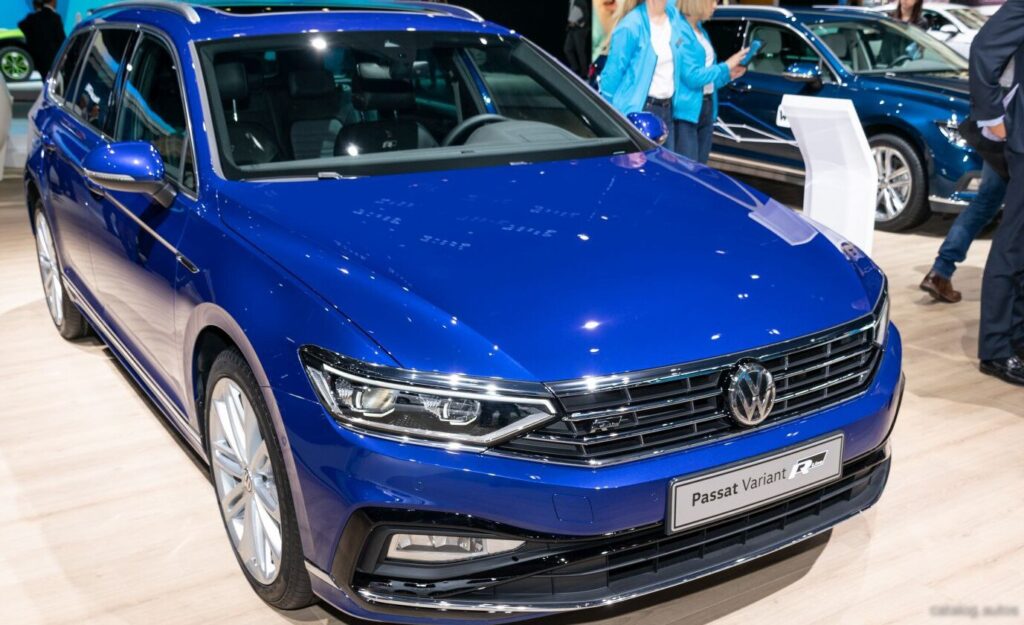
The Volkswagen Passat Variant (B8, facelift 2019) 1.5 TSI 150 hp with a 7-speed Dual Clutch Gearbox (DSG) and Active Cylinder Technology (ACT) represents a significant iteration of Volkswagen’s popular mid-size wagon. Introduced as part of the B8 Passat’s facelift in 2019 and continuing through the 2023 model year, this variant aimed to balance fuel efficiency with acceptable performance for the European market, where wagons remain a popular body style. It occupied a mid-range position within the Passat lineup, offering a more economical alternative to the higher-powered petrol and diesel options, while providing more features than the base-level trims. This model was primarily sold in Europe and other markets where wagons are preferred, and was not officially offered in the North American market.
Technical Specifications
| Brand | Volkswagen |
| Model | Passat |
| Generation | Passat Variant (B8, facelift 2019) |
| Type (Engine) | 1.5 TSI (150 Hp) DSG ACT |
| Start of production | 2019 |
| End of production | 2023 |
| Powertrain Architecture | Internal Combustion engine |
| Body type | Station wagon (estate) |
| Seats | 5 |
| Doors | 5 |
| Fuel consumption at Low speed (WLTP) | 8.6 l/100 km (27.4 US mpg, 32.8 UK mpg, 11.6 km/l) |
| Fuel consumption at Medium speed (WLTP) | 6.4 l/100 km (36.8 US mpg, 44.1 UK mpg, 15.6 km/l) |
| Fuel consumption at high speed (WLTP) | 5.5 l/100 km (42.8 US mpg, 51.4 UK mpg, 18.2 km/l) |
| Fuel consumption at very high speed (WLTP) | 6.6 l/100 km (35.6 US mpg, 42.8 UK mpg, 15.2 km/l) |
| Combined fuel consumption (WLTP) | 6.5 l/100 km (36.2 US mpg, 43.5 UK mpg, 15.4 km/l) |
| CO2 emissions (WLTP) | 147 g/km |
| Fuel consumption (economy) – urban (NEDC) | 6.6-6.8 l/100 km (35.6 – 34.6 US mpg, 42.8 – 41.5 UK mpg, 15.2 – 14.7 km/l) |
| Fuel consumption (economy) – extra urban (NEDC) | 4.5-4.7 l/100 km (52.3 – 50 US mpg, 62.8 – 60.1 UK mpg, 22.2 – 21.3 km/l) |
| Fuel consumption (economy) – combined (NEDC) | 5.3-5.5 l/100 km (44.4 – 42.8 US mpg, 53.3 – 51.4 UK mpg, 18.9 – 18.2 km/l) |
| CO2 emissions (NEDC) | 120-125 g/km |
| Fuel Type | Petrol (Gasoline) |
| Acceleration 0 – 100 km/h | 8.9 sec |
| Acceleration 0 – 62 mph | 8.9 sec |
| Acceleration 0 – 60 mph | 8.5 sec |
| Maximum speed | 214 km/h (132.97 mph) |
| Emission standard | EURO VId – TEMP – EVAP – ISC |
| Weight-to-power ratio | 9.3 kg/Hp, 107.5 Hp/tonne |
| Weight-to-torque ratio | 5.6 kg/Nm, 179.2 Nm/tonne |
| Power | 150 Hp @ 5000-6000 rpm |
| Power per litre | 100.1 Hp/l |
| Torque | 250 Nm @ 1500-3500 rpm (184.39 lb.-ft. @ 1500-3500 rpm) |
| Engine layout | Front, Transverse |
| Engine Model/Code | DPCA |
| Engine displacement | 1498 cm3 (91.41 cu. in.) |
| Number of cylinders | 4 |
| Engine configuration | Inline |
| Number of valves per cylinder | 4 |
| Fuel injection system | Direct injection |
| Engine aspiration | Turbocharger, Intercooler |
| Engine oil capacity | 4.3 l (4.54 US qt | 3.78 UK qt) |
| Kerb Weight | 1395 kg (3075.45 lbs.) |
| Max. weight | 2060 kg (4541.52 lbs.) |
| Max load | 665 kg (1466.07 lbs.) |
| Trunk (boot) space – minimum | 650 l (22.95 cu. ft.) |
| Trunk (boot) space – maximum | 1780 l (62.86 cu. ft.) |
| Fuel tank capacity | 66 l (17.44 US gal | 14.52 UK gal) |
| Max. roof load | 100 kg (220.46 lbs.) |
| Permitted trailer load with brakes (8%) | 1900 kg (4188.78 lbs.) |
| Permitted trailer load with brakes (12%) | 1600 kg (3527.4 lbs.) |
| Permitted trailer load without brakes | 730 kg (1609.37 lbs.) |
| Permitted towbar download | 90 kg (198.42 lbs.) |
| Length | 4773-4889 mm (187.91 – 192.48 in.) |
| Width | 1832 mm (72.13 in.) |
| Width including mirrors | 2083 mm (82.01 in.) |
| Height | 1516 mm (59.69 in.) |
| Wheelbase | 2786 mm (109.69 in.) |
| Front track | 1578-1586 mm (62.13 – 62.44 in.) |
| Rear (Back) track | 1564-1572 mm (61.57 – 61.89 in.) |
| Minimum turning circle (turning diameter) | 11.7 m (38.39 ft.) |
| Drivetrain Architecture | The Internal combustion engine (ICE) drives the front wheels of the vehicle. |
| Drive wheel | Front wheel drive |
| Number of gears and type of gearbox | 7 gears, automatic transmission DSG |
| Front brakes | Ventilated discs |
| Rear brakes | Disc |
| Assisting systems | ABS (Anti-lock braking system) |
| Steering type | Steering rack and pinion |
| Power steering | Electric Steering |
| Tires size | 215/60 R16; 215/55 R17 |
| Wheel rims size | 6.5 J x 16; 7J x 17 |
Powertrain & Engine Architecture
At the heart of this Passat Variant lies the 1.5 TSI (Turbocharged Stratified Injection) engine, specifically the DPCA engine code. This is a four-cylinder, inline petrol engine with a displacement of 1498 cc (91.41 cubic inches). It utilizes direct fuel injection, delivering fuel directly into the combustion chamber for improved efficiency and power. A single turbocharger with an intercooler provides forced induction, boosting power output to 150 hp at 5000-6000 rpm and 250 Nm (184.39 lb-ft) of torque between 1500-3500 rpm. A key feature of this engine is its Active Cylinder Technology (ACT), which can shut down two cylinders under light load conditions to reduce fuel consumption. The engine is paired with a 7-speed Dual Clutch Gearbox (DSG), offering quick and smooth gear changes. This DSG transmission is known for its efficiency and responsiveness, contributing to the overall driving experience.
Driving Characteristics
The 1.5 TSI 150 hp/DSG combination in the Passat Variant delivers a comfortable and refined driving experience. Acceleration from 0-100 km/h (0-62 mph) takes approximately 8.9 seconds, which is adequate for everyday driving but doesn’t offer particularly sporty performance. The DSG transmission provides seamless shifts, and the engine’s torque is readily available from low revs, making it easy to navigate city traffic and maintain speed on the highway. Compared to the more powerful 2.0 TSI variants, this engine feels less urgent, but it offers significantly better fuel economy. The ACT system is generally unobtrusive, and the transitions between four and two cylinders are smooth. The gear ratios in the DSG are well-chosen for both fuel efficiency and responsiveness.
Equipment & Trim Levels
The 1.5 TSI DSG ACT variant typically came equipped with a respectable level of standard features. These generally included air conditioning, an infotainment system with a touchscreen display, Bluetooth connectivity, alloy wheels, and a suite of safety features such as ABS, ESC (Electronic Stability Control), and multiple airbags. Higher trim levels offered additional features like leather upholstery, a larger infotainment screen with navigation, adaptive cruise control, and parking sensors. Interior upholstery was typically cloth on lower trims, with leather options available as upgrades. Dashboard configurations were consistent across the B8 Passat range, featuring a clean and modern design.
Chassis & Braking
The Passat Variant’s chassis is designed for comfort and stability. The front suspension utilizes MacPherson struts, while the rear suspension employs a multi-link setup. This configuration provides a good balance between ride quality and handling. Brakes are ventilated discs on the front axle and solid discs on the rear. ABS (Anti-lock Braking System) is standard, ensuring safe and controlled braking in various conditions. Stabilizer bars are fitted to both the front and rear axles to reduce body roll during cornering. The suspension tuning is geared towards providing a comfortable ride rather than aggressive handling.
Market Reception & Comparison
The 1.5 TSI DSG ACT Passat Variant was generally well-received by automotive critics as a practical and efficient option. It was praised for its fuel economy, comfortable ride, and refined driving experience. However, some reviewers noted that the engine lacked the outright performance of the higher-powered variants. Compared to the 2.0 TSI models, the 1.5 TSI offered better fuel economy but slower acceleration. Against diesel-powered Passats, it provided a lower initial purchase price but potentially higher running costs depending on fuel prices and maintenance requirements. Its main appeal lay in its balance of practicality, efficiency, and affordability.
Legacy
The 1.5 TSI engine has proven to be a relatively reliable powertrain, although some early versions experienced issues with particulate filter clogging. The DSG transmission, while generally robust, requires regular maintenance (fluid changes) to ensure longevity. In the used car market, the 1.5 TSI Passat Variant represents a good value proposition, offering a spacious and well-equipped wagon at a reasonable price. Its fuel efficiency and comfortable ride make it a popular choice for families and long-distance drivers. Properly maintained examples continue to provide reliable transportation and retain a decent level of resale value.