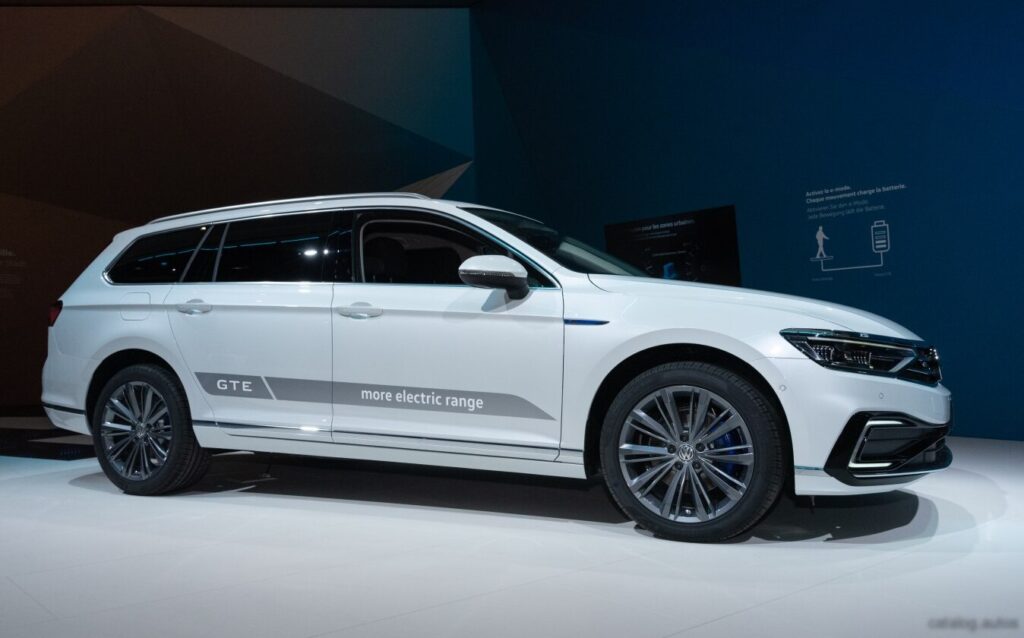
The Volkswagen Passat Variant GTE 1.4 TSI (218 hp) Plug-in Hybrid DSG, produced from September 2019 to 2023, represents a significant step in Volkswagen’s electrification strategy for the European market. Part of the B8 Passat generation (facelifted in 2019), the GTE variant combined a turbocharged gasoline engine with an electric motor, offering a blend of performance and fuel efficiency within the practical confines of a spacious station wagon (estate). This model sat at the premium end of the Passat Variant lineup, appealing to buyers seeking lower running costs and reduced emissions without sacrificing space or comfort. It was positioned as a direct competitor to other plug-in hybrid estates like the Peugeot 508 SW Hybrid and the Mercedes-Benz C-Class Estate EQ Power.
Technical Specifications
| Brand | Volkswagen |
| Model | Passat |
| Generation | Passat Variant (B8, facelift 2019) |
| Type (Engine) | GTE 1.4 TSI (218 Hp) Plug-in Hybrid DSG |
| Start of production | September, 2019 |
| End of production | 2023 |
| Powertrain Architecture | PHEV (Plug-in Hybrid Electric Vehicle) |
| Body type | Station wagon (estate) |
| Seats | 5 |
| Doors | 5 |
| Combined fuel consumption (WLTP) | 1.3 l/100 km (180.9 US mpg, 217.3 UK mpg, 76.9 km/l) |
| CO2 emissions (WLTP) | 30 g/km |
| Fuel consumption (NEDC) – combined | 1.6 l/100 km (147 US mpg, 176.6 UK mpg, 62.5 km/l) |
| CO2 emissions (NEDC) | 36-37 g/km |
| Fuel Type | Petrol / electricity |
| Acceleration 0 – 100 km/h | 7.6 sec |
| Acceleration 0 – 62 mph | 7.6 sec |
| Acceleration 0 – 60 mph | 7.2 sec |
| Maximum speed | 222 km/h (137.94 mph) |
| Emission standard | Euro 6d-ISC |
| Weight-to-power ratio | 7.7 kg/Hp, 129.4 Hp/tonne |
| Weight-to-torque ratio | 4.2 kg/Nm, 237.4 Nm/tonne |
| Gross battery capacity | 13 kWh |
| Net (usable) battery capacity | 10.4 kWh |
| Battery technology | Lithium-ion (Li-Ion) |
| Battery location | Below the floor, under the rear seats |
| All-electric range (NEDC) | 66-68 km (41.01 – 42.25 mi) |
| Average Energy consumption (WLTP) | 14.9 kWh/100 km (23.98 kWh/100 mi, 141 MPGe, 6.7 km/kWh, 4.2 mi/kWh) |
| Average Energy consumption (NEDC) | 14.7-15.1 kWh/100 km (23.66 – 24.3 kWh/100 mi, 142 – 139 MPGe, 6.8 – 6.6 km/kWh, 4.2 – 4.1 mi/kWh) |
| Electric motor power | 115 Hp |
| Electric motor Torque | 330 Nm (243.4 lb.-ft.) |
| Maximum revolutions of the electric motor | 6000 rpm |
| Electric motor location | Between the combustion engine and the transmission |
| System power | 218 Hp |
| System torque | 400 Nm (295.02 lb.-ft.) |
| Power | 156 Hp @ 5000-6000 rpm |
| Power per litre | 111.8 Hp/l |
| Torque | 250 Nm @ 1550-3500 rpm (184.39 lb.-ft. @ 1550-3500 rpm) |
| Engine layout | Front, Transverse |
| Engine Model/Code | EA211 / DGEB |
| Engine displacement | 1395 cm3 (85.13 cu. in.) |
| Number of cylinders | 4 |
| Engine configuration | Inline |
| Cylinder Bore | 74.5 mm (2.93 in.) |
| Piston Stroke | 80 mm (3.15 in.) |
| Compression ratio | 10:1 |
| Number of valves per cylinder | 4 |
| Fuel injection system | Direct injection |
| Engine aspiration | Turbocharger, Intercooler |
| Valvetrain | DOHC |
| Engine oil capacity | 4 l (4.23 US qt | 3.52 UK qt) |
| Kerb Weight | 1685 kg (3714.79 lbs.) |
| Max. weight | 2260 kg (4982.45 lbs.) |
| Max load | 575 kg (1267.66 lbs.) |
| Trunk (boot) space – minimum | 483 l (17.06 cu. ft.) |
| Trunk (boot) space – maximum | 1613 l (56.96 cu. ft.) |
| Fuel tank capacity | 50 l (13.21 US gal | 11 UK gal) |
| Max. roof load | 100 kg (220.46 lbs.) |
| Permitted trailer load with brakes (8%) | 1900 kg (4188.78 lbs.) |
| Permitted trailer load with brakes (12%) | 1600 kg (3527.4 lbs.) |
| Permitted trailer load without brakes | 750 kg (1653.47 lbs.) |
| Permitted towbar download | 90 kg (198.42 lbs.) |
| Length | 4773 mm (187.91 in.) |
| Width | 1832 mm (72.13 in.) |
| Width including mirrors | 2083 mm (82.01 in.) |
| Height | 1516 mm (59.69 in.) |
| Wheelbase | 2786 mm (109.69 in.) |
| Front track | 1578-1586 mm (62.13 – 62.44 in.) |
| Rear (Back) track | 1564-1572 mm (61.57 – 61.89 in.) |
| Ride height (ground clearance) | 145 mm (5.71 in.) |
| Minimum turning circle (turning diameter) | 11.7 m (38.39 ft.) |
| Drivetrain Architecture | The Internal combustion engine (ICE) and electric motor drive the front wheels of the car with the ability to work in full electric or mixed mode. |
| Drive wheel | Front wheel drive |
| Number of gears and type of gearbox | 6 gears, automatic transmission DSG |
| Front suspension | Independent type McPherson, Transverse stabilizer |
| Rear suspension | Independent multi-link suspension, Transverse stabilizer |
| Front brakes | Ventilated discs |
| Rear brakes | Disc |
| Assisting systems | ABS (Anti-lock braking system) |
| Steering type | Steering rack and pinion |
| Power steering | Electric Steering |
| Tires size | 215/55 R17; 235/45 R18 |
| Wheel rims size | 7J x 17; 8J x 18 |
Powertrain & Engine Architecture
The Passat GTE’s powertrain centers around the EA211 series 1.4-liter turbocharged four-cylinder gasoline engine (code DGEB). This engine produces 156 hp at 5000-6000 rpm and 250 Nm (184 lb-ft) of torque between 1550-3500 rpm. It utilizes direct fuel injection and an intercooled turbocharger to enhance efficiency and power output. The engine is paired with an 85kW (115 hp) electric motor, integrated between the engine and the 6-speed DSG dual-clutch transmission. The combined system output is 218 hp and 400 Nm (295 lb-ft) of torque. The 13 kWh lithium-ion battery pack, located under the rear seats, provides an all-electric range of 66-68 km (41-42 miles) under the NEDC cycle. The DSG transmission is specifically calibrated for hybrid operation, seamlessly blending power from both the engine and the electric motor.
Driving Characteristics
The 1.4 TSI GTE with the DSG transmission offers a surprisingly refined driving experience. In electric mode, the car provides near-silent acceleration and is perfectly adequate for urban commutes. Switching to hybrid mode allows the engine and motor to work in tandem, delivering brisk acceleration – 0-62 mph in 7.6 seconds. The DSG transmission provides quick and smooth gear changes, optimizing power delivery. Compared to the standard 1.4 TSI Passat, the GTE offers significantly more torque, resulting in stronger mid-range acceleration. While not as sporty as the higher-powered Passat variants, the GTE provides a good balance of performance and efficiency. The regenerative braking system effectively recaptures energy, extending the electric range.
Equipment & Trim Levels
The GTE trim level was well-equipped as standard. Interior features typically included sport seats upholstered in unique GTE-specific fabric, blue stitching accents, and aluminum pedals. The dashboard featured a dedicated GTE display showing energy flow and driving statistics. Standard equipment also included Volkswagen’s Discover Pro infotainment system with navigation, climate control, and a suite of driver assistance systems such as adaptive cruise control and lane assist. Optional extras included leather upholstery, a panoramic sunroof, and a premium sound system.
Chassis & Braking
The Passat GTE utilizes a McPherson strut front suspension and a multi-link rear suspension, providing a comfortable and controlled ride. The suspension was tuned to accommodate the added weight of the battery pack. Brakes consisted of ventilated discs at the front and solid discs at the rear. ABS, electronic stability control, and other safety systems were standard. The GTE typically featured slightly stiffer suspension components compared to the standard Passat, enhancing handling.
Market Reception & Comparison
The Passat GTE was generally well-received by automotive critics. It was praised for its fuel efficiency, comfortable ride, and practical estate car body style. However, some reviewers noted that the 1.4 TSI engine could feel strained under hard acceleration, and the overall driving experience wasn’t as engaging as some of its rivals. Compared to the Passat 2.0 TDI, the GTE offered lower emissions and the benefit of electric-only driving, but at a higher purchase price. Against competitors like the Peugeot 508 SW Hybrid, the Passat GTE offered a more spacious interior and a more established brand reputation.
Legacy
The Volkswagen Passat GTE represents an important step in Volkswagen’s transition towards electrification. While the model has been discontinued, the powertrain technology has been further refined and implemented in newer Volkswagen models. The 1.4 TSI engine and DSG transmission combination proved to be relatively reliable, although the hybrid system components, particularly the battery pack, require periodic maintenance. On the used car market, the Passat GTE remains a popular choice for buyers seeking a practical, fuel-efficient, and environmentally friendly estate car.