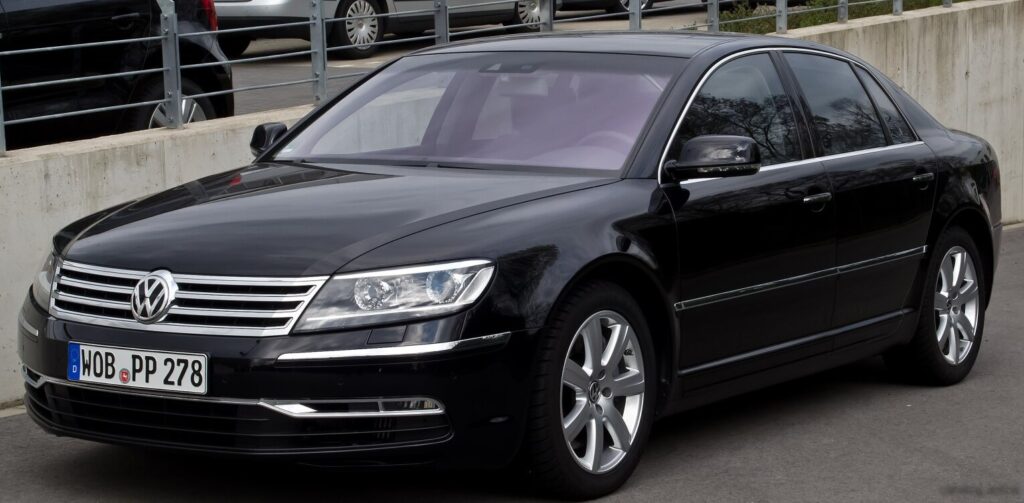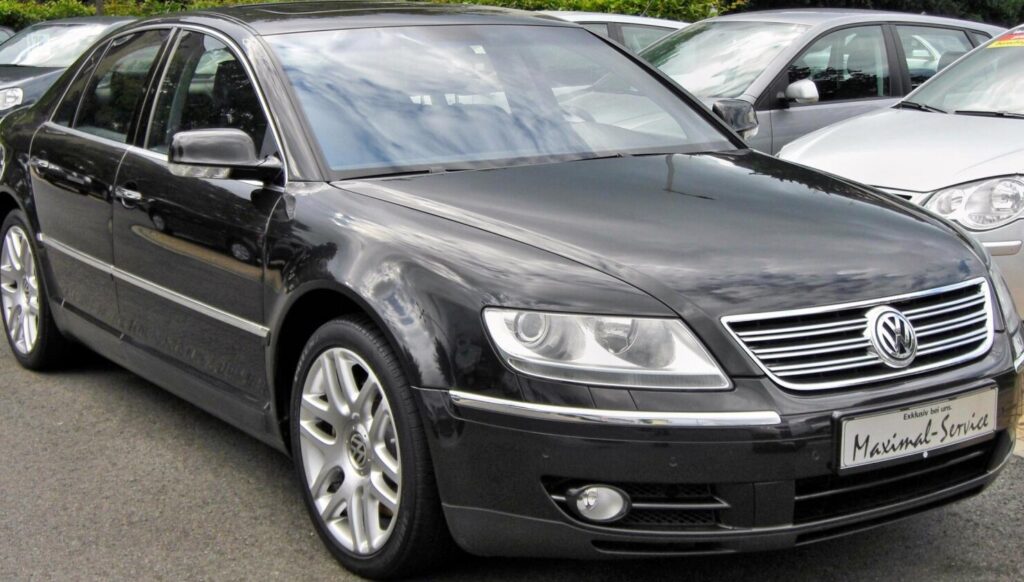
The Volkswagen Phaeton 3.2 V6, produced from 2002 to 2008, represented Volkswagen’s ambitious foray into the luxury sedan segment, directly challenging established German rivals like the Mercedes-Benz S-Class and BMW 7 Series. Positioned as a flagship model, the Phaeton aimed to showcase Volkswagen’s engineering prowess and build quality. This particular variant, powered by the 3.2-liter V6 engine producing 241 horsepower, served as a core offering within the Phaeton range, balancing performance with a more accessible price point compared to the range-topping W12 model. The Phaeton was built at a dedicated “glass factory” in Dresden, Germany, emphasizing transparency in the manufacturing process and reinforcing its premium image.
Technical Specifications
| Brand | Volkswagen |
| Model | Phaeton |
| Generation | Phaeton |
| Type (Engine) | 3.2 V6 (241 Hp) |
| Start of production | 2002 |
| End of production | 2008 |
| Powertrain Architecture | Internal Combustion engine |
| Body type | Sedan |
| Seats | 5 |
| Doors | 4 |
| Fuel consumption (urban) | 16.1 l/100 km (14.6 US mpg, 17.5 UK mpg, 6.2 km/l) |
| Fuel consumption (extra urban) | 8.7 l/100 km (27 US mpg, 32.5 UK mpg, 11.5 km/l) |
| Fuel consumption (combined) | 11.4 l/100 km (20.6 US mpg, 24.8 UK mpg, 8.8 km/l) |
| Fuel Type | Petrol (Gasoline) |
| Acceleration 0 – 100 km/h | 8.4 sec |
| Acceleration 0 – 62 mph | 8.4 sec |
| Acceleration 0 – 60 mph | 8 sec |
| Maximum speed | 245 km/h (152.24 mph) |
| Weight-to-power ratio | 8.3 kg/Hp, 120.8 Hp/tonne |
| Weight-to-torque ratio | 6.3 kg/Nm, 157.9 Nm/tonne |
| Power | 241 Hp @ 2400 rpm |
| Power per litre | 75.6 Hp/l |
| Torque | 315 Nm @ 2400 rpm (232.33 lb.-ft. @ 2400 rpm) |
| Engine layout | Front, Longitudinal |
| Engine Model/Code | AYT, BKL, BRK |
| Engine displacement | 3189 cm3 (194.6 cu. in.) |
| Number of cylinders | 6 |
| Engine configuration | V-engine |
| Cylinder Bore | 84 mm (3.31 in.) |
| Piston Stroke | 95.9 mm (3.78 in.) |
| Compression ratio | 11.3:1 |
| Number of valves per cylinder | 4 |
| Fuel injection system | Multi-port manifold injection |
| Engine aspiration | Naturally aspirated engine |
| Engine oil capacity | 6 l (6.34 US qt | 5.28 UK qt) |
| Coolant | 9 l (9.51 US qt | 7.92 UK qt) |
| Kerb Weight | 1995 kg (4398.22 lbs.) |
| Max. weight | 2600 kg (5732.02 lbs.) |
| Max load | 605 kg (1333.8 lbs.) |
| Trunk (boot) space – minimum | 500 l (17.66 cu. ft.) |
| Fuel tank capacity | 90 l (23.78 US gal | 19.8 UK gal) |
| Length | 5055 mm (199.02 in.) |
| Width | 1903 mm (74.92 in.) |
| Height | 1450 mm (57.09 in.) |
| Wheelbase | 2881 mm (113.43 in.) |
| Front track | 1628 mm (64.09 in.) |
| Rear (Back) track | 1612 mm (63.46 in.) |
| Drivetrain Architecture | The Internal combustion engine (ICE) drives the front wheels of the vehicle. |
| Drive wheel | Front wheel drive |
| Number of gears and type of gearbox | 6 gears, manual transmission |
| Front suspension | Air suspension |
| Rear suspension | Air suspension |
| Front brakes | Ventilated discs |
| Rear brakes | Ventilated discs |
| Assisting systems | ABS (Anti-lock braking system) |
| Steering type | Steering rack and pinion |
| Power steering | Hydraulic Steering |
| Tires size | 235/55 R16 |
| Wheel rims size | 7.5J x 16 |
Powertrain & Engine Architecture
The heart of the Phaeton 3.2 V6 is the AYT engine, a naturally aspirated 3.2-liter V6. This engine, also found in other Volkswagen Group vehicles like the Audi TT and A4, utilizes a 60-degree V-angle for optimal balance and smoothness. It features multi-port fuel injection and four valves per cylinder, contributing to its respectable power output. The engine codes BKL and BRK were also used depending on the specific year and market. The 3.2L engine was known for its relatively smooth power delivery and refined character. The six-speed manual transmission offered in this variant provided precise gear changes, although a five-speed Tiptronic automatic transmission was also available, catering to buyers prioritizing comfort and ease of use. The automatic transmission, while smooth, was sometimes criticized for being slightly less responsive than the manual.
Driving Characteristics
The Phaeton 3.2 V6 offered a comfortable and composed driving experience. With 241 horsepower and 232 lb-ft of torque, acceleration was brisk, achieving 0-60 mph in around 8 seconds. While not overtly sporty, the engine provided sufficient power for confident highway cruising and overtaking. The manual transmission allowed for greater driver engagement, while the automatic prioritized seamless shifts. Compared to the more powerful W12 model, the 3.2 V6 offered a lighter front end, resulting in slightly more balanced handling. However, it lacked the sheer acceleration and prestige of its flagship sibling. Compared to the diesel variants (like the 2.5 TDI), the 3.2 V6 offered a more refined and responsive driving experience, albeit with higher fuel consumption.
Equipment & Trim Levels
The Phaeton 3.2 V6 came standard with a generous array of features befitting its luxury positioning. These included leather upholstery, wood trim, automatic climate control, a premium audio system, and bi-xenon headlights. Optional extras included massaging seats, a rear entertainment system, and advanced parking assistance features. Trim levels were relatively limited, with most customization occurring through individual options. The interior design emphasized understated elegance and high-quality materials, creating a serene and comfortable cabin environment.
Chassis & Braking
The Phaeton utilized an advanced chassis design featuring an air suspension system on all four corners. This system provided a remarkably smooth ride, automatically adjusting ride height and damping characteristics to optimize comfort and handling. The car was equipped with ventilated disc brakes on all wheels, providing ample stopping power. ABS (Anti-lock Braking System) was standard. The suspension setup was tuned to prioritize ride comfort over outright sportiness, making it an excellent grand tourer.
Market Reception & Comparison
The Phaeton faced an uphill battle in the luxury sedan market. While praised for its build quality, technology, and comfortable ride, it struggled to gain widespread acceptance due to its relatively unknown brand image compared to its established rivals. Critics noted that while the Phaeton was a technically impressive vehicle, it lacked the cachet and brand recognition of Mercedes-Benz and BMW. The 3.2 V6 variant offered a more affordable entry point into the Phaeton range, but its fuel economy (around 20.6 mpg combined) was considered relatively poor for its class. Compared to the W12, the 3.2 V6 offered a better balance of performance and efficiency, making it a more practical choice for many buyers.
Legacy
The Volkswagen Phaeton, despite its limited commercial success, remains a fascinating and ambitious project in automotive history. The 3.2 V6 variant, while not the most sought-after model, offers a compelling combination of luxury, performance, and relative affordability on the used car market. The AYT engine is generally considered reliable, although regular maintenance is crucial. The air suspension system can be prone to issues if not properly maintained. Today, the Phaeton is appreciated by enthusiasts who value its unique blend of German engineering, understated elegance, and technological innovation. It serves as a reminder of Volkswagen’s aspirations to compete with the best in the world.