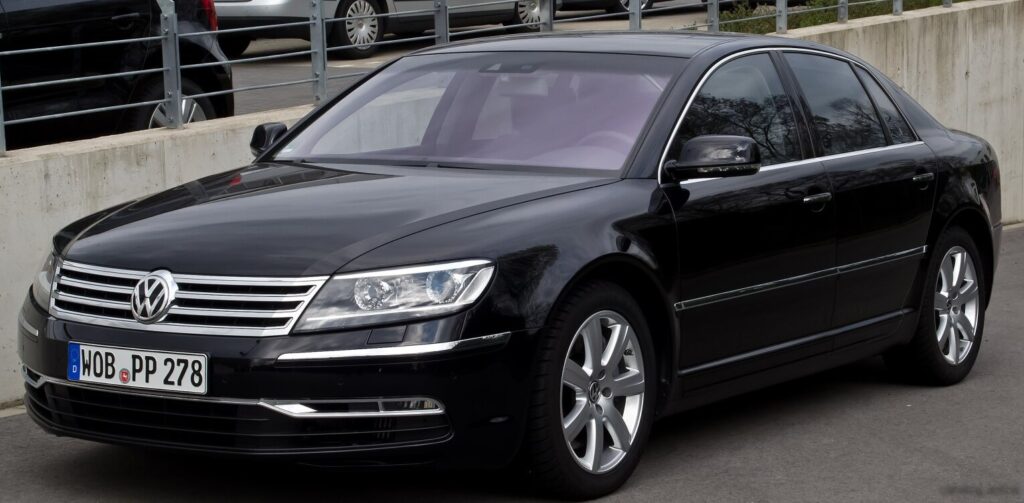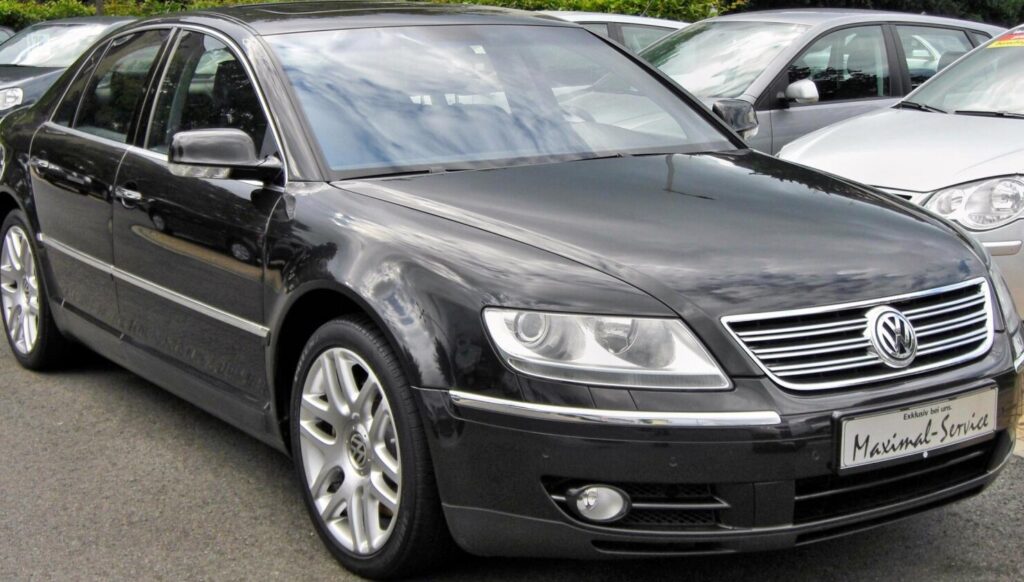
The Volkswagen Phaeton 4.2 i V8 40V Tiptronic 4Motion represents the pinnacle of Volkswagen’s ambition to create a true luxury sedan to rival established German marques like BMW and Mercedes-Benz. Produced from 2008 to 2010 as part of the first-generation Phaeton (2002-2016), this variant was positioned as the flagship model, offering a potent combination of performance, technology, and opulent comfort. It was built at the Transparent Factory in Dresden, Germany, emphasizing the car’s commitment to quality and craftsmanship. The Phaeton, internally designated as the D2 platform, aimed to deliver a driving experience comparable to its competitors while offering a unique blend of understated elegance and Volkswagen engineering.
Technical Specifications
| Brand | Volkswagen |
| Model | Phaeton |
| Type (Engine) | 4.2 i V8 40V (335 Hp) Tiptronic 4Motion |
| Start of production | 2008 year |
| End of production | 2010 year |
| Powertrain Architecture | Internal Combustion engine |
| Body type | Sedan |
| Seats | 4-5 |
| Doors | 4 |
| Fuel consumption (economy) – combined | 12.5 l/100 km |
| Fuel consumption (economy) – combined | 18.8 US mpg |
| Fuel consumption (economy) – combined | 22.6 UK mpg |
| Fuel consumption (economy) – combined | 8 km/l |
| CO2 emissions | 290 g/km |
| Fuel Type | Petrol (Gasoline) |
| Acceleration 0 – 100 km/h | 6.9 sec |
| Acceleration 0 – 62 mph | 6.9 sec |
| Acceleration 0 – 60 mph | 6.6 sec |
| Maximum speed | 250 km/h |
| Maximum speed | 155.34 mph |
| Emission standard | Euro 5 |
| Weight-to-power ratio | 6.6 kg/Hp |
| Weight-to-power ratio | 151.9 Hp/tonne |
| Weight-to-torque ratio | 5.1 kg/Nm |
| Weight-to-torque ratio | 195 Nm/tonne |
| Power | 335 Hp @ 6500 rpm |
| Power per litre | 80.3 Hp/l |
| Torque | 430 Nm @ 3500 rpm |
| Torque | 317.15 lb.-ft. @ 3500 rpm |
| Engine layout | Front, Longitudinal |
| Engine Model/Code | BGH, BGJ |
| Engine displacement | 4172 cm3 |
| Engine displacement | 254.59 cu. in. |
| Number of cylinders | 8 |
| Engine configuration | V-engine |
| Cylinder Bore | 84.5 mm |
| Cylinder Bore | 3.33 in. |
| Piston Stroke | 93 mm |
| Piston Stroke | 3.66 in. |
| Compression ratio | 11:1 |
| Number of valves per cylinder | 5 |
| Fuel injection system | Multi-port manifold injection |
| Engine aspiration | Naturally aspirated engine |
| Valvetrain | DOHC |
| Engine oil capacity | 7.5 l |
| Engine oil capacity | 7.93 US qt | 6.6 UK qt |
| Coolant | 9 l |
| Coolant | 9.51 US qt | 7.92 UK qt |
| Kerb Weight | 2205 kg |
| Kerb Weight | 4861.19 lbs. |
| Max. weight | 2730 kg |
| Max. weight | 6018.62 lbs. |
| Max load | 525 kg |
| Max load | 1157.43 lbs. |
| Trunk (boot) space – minimum | 500 l |
| Trunk (boot) space – minimum | 17.66 cu. ft. |
| Fuel tank capacity | 90 l |
| Fuel tank capacity | 23.78 US gal | 19.8 UK gal |
| Length | 5055 mm |
| Length | 199.02 in. |
| Width | 1903 mm |
| Width | 74.92 in. |
| Height | 1450 mm |
| Height | 57.09 in. |
| Wheelbase | 2881 mm |
| Wheelbase | 113.43 in. |
| Front track | 1628 mm |
| Front track | 64.09 in. |
| Rear (Back) track | 1612 mm |
| Rear (Back) track | 63.46 in. |
| Drive wheel | All wheel drive (4×4) |
| Number of gears and type of gearbox | 6 gears, automatic transmission |
| Front suspension | Air suspension |
| Rear suspension | Air suspension |
| Front brakes | Ventilated discs |
| Rear brakes | Disc |
| Assisting systems | ABS (Anti-lock braking system) |
| Steering type | Steering rack and pinion |
| Power steering | Hydraulic Steering |
| Tires size | 235/55 R18 |
Powertrain & Engine Architecture
The heart of the Phaeton 4.2 i is the 4.2-liter naturally aspirated V8 engine, specifically the BGH or BGJ engine code depending on the exact production year. This engine is a 90-degree V8 featuring dual overhead camshafts (DOHC) and five valves per cylinder. It utilizes a multi-port fuel injection system, delivering fuel directly into the intake ports. The engine produces 335 horsepower at 6500 rpm and 317 lb-ft of torque at 3500 rpm. The engine’s architecture is designed for smooth power delivery and refinement, prioritizing a luxurious driving experience over outright performance. Paired with the engine is a six-speed Tiptronic automatic transmission, offering both fully automatic operation and manual gear selection via steering wheel-mounted paddles or the gear selector. The 4Motion all-wheel-drive system distributes power between all four wheels, enhancing traction and stability, particularly in adverse weather conditions.
Driving Characteristics
The 4.2-liter V8 and Tiptronic transmission combination delivers a refined and effortless driving experience. Acceleration from 0-60 mph takes approximately 6.6 seconds, and the car has a governed top speed of 155 mph. The Tiptronic transmission provides smooth and quick shifts, although it isn’t as responsive as some dual-clutch transmissions found in competitors. The 4Motion system provides excellent grip and stability, making the Phaeton feel planted and secure in all conditions. Compared to the base 3.2-liter V6 models, the 4.2 V8 offers significantly more power and torque, resulting in noticeably quicker acceleration and more confident passing maneuvers. However, it lacks the fuel efficiency of the diesel options, such as the 3.0 TDI, which were popular in European markets.
Equipment & Trim Levels
The Phaeton 4.2 i V8 4Motion came standard with a comprehensive list of luxury features. Interior appointments included premium leather upholstery, wood trim, and a multi-function steering wheel. Standard equipment also included a sophisticated climate control system, power-adjustable and heated front and rear seats, a premium audio system, and a navigation system. Optional extras included massaging seats, rear-seat entertainment systems, and a variety of customization options for interior materials and colors. The Phaeton aimed to compete directly with the high-end trims of its rivals, offering a similar level of luxury and technology.
Chassis & Braking
The Phaeton features an independent suspension system with air suspension on both the front and rear axles. This air suspension system provides a remarkably smooth and comfortable ride, automatically adjusting to road conditions and load. The car is equipped with ventilated disc brakes on all four wheels, providing ample stopping power. An Anti-lock Braking System (ABS) is standard, enhancing safety and control during emergency braking situations. The steering is a hydraulic power-assisted rack and pinion system, offering precise and responsive steering feel.
Market Reception & Comparison
The Phaeton, despite its impressive engineering and luxurious appointments, struggled to gain widespread acceptance in the market. Critics praised its build quality, ride comfort, and technology, but many questioned its value proposition, arguing that it lacked the brand cachet of its German competitors. The 4.2-liter V8 variant, while offering strong performance, suffered from relatively poor fuel economy compared to the diesel options, which were more popular in Europe. In the US market, the Phaeton was relatively rare, and its high price tag limited its appeal. Compared to the 3.2-liter V6, the 4.2 V8 offered a significant performance upgrade but came at a substantial price premium.
Legacy
The Volkswagen Phaeton, while not a commercial success, remains a fascinating example of Volkswagen’s ambition and engineering prowess. The 4.2-liter V8 engine, while thirsty, is generally considered to be a reliable unit when properly maintained. Today, the Phaeton 4.2 i V8 4Motion is a relatively rare and sought-after vehicle among enthusiasts who appreciate its unique blend of luxury, performance, and understated elegance. Parts availability can be a concern, as the Phaeton shared components with other Volkswagen and Audi models, but a dedicated community of owners and specialists exists to support the car. The Phaeton represents a bold attempt by Volkswagen to challenge the established luxury car brands, and its legacy continues to intrigue and inspire automotive enthusiasts.