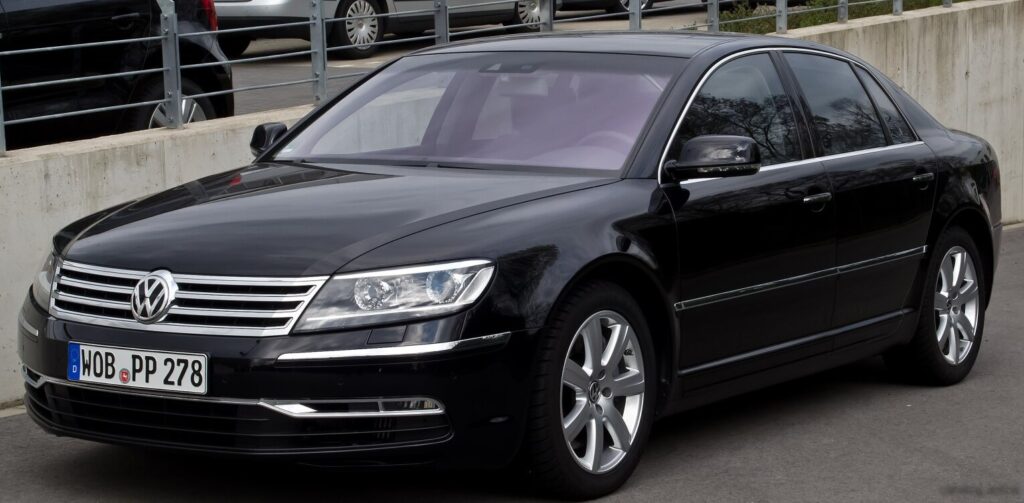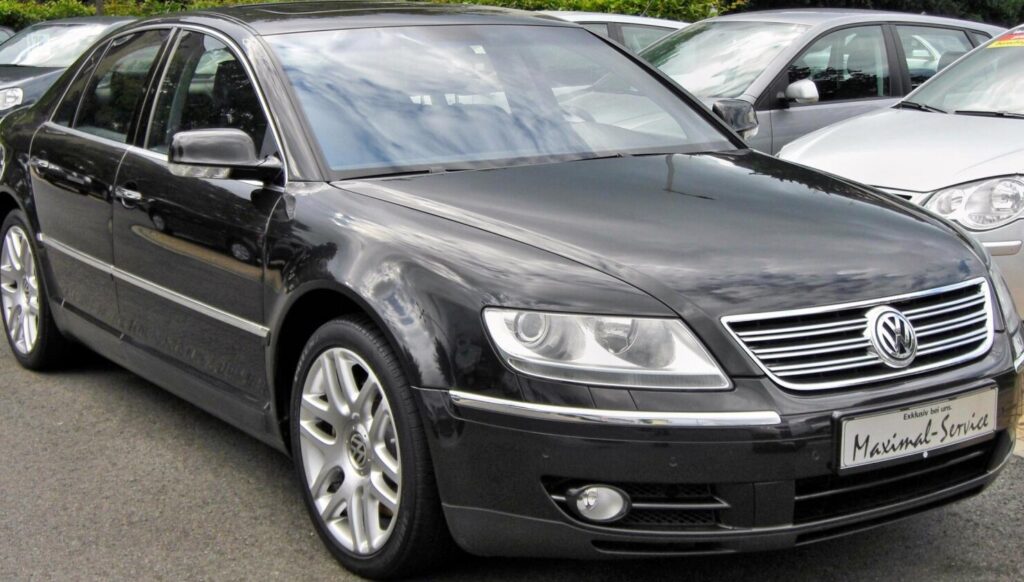
The Volkswagen Phaeton 6.0 W12 48V, produced from 2002 to 2005, represented Volkswagen’s ambitious foray into the ultra-luxury sedan segment. Designed to compete with established marques like BMW, Mercedes-Benz, and Audi, the Phaeton aimed to showcase Volkswagen’s engineering prowess and build quality. This flagship model, built at a dedicated “glass factory” in Dresden, Germany, was a statement of intent, utilizing advanced technology and premium materials. The 6.0 W12 48V variant was the top-of-the-line offering, boasting a unique 48-volt electrical system to support its sophisticated features and powerful engine. It was part of the first generation Phaeton (internally designated as the D1), and positioned itself as a direct competitor to the BMW 7 Series and Mercedes-Benz S-Class.
Technical Specifications
| Brand | Volkswagen |
| Model | Phaeton |
| Type (Engine) | 6.0 W12 48V (420 Hp) |
| Start of production | 2002 |
| End of production | 2005 |
| Powertrain Architecture | Internal Combustion engine |
| Body type | Sedan |
| Seats | 5 |
| Doors | 4 |
| Fuel consumption (urban) | 23.9 l/100 km (9.8 US mpg, 11.8 UK mpg, 4.2 km/l) |
| Fuel consumption (extra urban) | 10.9 l/100 km (21.6 US mpg, 25.9 UK mpg, 9.2 km/l) |
| Fuel consumption (combined) | 15.6 l/100 km (15.1 US mpg, 18.1 UK mpg, 6.4 km/l) |
| Fuel Type | Petrol (Gasoline) |
| Acceleration 0 – 100 km/h | 6.1 sec |
| Acceleration 0 – 62 mph | 6.1 sec |
| Acceleration 0 – 60 mph | 5.8 sec |
| Maximum speed | 285 km/h (177.09 mph) |
| Weight-to-power ratio | 5.5 kg/Hp, 182.6 Hp/tonne |
| Weight-to-torque ratio | 4.2 kg/Nm, 239.1 Nm/tonne |
| Power | 420 Hp @ 6000 rpm |
| Power per litre | 70 Hp/l |
| Torque | 550 Nm @ 3500 rpm (405.66 lb.-ft. @ 3500 rpm) |
| Engine layout | Front, Longitudinal |
| Engine Model/Code | BAN, BAP |
| Engine displacement | 5998 cm3 (366.02 cu. in.) |
| Number of cylinders | 12 |
| Engine configuration | W-engine |
| Cylinder Bore | 84 mm (3.31 in.) |
| Piston Stroke | 90.3 mm (3.56 in.) |
| Compression ratio | 10.75:1 |
| Number of valves per cylinder | 4 |
| Fuel injection system | Multi-port manifold injection |
| Engine aspiration | Naturally aspirated engine |
| Valvetrain | DOHC |
| Engine oil capacity | 11.8 l (12.47 US qt | 10.38 UK qt) |
| Coolant | 13 l (13.74 US qt | 11.44 UK qt) |
| Kerb Weight | 2300 kg (5070.63 lbs.) |
| Max. weight | 2850 kg (6283.17 lbs.) |
| Max load | 550 kg (1212.54 lbs.) |
| Trunk (boot) space – minimum | 500 l (17.66 cu. ft.) |
| Fuel tank capacity | 90 l (23.78 US gal | 19.8 UK gal) |
| Length | 5055 mm (199.02 in.) |
| Width | 1903 mm (74.92 in.) |
| Height | 1450 mm (57.09 in.) |
| Wheelbase | 2881 mm (113.43 in.) |
| Front track | 1628 mm (64.09 in.) |
| Rear (Back) track | 1612 mm (63.46 in.) |
| Drive wheel | All wheel drive (4×4) |
| Number of gears and type of gearbox | 5 gears, automatic transmission |
| Front suspension | Air suspension |
| Rear suspension | Air suspension |
| Front brakes | Ventilated discs |
| Rear brakes | Disc |
| Assisting systems | ABS (Anti-lock braking system) |
| Steering type | Steering rack and pinion |
| Power steering | Hydraulic Steering |
| Tires size | 235/55 R17 |
| Wheel rims size | 17 |
Powertrain & Engine Architecture
The heart of the Phaeton 6.0 W12 48V is its 5.998-liter W12 engine, designated as either BAN or BAP depending on minor variations. This engine is essentially two narrow-angle VR6 engines combined at a 72-degree angle, resulting in a compact and relatively smooth twelve-cylinder configuration. It features a naturally aspirated design with multi-port fuel injection and a double overhead camshaft (DOHC) valvetrain. The 48-volt electrical system was a key innovation, enabling features like active anti-roll bars and electronically controlled dampers, enhancing ride comfort and handling. The engine produces 420 horsepower at 6000 rpm and a substantial 550 Nm (405.66 lb-ft) of torque at 3500 rpm. This power is delivered to all four wheels via a five-speed automatic transmission. The transmission was specifically tuned for smooth and refined shifts, prioritizing comfort over outright performance.
Driving Characteristics
The Phaeton 6.0 W12 48V offered a driving experience focused on effortless cruising and luxurious comfort. The W12 engine provided ample power for swift acceleration – 0 to 60 mph in around 5.8 seconds – but its character was more about smooth, linear power delivery than aggressive responsiveness. The five-speed automatic transmission, while refined, wasn’t as quick-shifting as some of its competitors. The all-wheel-drive system provided excellent traction in all weather conditions, and the air suspension delivered a remarkably comfortable ride, effectively isolating passengers from road imperfections. Compared to the more common V6 and TDI versions of the Phaeton, the W12 offered significantly more power and a more prestigious feel, but at the cost of increased fuel consumption.
Equipment & Trim Levels
The 6.0 W12 48V was the most lavishly equipped Phaeton variant. Standard features included premium leather upholstery, wood trim, heated and ventilated front seats with massage functions, a sophisticated climate control system, and a high-end audio system. The 48-volt system enabled features like electronically adjustable seats with memory functions, power-adjustable steering column, and advanced driver assistance systems. Optional extras included rear-seat entertainment, a refrigerator in the rear center console, and a variety of bespoke customization options. The interior was designed to rival the best that Mercedes-Benz and BMW had to offer, emphasizing craftsmanship and attention to detail.
Chassis & Braking
The Phaeton’s chassis was designed for a blend of comfort and handling. It utilized an independent suspension system with air springs at all four corners, providing a smooth and controlled ride. The 48-volt system allowed for active anti-roll bars, minimizing body roll during cornering. Braking duties were handled by ventilated disc brakes at all four wheels, coupled with an Anti-lock Braking System (ABS). The Phaeton’s weight (approximately 2300 kg or 5070 lbs) necessitated a robust braking system to ensure adequate stopping power.
Market Reception & Comparison
The Phaeton 6.0 W12 48V received mixed reviews from automotive critics. While praised for its luxurious interior, advanced technology, and smooth ride, it was often criticized for its high price, complex engineering, and relatively understated styling. Compared to the V6 and TDI models, the W12 offered a significant performance upgrade but suffered from considerably worse fuel economy (around 15.6 l/100 km combined). Its fuel consumption was a major drawback, especially in Europe where fuel prices were high. Reliability was also a concern, as the complex W12 engine and 48-volt system were prone to occasional issues.
Legacy
The Volkswagen Phaeton, despite its limited sales success, remains a fascinating and ambitious project in automotive history. The 6.0 W12 48V variant, as the flagship model, represents the pinnacle of Volkswagen’s engineering capabilities during that era. Today, the Phaeton is gaining a following among enthusiasts who appreciate its unique blend of luxury, technology, and understated elegance. While maintenance can be expensive due to the complexity of the W12 engine and 48-volt system, well-maintained examples are becoming increasingly collectible. The Phaeton demonstrated Volkswagen’s ability to compete with the best in the luxury segment, even if it didn’t achieve the commercial success it deserved.