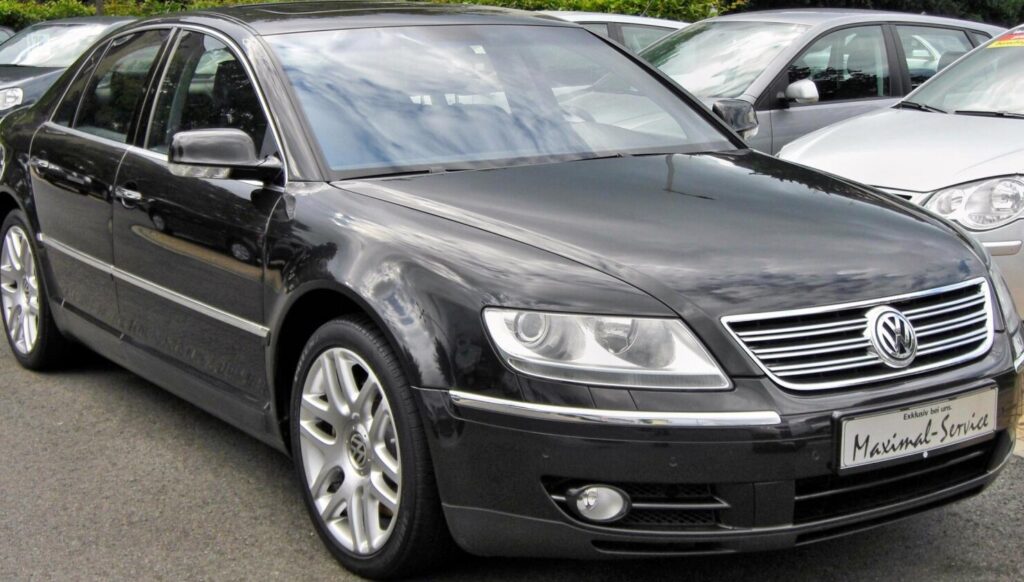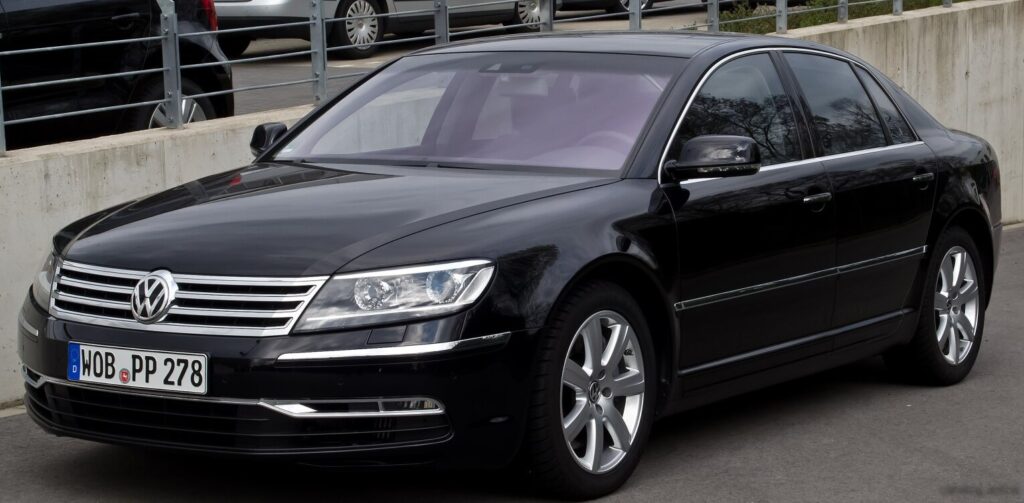
The Volkswagen Phaeton, particularly the facelifted version produced from 2010 to 2016, represented Volkswagen’s ambitious attempt to compete directly with luxury marques like BMW, Mercedes-Benz, and Audi. Introduced in September 2013 and running through August 2015, the 3.0 V6 TDI 4MOTION Tiptronic variant, producing 245 horsepower, occupied a significant position within the Phaeton range. This model aimed to deliver a blend of performance, efficiency, and all-weather capability, appealing to buyers seeking a sophisticated and technologically advanced luxury sedan. It was positioned as a mid-to-upper range offering, slotting between the entry-level 3.6L V6 petrol and the flagship 4.2L W12 models.
Technical Specifications
| Brand | Volkswagen |
| Model | Phaeton |
| Generation | Phaeton (facelift 2010) |
| Type (Engine) | 3.0 V6 TDI (245 Hp) 4MOTION Tiptronic 4 Seat |
| Start of production | September, 2013 |
| End of production | August, 2015 |
| Powertrain Architecture | Internal Combustion engine |
| Body type | Sedan |
| Seats | 4 |
| Doors | 4 |
| Fuel consumption (economy) – urban (NEDC) | 11.6 l/100 km (20.3 US mpg, 24.4 UK mpg, 8.6 km/l) |
| Fuel consumption (economy) – extra urban (NEDC) | 6.7 l/100 km (35.1 US mpg, 42.2 UK mpg, 14.9 km/l) |
| Fuel consumption (economy) – combined (NEDC) | 8.5 l/100 km (27.7 US mpg, 33.2 UK mpg, 11.8 km/l) |
| CO2 emissions (NEDC) | 224 g/km |
| Fuel Type | Diesel |
| Acceleration 0 – 100 km/h | 8.6 sec |
| Acceleration 0 – 62 mph | 8.6 sec |
| Acceleration 0 – 60 mph | 8.2 sec |
| Maximum speed | 238 km/h (147.89 mph) |
| Emission standard | Euro 5 |
| Weight-to-power ratio | 9.2 kg/Hp, 108.9 Hp/tonne |
| Weight-to-torque ratio | 4.5 kg/Nm, 222.2 Nm/tonne |
| Power | 245 Hp @ 4000 rpm |
| Power per litre | 82.6 Hp/l |
| Torque | 500 Nm @ 1500-3000 rpm (368.78 lb.-ft. @ 1500-3000 rpm) |
| Engine layout | Front, Longitudinal |
| Engine Model/Code | EA896 / CEXB |
| Engine displacement | 2967 cm3 (181.06 cu. in.) |
| Number of cylinders | 6 |
| Engine configuration | V-engine |
| Cylinder Bore | 83 mm (3.27 in.) |
| Piston Stroke | 91.4 mm (3.6 in.) |
| Number of valves per cylinder | 4 |
| Fuel injection system | Diesel Commonrail |
| Engine aspiration | Turbocharger, Intercooler |
| Valvetrain | DOHC |
| Engine oil capacity | 8.3 l (8.77 US qt | 7.3 UK qt) |
| Coolant | 13 l (13.74 US qt | 11.44 UK qt) |
| Kerb Weight | 2250 kg (4960.4 lbs.) |
| Max. weight | 2800 kg (6172.94 lbs.) |
| Max load | 550 kg (1212.54 lbs.) |
| Trunk (boot) space – minimum | 500 l (17.66 cu. ft.) |
| Fuel tank capacity | 90 l (23.78 US gal | 19.8 UK gal) |
| Max. roof load | 100 kg (220.46 lbs.) |
| Permitted trailer load with brakes (8%) | 2500 kg (5511.56 lbs.) |
| Permitted trailer load with brakes (12%) | 2500 kg (5511.56 lbs.) |
| Permitted trailer load without brakes | 750 kg (1653.47 lbs.) |
| Permitted towbar download | 100 kg (220.46 lbs.) |
| Length | 5059 mm (199.17 in.) |
| Width | 1908 mm (75.12 in.) |
| Width including mirrors | 2118 mm (83.39 in.) |
| Height | 1450 mm (57.09 in.) |
| Wheelbase | 2881 mm (113.43 in.) |
| Front track | 1630 mm (64.17 in.) |
| Rear (Back) track | 1617 mm (63.66 in.) |
| Ride height (ground clearance) | 120 mm (4.72 in.) |
| Minimum turning circle (turning diameter) | 12 m (39.37 ft.) |
| Drivetrain Architecture | The Internal combustion engine (ICE) drives permanently the four wheels of the vehicle. |
| Drive wheel | All wheel drive (4×4) |
| Number of gears and type of gearbox | 6 gears, automatic transmission Tiptronic |
| Front suspension | Double wishbone, Transverse stabilizer, Air suspension |
| Rear suspension | Independent on trapezoidal lever, Air suspension, Transverse stabilizer |
| Front brakes | Ventilated discs, 360×34 mm |
| Rear brakes | Ventilated discs, 310×22 mm |
INTRODUCTION
The 3.0 V6 TDI 4MOTION Tiptronic Phaeton, produced between 2013 and 2015, was a key variant of the facelifted second-generation Phaeton (introduced in 2010). Built on the Volkswagen Group’s D3 platform (also known as the 4H platform), shared with the Audi A8 and Bentley Continental GT, the Phaeton aimed to provide a luxurious experience with advanced technology. This particular engine and transmission combination was designed to offer a balance between performance and fuel economy, appealing to drivers who desired a refined driving experience without sacrificing practicality. The facelift brought subtle styling updates, improved interior materials, and enhanced technology features, further solidifying the Phaeton’s position as a genuine luxury contender.
Powertrain & Engine Architecture
At the heart of this Phaeton variant lies the EA896 series 3.0-liter V6 TDI engine, specifically the CEXB code. This engine is a common-rail direct injection diesel, utilizing piezo injectors for precise fuel delivery. The engine features a single turbocharger with an intercooler, boosting power output to 245 horsepower at 4000 rpm and a substantial 500 Nm (368.78 lb-ft) of torque available from 1500 to 3000 rpm. The engine employs a double overhead camshaft (DOHC) valvetrain with four valves per cylinder. The six-speed Tiptronic automatic transmission, a torque converter-based unit, was specifically tuned to handle the engine’s output and provide smooth, responsive shifts. The ‘Tiptronic’ function allowed drivers to manually select gears for greater control.
Driving Characteristics
The 3.0 TDI 4MOTION Phaeton offered a composed and refined driving experience. While not overtly sporty, the engine provided ample power for effortless cruising and confident overtaking. The 4MOTION all-wheel-drive system ensured excellent traction in all weather conditions, enhancing stability and safety. The Tiptronic transmission, while smooth, wasn’t as quick-shifting as some dual-clutch transmissions found in competitors. Gear ratios were optimized for comfortable highway driving, with a focus on maximizing fuel efficiency. Compared to the petrol-powered Phaeton variants, the TDI offered significantly better fuel economy and torque, making it a more practical choice for long-distance travel. Against the more powerful W12 model, the 3.0 TDI provided a more balanced driving experience, sacrificing some outright performance for improved efficiency and a lighter front-end feel.
Equipment & Trim Levels
The 3.0 V6 TDI 4MOTION Phaeton came standard with a comprehensive array of luxury features. These included leather upholstery, four-zone automatic climate control, a premium audio system, and a navigation system. Standard safety equipment included multiple airbags, ABS, electronic stability control, and parking sensors. Optional extras included massaging seats, a rear-seat entertainment system, adaptive cruise control, and a panoramic sunroof. Interior trim options varied, allowing buyers to personalize the cabin with different wood veneers and leather colors. The Phaeton prioritized a high level of standard equipment, minimizing the need for extensive optioning.
Chassis & Braking
The Phaeton’s chassis featured an independent suspension system all around, with double wishbones at the front and a trapezoidal lever setup at the rear. Air suspension was standard, providing a remarkably smooth and comfortable ride. The system automatically adjusted ride height based on driving conditions and load. Braking duties were handled by ventilated disc brakes on all four wheels, providing ample stopping power. The front brakes measured 360x34mm, while the rear brakes were 310x22mm. ABS and electronic stability control were standard, enhancing safety and control.
Market Reception & Comparison
The Phaeton, despite its impressive engineering and luxurious appointments, struggled to gain significant market share. Critics praised its ride quality, refinement, and technology, but often noted its relatively understated styling and the challenge of competing against established luxury brands. The 3.0 TDI 4MOTION variant was generally well-received for its balance of performance and fuel economy. Fuel economy figures of around 27.7 US mpg combined were competitive for a vehicle of its size and weight. Reliability was generally good, although the complex technology could lead to higher maintenance costs compared to more mainstream vehicles. Compared to the 3.6L V6 petrol, the TDI offered superior fuel economy and torque. Compared to the W12, it provided a more sensible balance of performance and running costs.
Legacy
The Volkswagen Phaeton, while ultimately discontinued in 2016, remains a fascinating example of Volkswagen’s ambition to create a world-class luxury car. The 3.0 V6 TDI 4MOTION Tiptronic variant, with its robust engine and sophisticated technology, has proven to be a relatively reliable and durable powertrain. On the used car market, these Phaetons can be found at attractive prices, offering a significant amount of luxury and technology for the money. However, potential buyers should be aware of the potential for higher maintenance costs associated with the vehicle’s complex systems. The Phaeton, despite its commercial shortcomings, left a lasting impression as a technologically advanced and surprisingly capable luxury sedan.