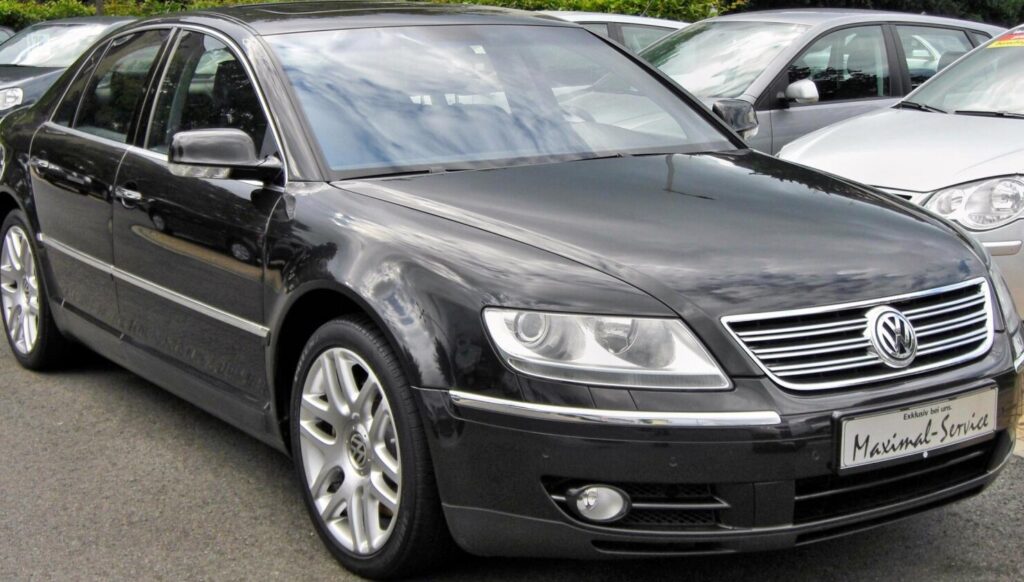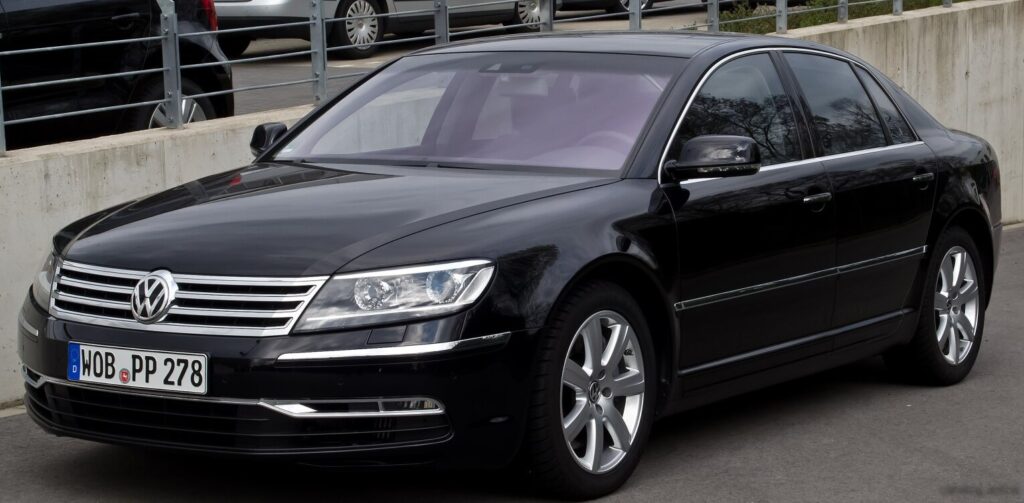
The Volkswagen Phaeton (facelift, 2010-2015) 3.6 V6 FSI 4MOTION Tiptronic represents a significant iteration of Volkswagen’s flagship luxury sedan. Introduced in May 2010 as part of a comprehensive facelift, this variant aimed to refine the Phaeton’s blend of understated elegance, advanced technology, and robust performance. Positioned as a mid-range offering within the Phaeton lineup, it slotted between the entry-level 3.6 V6 FSI with rear-wheel drive and the more potent 4.2 V8 models. Production continued until April 2015, marking the end of the first-generation Phaeton. The facelift brought subtle but important changes to the exterior styling, interior appointments, and crucially, the technological features available.
Technical Specifications
| Brand | Volkswagen |
| Model | Phaeton |
| Generation | Phaeton (facelift 2010) |
| Type (Engine) | 3.6 V6 FSI (280 Hp) 4MOTION Tiptronic 4 Seat |
| Start of production | May, 2010 |
| End of production | April, 2015 |
| Powertrain Architecture | Internal Combustion engine |
| Body type | Sedan |
| Seats | 4 |
| Doors | 4 |
| Fuel consumption (economy) – urban (NEDC) | 16.5 l/100 km (14.3 US mpg, 17.1 UK mpg, 6.1 km/l) |
| Fuel consumption (economy) – extra urban (NEDC) | 8.4 l/100 km (28 US mpg, 33.6 UK mpg, 11.9 km/l) |
| Fuel consumption (economy) – combined (NEDC) | 11.4 l/100 km (20.6 US mpg, 24.8 UK mpg, 8.8 km/l) |
| CO2 emissions (NEDC) | 265 g/km |
| Fuel Type | Petrol (Gasoline) |
| Acceleration 0 – 100 km/h | 8.9 sec |
| Acceleration 0 – 62 mph | 8.9 sec |
| Acceleration 0 – 60 mph | 8.5 sec |
| Maximum speed | 250 km/h (155.34 mph) |
| Emission standard | Euro 5 |
| Weight-to-power ratio | 7.8 kg/Hp, 128.9 Hp/tonne |
| Weight-to-torque ratio | 5.9 kg/Nm, 170.3 Nm/tonne |
| Power | 280 Hp @ 6250 rpm |
| Power per litre | 77.8 Hp/l |
| Torque | 370 Nm @ 3500 rpm (272.9 lb.-ft. @ 3500 rpm) |
| Engine layout | Front, Longitudinal |
| Engine Model/Code | EA390 / CHNA, CMVA |
| Engine displacement | 3597 cm3 (219.5 cu. in.) |
| Number of cylinders | 6 |
| Engine configuration | VR-engine |
| Cylinder Bore | 89 mm (3.5 in.) |
| Piston Stroke | 96.4 mm (3.8 in.) |
| Compression ratio | 12:1 |
| Number of valves per cylinder | 4 |
| Fuel injection system | Direct injection |
| Engine aspiration | Naturally aspirated engine |
| Valvetrain | DOHC |
| Engine oil capacity | 6.2 l (6.55 US qt | 5.46 UK qt) |
| Kerb Weight | 2173 kg (4790.64 lbs.) |
| Max. weight | 2710 kg (5974.53 lbs.) |
| Max load | 537 kg (1183.88 lbs.) |
| Trunk (boot) space – minimum | 500 l (17.66 cu. ft.) |
| Fuel tank capacity | 90 l (23.78 US gal | 19.8 UK gal) |
| Max. roof load | 100 kg (220.46 lbs.) |
| Permitted trailer load with brakes (8%) | 2500 kg (5511.56 lbs.) |
| Permitted trailer load with brakes (12%) | 2300 kg (5070.63 lbs.) |
| Permitted trailer load without brakes | 750 kg (1653.47 lbs.) |
| Permitted towbar download | 100 kg (220.46 lbs.) |
| Length | 5059 mm (199.17 in.) |
| Width | 1903 mm (74.92 in.) |
| Width including mirrors | 2118 mm (83.39 in.) |
| Height | 1450 mm (57.09 in.) |
| Wheelbase | 2881 mm (113.43 in.) |
| Front track | 1630 mm (64.17 in.) |
| Rear (Back) track | 1617 mm (63.66 in.) |
| Ride height (ground clearance) | 120 mm (4.72 in.) |
| Minimum turning circle (turning diameter) | 12 m (39.37 ft.) |
| Front suspension | Double wishbone, Transverse stabilizer, Air suspension |
| Rear suspension | Independent on trapezoidal lever, Air suspension, Transverse stabilizer |
| Front brakes | Ventilated discs, 360×34 mm |
| Rear brakes | Ventilated discs, 310×22 mm |
| Number of gears and type of gearbox | 6 gears, automatic transmission Tiptronic |
Powertrain & Engine Architecture
At the heart of the 2010-2015 Phaeton 3.6 V6 FSI 4MOTION lies the EA390 engine family, specifically the CHNA or CMVA engine code. This 3.6-liter VR6 engine is a naturally aspirated powerplant featuring direct fuel injection (FSI – Fuel Stratified Injection). The VR configuration, a Volkswagen hallmark, combines the smoothness of a V6 with the compactness of an inline engine. The engine produces 280 horsepower at 6250 rpm and 273 lb-ft of torque at 3500 rpm. The FSI system delivers fuel directly into the combustion chamber, improving efficiency and power output. The engine utilizes a double overhead camshaft (DOHC) valvetrain with four valves per cylinder. Paired with this engine is a six-speed Tiptronic automatic transmission, offering both fully automatic operation and manual gear selection via steering wheel-mounted paddles or the gear selector. The 4MOTION all-wheel-drive system utilizes a Torsen differential, providing variable torque distribution between the front and rear axles for enhanced traction and stability.
Driving Characteristics
The 3.6 V6 FSI 4MOTION Phaeton delivers a refined and comfortable driving experience. While not overtly sporty, the engine provides ample power for effortless cruising and confident overtaking. The Tiptronic transmission is generally smooth and responsive, although it can occasionally feel hesitant during quick downshifts. The 4MOTION system provides excellent grip in all weather conditions, enhancing stability and control. Compared to the more powerful V8 models, the 3.6 V6 offers a more balanced driving experience, prioritizing comfort and refinement over outright performance. Against the diesel-powered variants, the 3.6 V6 provides a different character, with a more linear power delivery and a distinctive engine note. The gear ratios are tuned for relaxed highway cruising, with a focus on minimizing engine noise and maximizing fuel efficiency.
Equipment & Trim Levels
The 2010-2015 Phaeton 3.6 V6 FSI 4MOTION came generously equipped as standard. Typical features included leather upholstery, wood trim, a premium audio system, automatic climate control, bi-xenon headlights, and a power-adjustable driver’s seat with memory function. Optional extras included massaging seats, a rear-seat entertainment system, adaptive cruise control, and a panoramic sunroof. The interior design emphasized luxury and sophistication, with high-quality materials and meticulous attention to detail. The dashboard layout was clean and intuitive, with a central touchscreen display controlling many of the vehicle’s functions.
Chassis & Braking
The Phaeton’s chassis features a double wishbone front suspension and an independent trapezoidal lever rear suspension, both incorporating air suspension as standard. This air suspension system provides a remarkably smooth and comfortable ride, automatically adjusting the damping characteristics to suit road conditions. The braking system consists of ventilated discs on all four wheels, providing ample stopping power. Anti-lock brakes (ABS) and electronic stability control (ESC) are standard features, enhancing safety and control. The Phaeton’s suspension is tuned for comfort, prioritizing ride quality over sporty handling.
Market Reception & Comparison
The Phaeton, even in its facelifted form, remained a niche vehicle in the luxury sedan segment. Critics generally praised its build quality, refinement, and advanced technology, but noted its relatively understated styling and lack of brand recognition compared to established rivals like the Mercedes-Benz S-Class and BMW 7 Series. The 3.6 V6 FSI 4MOTION variant offered a compelling balance of performance and fuel economy, achieving around 20.6 mpg combined. However, its fuel consumption was higher than that of the diesel-powered models. Reliability was generally good, although the Phaeton’s complex technology could potentially lead to higher maintenance costs.
Legacy
The Volkswagen Phaeton, despite its limited sales success, remains a fascinating and ambitious project. The 3.6 V6 FSI 4MOTION variant represents a sweet spot in the lineup, offering a refined and capable luxury sedan experience. On the used car market, these Phaetons can be found at relatively affordable prices, making them an attractive option for buyers seeking a unique and well-equipped luxury vehicle. The EA390 engine family, while no longer in production, is known for its durability and reliability when properly maintained. The Phaeton’s advanced technology and luxurious appointments continue to impress, cementing its status as a distinctive and often overlooked gem in the automotive world.