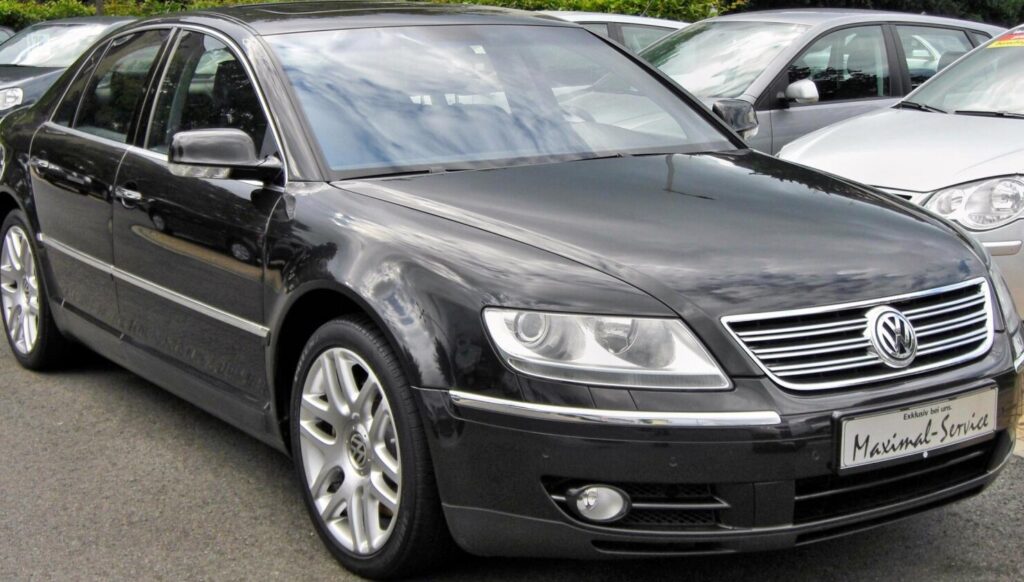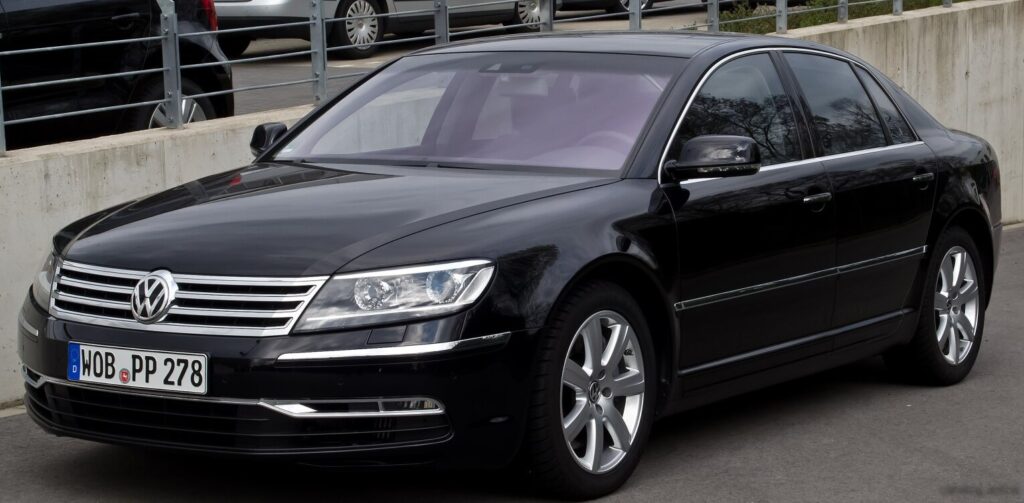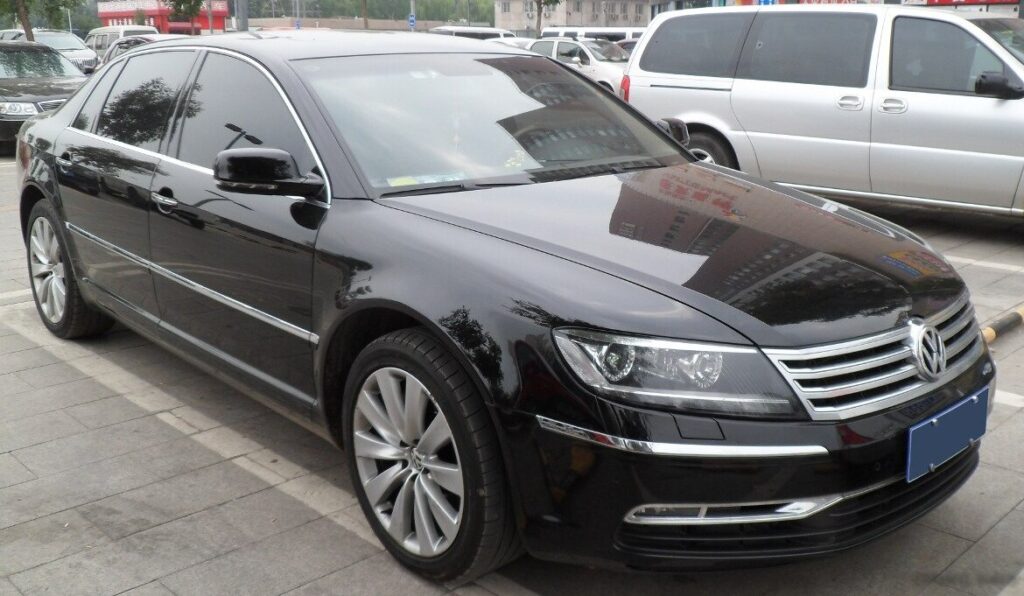
The Volkswagen Phaeton Long (facelift, 2010) 4.2 V8 4MOTION Tiptronic represents the pinnacle of Volkswagen’s luxury sedan ambitions. Produced from May 2010 to April 2015, this variant was a significant iteration of the first-generation Phaeton (designated 1HX0/A3), offering a blend of opulent comfort, advanced technology, and robust performance. Positioned as the flagship model within the Phaeton range, it aimed to compete directly with established luxury brands like BMW, Mercedes-Benz, and Audi. The “Long” designation refers to the extended wheelbase, providing increased rear passenger legroom, further emphasizing its chauffeur-driven appeal. This particular configuration, pairing the naturally aspirated 4.2-liter V8 engine with a six-speed Tiptronic automatic transmission and Volkswagen’s 4MOTION all-wheel-drive system, was the top-tier offering in the Phaeton lineup.
Technical Specifications
| Brand | Volkswagen |
| Model | Phaeton |
| Generation | Phaeton Long (facelift 2010) |
| Type (Engine) | 4.2 V8 (335 Hp) 4MOTION Tiptronic 4 Seat |
| Start of production | May, 2010 |
| End of production | April, 2015 |
| Powertrain Architecture | Internal Combustion engine |
| Body type | Sedan |
| Seats | 4 |
| Doors | 4 |
| Fuel consumption (economy) – urban (NEDC) | 18.2 l/100 km (12.9 US mpg, 15.5 UK mpg, 5.5 km/l) |
| Fuel consumption (economy) – extra urban (NEDC) | 9.2 l/100 km (25.6 US mpg, 30.7 UK mpg, 10.9 km/l) |
| Fuel consumption (economy) – combined (NEDC) | 12.5 l/100 km (18.8 US mpg, 22.6 UK mpg, 8 km/l) |
| CO2 emissions (NEDC) | 290 g/km |
| Fuel Type | Petrol (Gasoline) |
| Acceleration 0 – 100 km/h | 6.9 sec |
| Acceleration 0 – 62 mph | 6.9 sec |
| Acceleration 0 – 60 mph | 6.6 sec |
| Maximum speed | 250 km/h (155.34 mph), Electronically limited |
| Emission standard | Euro 5 |
| Weight-to-power ratio | 6.7 kg/Hp, 148.2 Hp/tonne |
| Weight-to-torque ratio | 5.3 kg/Nm, 190.3 Nm/tonne |
| Power | 335 Hp @ 6500 rpm |
| Power per litre | 80.3 Hp/l |
| Torque | 430 Nm @ 3500 rpm (317.15 lb.-ft. @ 3500 rpm) |
| Engine layout | Front, Longitudinal |
| Engine Model/Code | BGH, BGJ |
| Engine displacement | 4172 cm3 (254.59 cu. in.) |
| Number of cylinders | 8 |
| Engine configuration | V-engine |
| Cylinder Bore | 84.5 mm (3.33 in.) |
| Piston Stroke | 93 mm (3.66 in.) |
| Compression ratio | 11:1 |
| Number of valves per cylinder | 5 |
| Fuel injection system | Multi-port manifold injection |
| Engine aspiration | Naturally aspirated engine |
| Valvetrain | DOHC |
| Engine oil capacity | 7.5 l (7.93 US qt | 6.6 UK qt) |
| Coolant | 9 l (9.51 US qt | 7.92 UK qt) |
| Kerb Weight | 2260 kg (4982.45 lbs.) |
| Max. weight | 2780 kg (6128.85 lbs.) |
| Max load | 520 kg (1146.4 lbs.) |
| Trunk (boot) space – minimum | 500 l (17.66 cu. ft.) |
| Fuel tank capacity | 90 l (23.78 US gal | 19.8 UK gal) |
| Max. roof load | 100 kg (220.46 lbs.) |
| Permitted trailer load with brakes (8%) | 2500 kg (5511.56 lbs.) |
| Permitted trailer load with brakes (12%) | 2400 kg (5291.09 lbs.) |
| Permitted trailer load without brakes | 750 kg (1653.47 lbs.) |
| Permitted towbar download | 100 kg (220.46 lbs.) |
| Length | 5179 mm (203.9 in.) |
| Width | 1903 mm (74.92 in.) |
| Width including mirrors | 2118 mm (83.39 in.) |
| Height | 1450 mm (57.09 in.) |
| Wheelbase | 3001 mm (118.15 in.) |
| Front track | 1630 mm (64.17 in.) |
| Rear (Back) track | 1617 mm (63.66 in.) |
| Ride height (ground clearance) | 120 mm (4.72 in.) |
| Minimum turning circle (turning diameter) | 12.5 m (41.01 ft.) |
| Front suspension | Double wishbone, Transverse stabilizer, Air suspension |
| Rear suspension | Independent on trapezoidal lever, Air suspension, Transverse stabilizer |
| Front brakes | Ventilated discs, 360×34 mm |
| Rear brakes | Ventilated discs, 310×22 mm |
| Number of gears and type of gearbox | 6 gears, automatic transmission Tiptronic |
Powertrain & Engine Architecture
The heart of the Phaeton Long 4.2 V8 is the BGH or BGJ engine code, a 4.172-liter naturally aspirated V8. This engine utilizes a multi-port fuel injection system and a double overhead camshaft (DOHC) valvetrain with five valves per cylinder. The engine’s architecture is longitudinal, meaning it’s mounted lengthwise in the chassis. The 4.2-liter V8 produces 335 horsepower at 6500 rpm and 430 Nm (317 lb-ft) of torque at 3500 rpm. Paired with this engine is a ZF-sourced six-speed Tiptronic automatic transmission. This transmission allows for both fully automatic operation and manual gear selection via steering wheel-mounted paddles or the gear selector. The Tiptronic transmission features adaptive shift programming, adjusting shift points based on driving style and conditions. The 4MOTION all-wheel-drive system is permanent, distributing power to all four wheels for enhanced traction and stability, particularly in adverse weather conditions.
Driving Characteristics
The 4.2 V8 Tiptronic combination delivers a refined and powerful driving experience. Acceleration from 0 to 60 mph takes approximately 6.6 seconds, and the car is electronically limited to a top speed of 155 mph. While not overtly sporty, the engine provides ample power for effortless cruising and confident overtaking. The Tiptronic transmission offers smooth and responsive shifts, although it may not be as quick or engaging as a dual-clutch transmission. The 4MOTION system provides excellent grip and stability, inspiring confidence in various driving conditions. Compared to the 3.6-liter V6 Phaeton, the 4.2 V8 offers significantly more power and torque, resulting in noticeably quicker acceleration. However, it comes at the expense of fuel economy. Compared to the diesel variants (like the 3.0 TDI), the V8 is less fuel-efficient but provides a different character – a smoother, more linear power delivery.
Equipment & Trim Levels
The Phaeton Long 4.2 V8 came standard with a comprehensive array of luxury features. These included premium leather upholstery, wood trim, multi-adjustable heated and ventilated front seats with massage function, a sophisticated climate control system, a premium audio system, and a navigation system. The “Long” wheelbase provided significantly more rear legroom, often paired with individual rear seats with heating, ventilation, and massage functions. Optional extras included a rear-seat entertainment system, a panoramic sunroof, and various customization options for interior materials and colors. The Phaeton aimed to offer a bespoke experience, allowing customers to tailor the car to their individual preferences.
Chassis & Braking
The Phaeton Long featured an advanced chassis design incorporating an air suspension system on both the front and rear axles. This air suspension provided a remarkably smooth and comfortable ride, automatically adjusting ride height and damping characteristics based on road conditions and driving style. The front suspension utilized a double wishbone configuration with a transverse stabilizer, while the rear suspension employed an independent trapezoidal lever setup, also with a transverse stabilizer. Braking duties were handled by ventilated disc brakes on all four wheels, providing ample stopping power. The Phaeton also included ABS (Anti-lock Braking System) and electronic stability control as standard safety features.
Market Reception & Comparison
The Phaeton, despite its impressive engineering and luxurious appointments, struggled to gain widespread acceptance in the luxury car market. Critics praised its build quality, ride comfort, and technology, but often questioned its value proposition compared to established rivals. The 4.2 V8 variant, while offering the most performance, suffered from relatively poor fuel economy and higher maintenance costs. Compared to the 3.6-liter V6, the V8 offered a more prestigious image and greater performance, but at a significant price premium. The diesel variants, particularly the 3.0 TDI, proved more popular due to their superior fuel efficiency and lower running costs.
Legacy
The Volkswagen Phaeton, while ultimately a commercial disappointment, remains a fascinating example of Volkswagen’s ambition to compete in the ultra-luxury segment. The 4.2 V8 Tiptronic variant, with its powerful engine and sophisticated technology, represents the pinnacle of that ambition. Today, well-maintained Phaetons are becoming increasingly sought after by enthusiasts who appreciate their unique blend of luxury, performance, and engineering excellence. However, potential buyers should be aware of the higher maintenance costs associated with the V8 engine and the complexity of the car’s advanced systems. The Phaeton’s legacy lies not in its sales figures, but in its demonstration of Volkswagen’s engineering capabilities and its willingness to challenge the established order in the luxury car market.