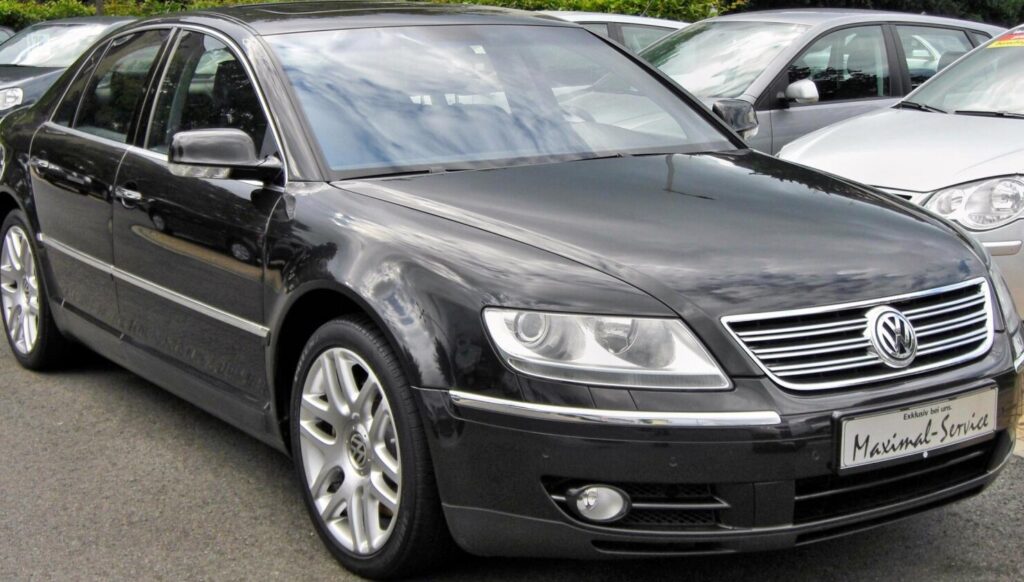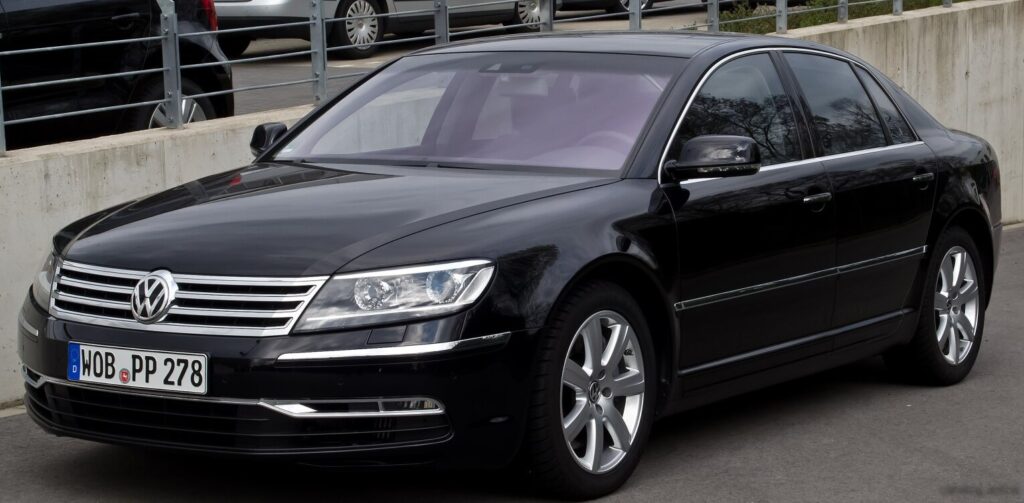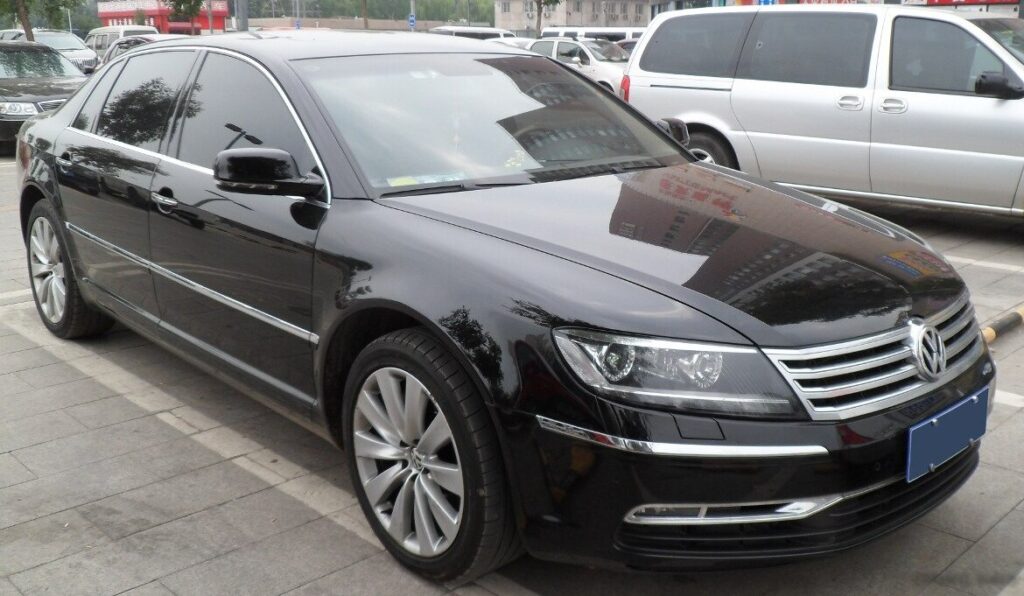
The Volkswagen Phaeton Long (facelift 2010) 6.0 W12 4MOTION Tiptronic represents the pinnacle of Volkswagen’s luxury sedan ambitions. Produced from May 2010 to 2011, this extended-wheelbase variant of the Phaeton aimed to compete directly with flagship models from established luxury brands like BMW, Mercedes-Benz, and Audi. Positioned as the most opulent and powerful iteration of the second-generation Phaeton (introduced in 2002, internally designated as the 1HX0/A3 platform), the W12 model showcased Volkswagen’s engineering prowess and commitment to a truly high-end automotive experience. The facelift brought subtle styling revisions and updated technology, further refining the Phaeton’s already sophisticated character.
Technical Specifications
| Brand | Volkswagen |
| Model | Phaeton |
| Generation | Phaeton Long (facelift 2010) |
| Type (Engine) | 6.0 W12 (450 Hp) 4MOTION Tiptronic |
| Start of production | May, 2010 |
| End of production | 2011 |
| Powertrain Architecture | Internal Combustion engine |
| Body type | Sedan |
| Seats | 5 |
| Doors | 4 |
| Fuel consumption (economy) – urban (NEDC) | 21.4 l/100 km (11 US mpg, 13.2 UK mpg, 4.7 km/l) |
| Fuel consumption (economy) – extra urban (NEDC) | 10.5 l/100 km (22.4 US mpg, 26.9 UK mpg, 9.5 km/l) |
| Fuel consumption (economy) – combined (NEDC) | 14.5 l/100 km (16.2 US mpg, 19.5 UK mpg, 6.9 km/l) |
| CO2 emissions (NEDC) | 348 g/km |
| Fuel Type | Petrol (Gasoline) |
| Acceleration 0 – 100 km/h | 6.1 sec |
| Acceleration 0 – 62 mph | 6.1 sec |
| Acceleration 0 – 60 mph | 5.8 sec |
| Maximum speed | 250 km/h (155.34 mph), Electronically limited |
| Emission standard | Euro 5 |
| Weight-to-power ratio | 5.2 kg/Hp, 190.8 Hp/tonne |
| Weight-to-torque ratio | 4.2 kg/Nm, 237.5 Nm/tonne |
| Power | 450 Hp @ 6050 rpm |
| Power per litre | 75 Hp/l |
| Torque | 560 Nm @ 2750-5200 rpm (413.03 lb.-ft. @ 2750-5200 rpm) |
| Engine layout | Front, Longitudinal |
| Engine Model/Code | EA398 / BRN, BRP, BTT |
| Engine displacement | 5998 cm3 (366.02 cu. in.) |
| Number of cylinders | 12 |
| Engine configuration | W-engine |
| Cylinder Bore | 84 mm (3.31 in.) |
| Piston Stroke | 90.2 mm (3.55 in.) |
| Compression ratio | 10.75:1 |
| Number of valves per cylinder | 4 |
| Fuel injection system | Multi-port manifold injection |
| Engine aspiration | Naturally aspirated engine |
| Valvetrain | DOHC |
| Engine oil capacity | 12.5 l (13.21 US qt | 11 UK qt) |
| Coolant | 17 l (17.96 US qt | 14.96 UK qt) |
| Kerb Weight | 2358 kg (5198.5 lbs.) |
| Max. weight | 2910 kg (6415.45 lbs.) |
| Max load | 552 kg (1216.95 lbs.) |
| Trunk (boot) space – minimum | 500 l (17.66 cu. ft.) |
| Fuel tank capacity | 90 l (23.78 US gal | 19.8 UK gal) |
| Max. roof load | 100 kg (220.46 lbs.) |
| Permitted trailer load with brakes (8%) | 2500 kg (5511.56 lbs.) |
| Permitted trailer load with brakes (12%) | 2400 kg (5291.09 lbs.) |
| Permitted trailer load without brakes | 750 kg (1653.47 lbs.) |
| Permitted towbar download | 100 kg (220.46 lbs.) |
| Length | 5179 mm (203.9 in.) |
| Width | 1903 mm (74.92 in.) |
| Width including mirrors | 2118 mm (83.39 in.) |
| Height | 1450 mm (57.09 in.) |
| Wheelbase | 3001 mm (118.15 in.) |
| Front track | 1630 mm (64.17 in.) |
| Rear (Back) track | 1617 mm (63.66 in.) |
| Ride height (ground clearance) | 118 mm (4.65 in.) |
| Minimum turning circle (turning diameter) | 12.5 m (41.01 ft.) |
| Approach angle | 12.9° |
| Departure angle | 15.9° |
| Ramp-over (brakeover) angle | 11.1° |
| Drivetrain Architecture | The Internal combustion engine (ICE) drives permanently the four wheels of the vehicle. |
| Drive wheel | All wheel drive (4×4) |
| Number of gears and type of gearbox | 5 gears, automatic transmission Tiptronic |
| Front suspension | Double wishbone, Transverse stabilizer, Air suspension |
| Rear suspension | Independent on trapezoidal lever, Air suspension, Transverse stabilizer |
| Front brakes | Ventilated discs, 365×34 mm |
| Rear brakes | Ventilated discs, 335×22 mm |
| Assisting systems | ABS (Anti-lock braking system) |
| Steering type | Steering rack and pinion |
| Power steering | Electric Steering |
| Tires size | 255/45 R18; 245/45 R19; 255/40 R19; 275/35 R20 |
| Wheel rims size | 8.5J x 18; 8.5J x 19; 9J x 19; 9J x 20 |
Powertrain & Engine Architecture
The heart of the Phaeton Long W12 is the EA398 engine, specifically coded BRN, BRP, or BTT depending on the minor variations and market. This 6.0-liter W12 engine is a naturally aspirated powerplant, producing 450 horsepower at 6,050 rpm and a substantial 560 Nm (413 lb-ft) of torque between 2,750 and 5,200 rpm. The W12 configuration, essentially two narrow-angle VR6 engines sharing a common crankshaft, provides a remarkably smooth and refined power delivery. It utilizes multi-port fuel injection and a double overhead camshaft (DOHC) valvetrain. The engine is longitudinally mounted in the front of the vehicle. Paired with the W12 is a five-speed Tiptronic automatic transmission, offering both fully automatic operation and manual gear selection via steering wheel-mounted paddles or the gear selector. This transmission was known for its smooth shifts, but by modern standards, the limited number of gears impacted fuel efficiency and overall responsiveness.
Driving Characteristics
The Phaeton Long W12 delivers a driving experience focused on effortless power and supreme comfort. The 450 hp engine provides brisk acceleration – 0 to 60 mph in around 5.8 seconds – and a top speed electronically limited to 155 mph. However, the car’s substantial weight (over 5,200 lbs) is noticeable. The Tiptronic transmission, while smooth, doesn’t offer the lightning-fast shifts of modern dual-clutch transmissions. The gear ratios are tuned for grand touring, prioritizing relaxed cruising over outright performance. Compared to the more common V6 or TDI versions of the Phaeton, the W12 offers a significantly more refined and powerful experience, but at the cost of considerably higher fuel consumption.
Equipment & Trim Levels
The Phaeton Long W12 came standard with a comprehensive array of luxury features. Interior appointments included premium leather upholstery, wood trim, and a sophisticated infotainment system. Standard equipment typically included heated and ventilated front seats with massage functions, a rear seat entertainment system, a premium audio system, and advanced climate control. The “Long” wheelbase added significant rear legroom, enhancing the experience for passengers. Optional extras included bespoke interior customization options, a refrigerator in the rear center console, and various driver-assistance systems.
Chassis & Braking
The Phaeton Long W12 featured an advanced chassis designed for both comfort and handling. It utilized a double wishbone front suspension and an independent trapezoidal lever rear suspension, both incorporating air suspension for a smooth ride. The air suspension allowed for adjustable ride height and damping settings. Braking duties were handled by ventilated disc brakes on all four wheels – 365mm front, 335mm rear – coupled with an Anti-lock Braking System (ABS). The 4MOTION all-wheel-drive system provided excellent traction in all weather conditions.
Market Reception & Comparison
The Phaeton Long W12 was critically well-regarded for its engineering excellence, luxurious interior, and refined driving experience. However, it struggled to gain significant market share, largely due to its high price tag and the strength of established competitors. Critics often noted the car’s substantial fuel consumption (around 16 mpg combined) and the relatively dated five-speed automatic transmission. Compared to the V6 and TDI Phaeton models, the W12 was significantly more expensive to purchase and maintain, appealing to a niche market of buyers seeking the ultimate in Volkswagen luxury.
Legacy
The Volkswagen Phaeton, despite its limited commercial success, remains a fascinating example of Volkswagen’s ambition to compete in the ultra-luxury segment. The W12 engine, while complex, has proven to be relatively reliable when properly maintained. Today, the Phaeton Long W12 is a sought-after vehicle among collectors and enthusiasts who appreciate its unique blend of German engineering, luxurious appointments, and understated elegance. Finding well-maintained examples can be challenging, and maintenance costs are substantial, but the Phaeton W12 offers a distinctive and rewarding ownership experience.