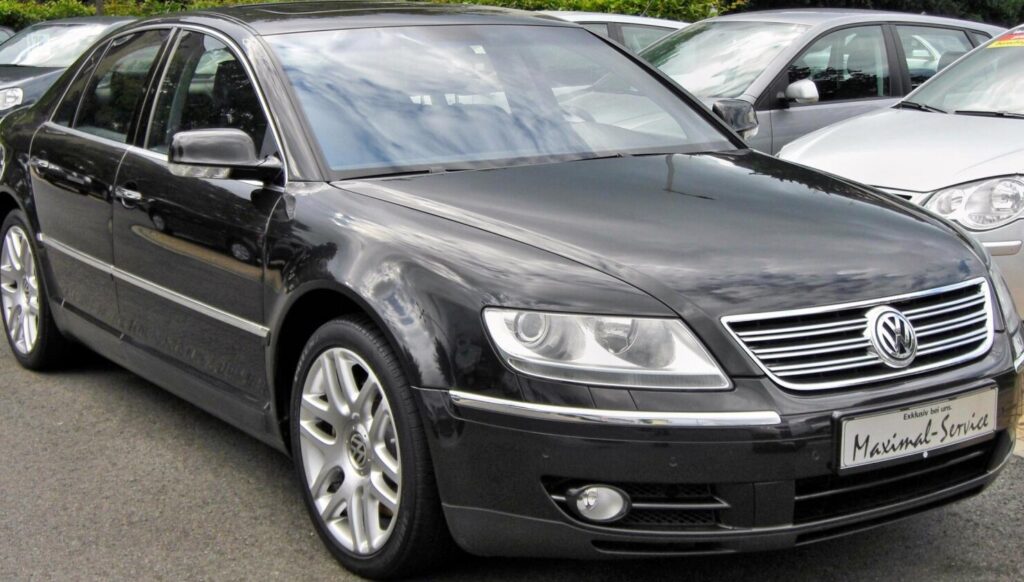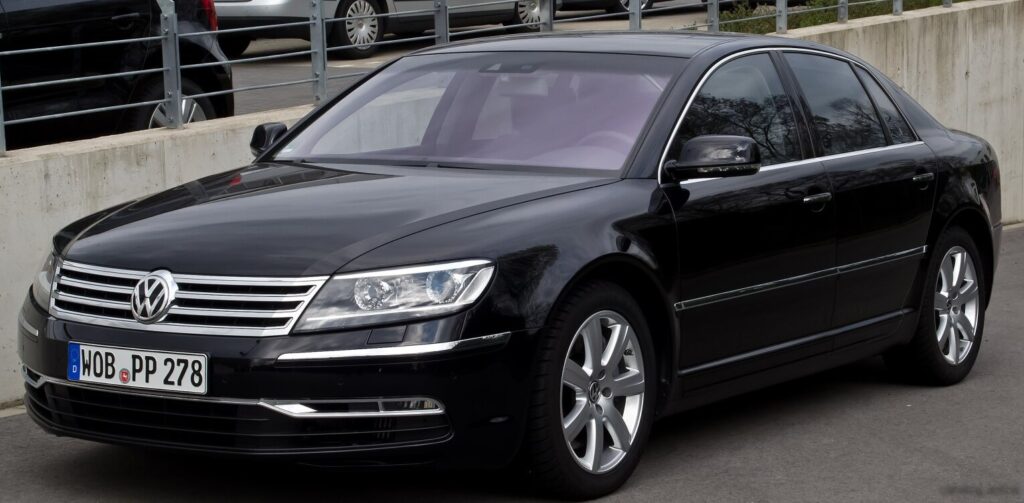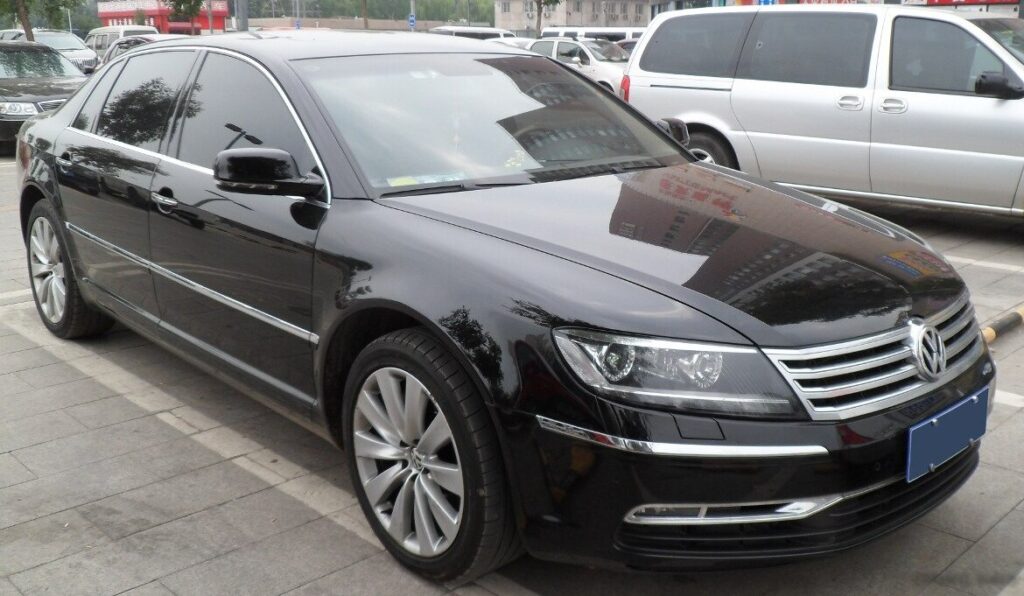
The Volkswagen Phaeton Long (facelift 2010) 6.0 W12, produced from May 2010 to 2011, represents the pinnacle of Volkswagen’s luxury sedan ambitions. Positioned as a direct competitor to the BMW 7 Series and Mercedes-Benz S-Class, the Phaeton aimed to showcase German engineering and craftsmanship. The “Long” designation indicates an extended wheelbase, providing significantly more rear passenger legroom. This particular variant, equipped with the 6.0-liter W12 engine, the 4MOTION all-wheel-drive system, and a Tiptronic automatic transmission, was the flagship model, offering the highest levels of performance and luxury within the Phaeton range. It was built on the D2 platform, also known as the 1HX0/A3 platform, shared with the Audi A8 of the same era.
Technical Specifications
| Brand | Volkswagen |
| Model | Phaeton |
| Generation | Phaeton Long (facelift 2010) |
| Type (Engine) | 6.0 W12 (450 Hp) 4MOTION Tiptronic 4 Seat |
| Start of production | May, 2010 |
| End of production | 2011 |
| Powertrain Architecture | Internal Combustion engine |
| Body type | Sedan |
| Seats | 4 |
| Doors | 4 |
| Fuel consumption (economy) – urban (NEDC) | 21.4 l/100 km (11 US mpg, 13.2 UK mpg, 4.7 km/l) |
| Fuel consumption (economy) – extra urban (NEDC) | 10.5 l/100 km (22.4 US mpg, 26.9 UK mpg, 9.5 km/l) |
| Fuel consumption (economy) – combined (NEDC) | 14.5 l/100 km (16.2 US mpg, 19.5 UK mpg, 6.9 km/l) |
| CO2 emissions (NEDC) | 348 g/km |
| Fuel Type | Petrol (Gasoline) |
| Acceleration 0 – 100 km/h | 6.1 sec |
| Acceleration 0 – 62 mph | 6.1 sec |
| Acceleration 0 – 60 mph | 5.8 sec |
| Maximum speed | 250 km/h (155.34 mph), Electronically limited |
| Emission standard | Euro 5 |
| Weight-to-power ratio | 5.3 kg/Hp, 188.8 Hp/tonne |
| Weight-to-torque ratio | 4.3 kg/Nm, 235 Nm/tonne |
| Power | 450 Hp @ 6050 rpm |
| Power per litre | 75 Hp/l |
| Torque | 560 Nm @ 2750-5200 rpm (413.03 lb.-ft. @ 2750-5200 rpm) |
| Engine layout | Front, Longitudinal |
| Engine Model/Code | EA398 / BRN, BRP, BTT |
| Engine displacement | 5998 cm3 (366.02 cu. in.) |
| Number of cylinders | 12 |
| Engine configuration | W-engine |
| Cylinder Bore | 84 mm (3.31 in.) |
| Piston Stroke | 90.2 mm (3.55 in.) |
| Compression ratio | 10.75:1 |
| Number of valves per cylinder | 4 |
| Fuel injection system | Multi-port manifold injection |
| Engine aspiration | Naturally aspirated engine |
| Valvetrain | DOHC |
| Engine oil capacity | 12.5 l (13.21 US qt | 11 UK qt) |
| Coolant | 17 l (17.96 US qt | 14.96 UK qt) |
| Kerb Weight | 2383 kg (5253.62 lbs.) |
| Max. weight | 2910 kg (6415.45 lbs.) |
| Max load | 527 kg (1161.84 lbs.) |
| Trunk (boot) space – minimum | 500 l (17.66 cu. ft.) |
| Fuel tank capacity | 90 l (23.78 US gal | 19.8 UK gal) |
| Max. roof load | 100 kg (220.46 lbs.) |
| Permitted trailer load with brakes (8%) | 2500 kg (5511.56 lbs.) |
| Permitted trailer load with brakes (12%) | 2400 kg (5291.09 lbs.) |
| Permitted trailer load without brakes | 750 kg (1653.47 lbs.) |
| Permitted towbar download | 100 kg (220.46 lbs.) |
| Length | 5179 mm (203.9 in.) |
| Width | 1903 mm (74.92 in.) |
| Width including mirrors | 2118 mm (83.39 in.) |
| Height | 1450 mm (57.09 in.) |
| Wheelbase | 3001 mm (118.15 in.) |
| Front track | 1630 mm (64.17 in.) |
| Rear (Back) track | 1617 mm (63.66 in.) |
| Ride height (ground clearance) | 118 mm (4.65 in.) |
| Minimum turning circle (turning diameter) | 12.5 m (41.01 ft.) |
| Approach angle | 12.9° |
| Departure angle | 15.9° |
| Ramp-over (brakeover) angle | 11.1° |
| Drivetrain Architecture | The Internal combustion engine (ICE) drives permanently the four wheels of the vehicle. |
| Drive wheel | All wheel drive (4×4) |
| Number of gears and type of gearbox | 5 gears, automatic transmission Tiptronic |
| Front suspension | Double wishbone, Transverse stabilizer, Air suspension |
| Rear suspension | Independent on trapezoidal lever, Air suspension, Transverse stabilizer |
| Front brakes | Ventilated discs, 365×34 mm |
| Rear brakes | Ventilated discs, 335×22 mm |
| Assisting systems | ABS (Anti-lock braking system) |
| Steering type | Steering rack and pinion |
| Power steering | Electric Steering |
| Tires size | 255/45 R18; 245/45 R19; 255/40 R19; 275/35 R20 |
| Wheel rims size | 8.5J x 18; 8.5J x 19; 9J x 19; 9J x 20 |
Powertrain & Engine Architecture
The heart of this Phaeton variant is the EA398 6.0-liter W12 engine. This engine, also found in various Bentley and Audi models, features a unique W configuration – essentially two narrow-angle VR6 engines sharing a common crankshaft. This design allows for a shorter engine length compared to a traditional V12, aiding in packaging. The engine utilizes multi-port fuel injection and a double overhead camshaft (DOHC) valvetrain. The engine codes for this generation include BRN, BRP, and BTT, with minor variations depending on the specific year and market. The Tiptronic 5-speed automatic transmission, a ZF-sourced unit, was specifically calibrated to handle the W12’s substantial torque output. It offered both fully automatic operation and manual gear selection via steering wheel-mounted paddles or the gear selector.
Driving Characteristics
The 6.0 W12 Phaeton Long delivered a remarkably smooth and refined driving experience. The 450 horsepower and 560 Nm (413 lb-ft) of torque provided effortless acceleration, with a 0-60 mph time of around 5.8 seconds. The Tiptronic transmission, while not as quick-shifting as modern dual-clutch transmissions, offered smooth and predictable gear changes. The 4MOTION all-wheel-drive system provided excellent traction in all weather conditions. Compared to the 3.6-liter V6 or the diesel variants, the W12 offered a significant performance advantage, but at the cost of considerably higher fuel consumption. The air suspension contributed to a comfortable ride, effectively isolating passengers from road imperfections.
Equipment & Trim Levels
The Phaeton Long 6.0 W12 came standard with a comprehensive array of luxury features. These included premium leather upholstery, heated and ventilated front and rear seats with massage functions, a rear entertainment system with dual screens, a high-end audio system, and a panoramic sunroof. Wood trim adorned the interior, and virtually every surface was covered in soft-touch materials. Optional extras included bespoke interior customization options, allowing buyers to personalize their Phaeton to an even greater extent. The Long wheelbase version prioritized rear passenger comfort, offering generous legroom and individual climate control for rear occupants.
Chassis & Braking
The Phaeton Long featured an independent suspension system all around, with double wishbones at the front and a trapezoidal lever setup at the rear. Air suspension was standard, providing adjustable ride height and damping. Braking duties were handled by ventilated disc brakes on all four wheels, with larger rotors at the front. The electronic stability control (ESC) system and anti-lock braking system (ABS) were standard safety features. The chassis was designed to provide a balance between comfort and handling, prioritizing a smooth and stable ride over sporty agility.
Market Reception & Comparison
The Phaeton, despite its impressive engineering and luxurious appointments, struggled to gain significant traction in the market. Critics praised its build quality, refinement, and technology, but questioned its value proposition compared to established rivals from BMW and Mercedes-Benz. The W12 variant, in particular, was criticized for its high price and fuel consumption. Compared to the V6 and TDI models, the W12 offered superior performance but significantly lower fuel economy. The TDI models, with their greater efficiency, proved more popular in Europe, while the V6 offered a more affordable entry point into the Phaeton range.
Legacy
The Volkswagen Phaeton, while not a commercial success, remains a fascinating example of Volkswagen’s ambition to compete in the ultra-luxury segment. The 6.0 W12 engine, while complex, has proven to be relatively reliable when properly maintained. However, maintenance costs can be substantial due to the engine’s complexity and the vehicle’s overall sophistication. On the used car market, the Phaeton Long 6.0 W12 represents a unique and relatively affordable way to experience a high level of luxury and performance. Finding a well-maintained example is crucial, as deferred maintenance can lead to costly repairs. The Phaeton’s legacy lies in its demonstration of Volkswagen’s engineering prowess and its willingness to challenge the established order in the luxury car market.