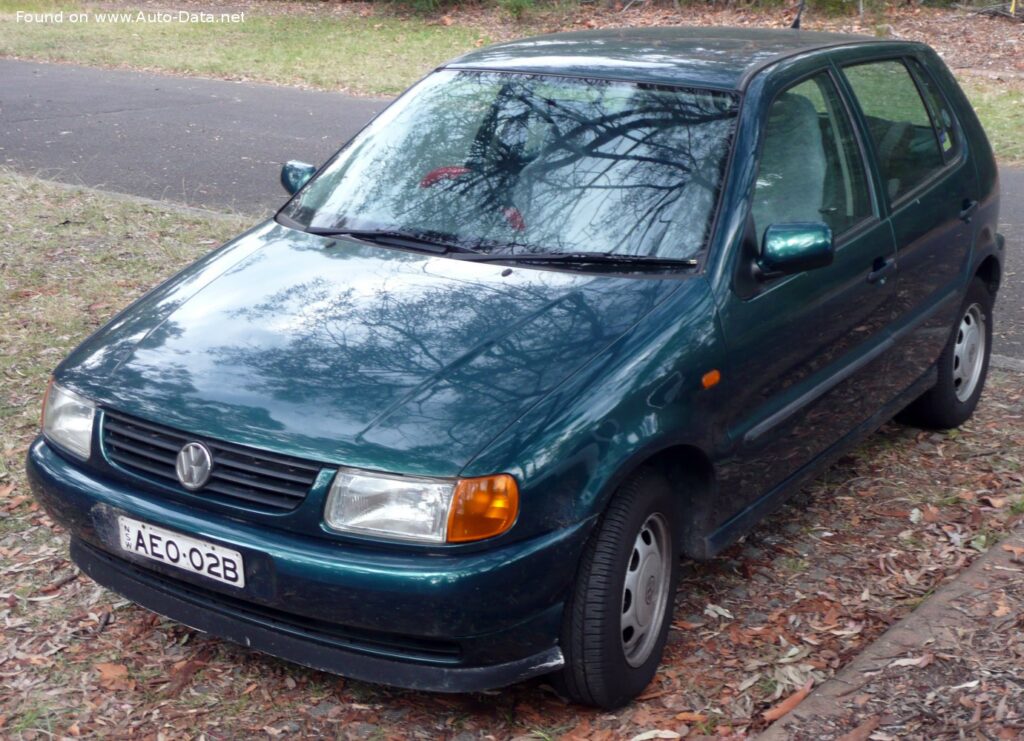
The Volkswagen Polo III, internally designated as the 6N/6KV, represents a significant chapter in the history of Volkswagen’s compact car lineage. Introduced in 1994, this generation of the Polo marked a substantial evolution from its predecessors, bringing enhanced refinement, improved safety, and a more modern design to the highly competitive European supermini segment. The specific variant under discussion, the Volkswagen Polo III (6N/6KV) 1.0 (45 Hp), served as one of the entry-level models, embodying the core values of economy, practicality, and urban maneuverability that defined the Polo’s appeal in its primary markets.
While the Volkswagen Polo line has never been officially sold in the United States, it has been a perennial bestseller and a cornerstone of Volkswagen’s global strategy, particularly in Europe and other international markets. The 6N/6KV generation, produced from 1994 to 1996 in this particular engine configuration, was crucial in solidifying the Polo’s reputation as a reliable and accessible small car. This model was designed to offer economical transportation without sacrificing the build quality and driving dynamics expected from a Volkswagen. It competed fiercely against rivals like the Ford Fiesta, Opel Corsa, and Fiat Punto, carving out a substantial market share through its blend of German engineering and everyday usability.
Engine & Performance of the Volkswagen Polo III (6N/6KV)
At the heart of the Volkswagen Polo III (6N/6KV) 1.0 (45 Hp) was a compact, naturally aspirated gasoline engine designed for efficiency and durability. This powertrain architecture featured an internal combustion engine mounted transversely at the front, driving the front wheels – a conventional and highly effective layout for a car in this class. The engine, identified by the code AEV, was an inline four-cylinder unit, a configuration favored for its inherent balance and smooth operation compared to three-cylinder alternatives common in some rival entry-level vehicles.
With an engine displacement of 1043 cubic centimeters (approximately 1.0 liter or 63.65 cubic inches), this unit produced a modest but adequate 45 horsepower at 5200 revolutions per minute. Torque output stood at 76 Newton-meters, or 56.05 pound-feet, also peaking at 5200 rpm. These figures highlight the engine’s design philosophy: to provide dependable motivation for urban commuting and short-distance travel rather than exhilarating performance. The power per liter ratio was 43.1 Hp/l, indicating a conservative tuning focused on longevity and fuel economy.
Mated to a 5-speed manual transmission, the 1.0-liter Polo delivered a combined fuel economy of 6.6 liters per 100 kilometers, translating to an impressive 35.6 US miles per gallon. This efficiency was a key selling point, particularly in markets where fuel costs were a significant consideration. Performance metrics reflect the car’s entry-level status: acceleration from 0 to 60 mph took approximately 20.3 seconds, while the top speed was 90.1 mph (145 km/h). While not quick by modern standards, these figures were competitive for its segment at the time, emphasizing its role as a practical, economical city car. The engine utilized a single-point injection fuel system and an OHC (Overhead Camshaft) valvetrain with two valves per cylinder, a proven and cost-effective setup for its era.
Design & Features of the Volkswagen Polo III (6N/6KV)
The Volkswagen Polo III (6N/6KV) represented a significant departure in design from the more angular Polo II. With its smoother, more rounded lines, the 6N generation adopted the contemporary Volkswagen design language seen in larger models like the Golf III. The car was available as a 3-door or 5-door hatchback, offering versatility to cater to different customer needs. The hatchback body type was incredibly popular in Europe due to its compact footprint and practical cargo capacity.
Measuring 146.26 inches (3715 mm) in length, 65.16 inches (1655 mm) in width, and 55.91 inches (1420 mm) in height, the Polo III was perfectly sized for navigating crowded city streets and fitting into tight parking spaces. Its wheelbase of 94.49 inches (2400 mm) contributed to a stable ride for its class, while the front track of 53.82 inches (1367 mm) and rear track of 55.12 inches (1400 mm) provided a confident stance. The design prioritized interior space, offering seating for five occupants, though the rear seats were more comfortable for two adults or three children on longer journeys.
Inside, the Polo III was characterized by its functional and ergonomic dashboard layout. While not luxurious, the materials were durable and assembly quality was typical of Volkswagen standards, contributing to a sense of solidity. Features for the 1.0 (45 Hp) model were relatively basic, focusing on essentials. Safety features included a robust body structure and, depending on the market and trim, could include driver and passenger airbags, which were becoming more common in the mid-1990s. The car was equipped with a steering rack and pinion system for direct steering feel, front ventilated disc brakes for effective stopping power, and rear drum brakes, a common and cost-effective setup for small cars. The front suspension utilized wishbones, while the rear also featured wishbones, providing a comfortable yet controlled ride. The standard tire size was 155/70 R13 on 13-inch wheel rims, emphasizing economy and ride comfort.
Practicality was a strong suit, with a minimum trunk (boot) space of 245 liters (8.65 cubic feet), which could expand significantly to 975 liters (34.43 cubic feet) with the rear seats folded down, making it surprisingly capable for carrying cargo despite its small exterior dimensions. The fuel tank capacity of 45 liters (11.89 US gallons) provided a decent range, further enhancing its appeal as an economical daily driver.
Technical Specifications
| Category | Specification |
| General Information | |
| Brand | Volkswagen |
| Polo | Polo |
| Generation | Polo III (6N/6KV) |
| Type (Engine) | 1.0 (45 Hp) |
| Start of production | 1994 year |
| End of production | 1996 year |
| Powertrain Architecture | Internal Combustion engine |
| Body type | Hatchback |
| Seats | 5 |
| Doors | 3-5 |
| Performance Specs | |
| Fuel consumption (economy) – combined | 6.6 l/100 km (35.6 US mpg, 42.8 UK mpg, 15.2 km/l) |
| Fuel Type | Petrol (Gasoline) |
| Acceleration 0 – 60 mph | 20.3 sec |
| Acceleration 0 – 100 km/h | 21.4 sec |
| Maximum speed | 145 km/h (90.1 mph) |
| Weight-to-power ratio | 21.2 kg/Hp (47.1 Hp/tonne) |
| Weight-to-torque ratio | 12.6 kg/Nm (79.6 Nm/tonne) |
| Engine Specs | |
| Power | 45 Hp @ 5200 rpm |
| Power per liter | 43.1 Hp/l |
| Torque | 76 Nm @ 5200 rpm (56.05 lb.-ft. @ 5200 rpm) |
| Engine layout | Front, Transverse |
| Engine Model/Code | AEV |
| Engine displacement | 1043 cm3 (1.0 L, 63.65 cu. in.) |
| Number of cylinders | 4 |
| Engine configuration | Inline |
| Cylinder Bore | 75 mm (2.95 in.) |
| Piston Stroke | 59 mm (2.32 in.) |
| Compression ratio | 10:1 |
| Number of valves per cylinder | 2 |
| Fuel injection system | Single-point injection |
| Engine aspiration | Naturally aspirated engine |
| Valvetrain | OHC |
| Engine oil capacity | 3.4 l (3.59 US qt, 2.99 UK qt) |
| Engine oil specification | Not specified in data |
| Coolant | 5.6 l (5.92 US qt, 4.93 UK qt) |
| Space, Volume and Weights | |
| Kerb Weight | 955 kg (2105.41 lbs.) |
| Max. weight (Gross Vehicle Weight Rating) | 1375 kg (3031.36 lbs.) |
| Max load | 420 kg (925.94 lbs.) |
| Trunk (boot) space – minimum | 245 l (8.65 cu. ft.) |
| Trunk (boot) space – maximum | 975 l (34.43 cu. ft.) |
| Fuel tank capacity | 45 l (11.89 US gal, 9.9 UK gal) |
| Dimensions | |
| Length | 3715 mm (146.26 in.) |
| Width | 1655 mm (65.16 in.) |
| Height | 1420 mm (55.91 in.) |
| Wheelbase | 2400 mm (94.49 in.) |
| Front track | 1367 mm (53.82 in.) |
| Rear track | 1400 mm (55.12 in.) |
| Drivetrain, Brakes and Suspension Specs | |
| Drivetrain Architecture | The Internal combustion engine (ICE) drives the front wheels of the vehicle. |
| Drive wheel | Front wheel drive |
| Number of gears and type of gearbox | 5 gears, manual transmission |
| Front suspension | Wishbone |
| Rear suspension | Wishbone |
| Front brakes | Ventilated discs |
| Rear brakes | Drum |
| Steering type | Steering rack and pinion |
| Tires size | 155/70 R13 |
| Wheel rims size | 13 |
Legacy and Market Impact of the Volkswagen Polo III (6N/6KV)
The Volkswagen Polo III (6N/6KV) left a significant mark on the European automotive landscape, cementing its position as a highly regarded supermini. Its introduction in 1994 was met with strong positive reception, as it offered a more mature, refined, and safer package than many of its competitors. For a brand like Volkswagen, known for its robust engineering, the Polo III was instrumental in attracting buyers looking for a small car that didn’t feel cheap or compromised.
The 1.0 (45 Hp) variant, specifically, was critical for its accessibility. It provided an entry point into the Volkswagen brand for many first-time car buyers, young drivers, and those prioritizing absolute economy. Its low running costs, excellent fuel efficiency, and renowned Volkswagen reliability made it a smart choice for urban dwellers and commuters across Europe. While its performance figures might seem humble by today’s standards, they were perfectly adequate for the traffic conditions and speed limits prevalent in many European cities and towns.
The Polo III faced stiff competition from a host of well-established rivals. Key competitors included the Ford Fiesta, which also offered a strong blend of practicality and driving dynamics; the Opel Corsa (Vauxhall Corsa in the UK), another German-engineered contender known for its value; and the Italian Fiat Punto, celebrated for its stylish design and nimble handling. Japanese offerings like the Nissan Micra and Toyota Starlet also vied for market share, often emphasizing reliability and a strong feature set. Despite this crowded field, the Polo III consistently performed well in sales, benefiting from Volkswagen’s strong brand image and a perception of superior build quality.
The legacy of the Polo III (6N/6KV) is one of quiet competence and enduring appeal. It demonstrated Volkswagen’s ability to scale its engineering prowess down to a compact, affordable package without losing the essence of the brand. Many examples of this generation remain on European roads today, a testament to their durability and the affection they garnered from their owners. It played a crucial role in evolving the supermini segment, pushing boundaries in terms of safety, refinement, and interior quality for its class. The Polo III successfully bridged the gap between basic transportation and a more sophisticated, comfortable small car experience, paving the way for future generations of the Polo to continue Volkswagen’s dominance in the global compact car market. Its heritage lies in being a dependable, economical, and well-built vehicle that perfectly served the needs of its target audience during a pivotal time for small cars.